


The US president took the opportunity of a prime-time speech to the US public on April 1 to repeat his by now-familiar criticism of America’s Nato allies for not joining the war in Iran. He told them to “build up some delayed courage. Should have done it before. Should have done it with us as we asked.”
Trump’s anger at Nato in the past fortnight has been focused on the reluctance of the likes of the UK, Germany and France to land a hand in forcing Iran to open the Strait of Hormuz. This vital waterway, through which ordinarily one-fifth of the world’s oil and gas transits, has been effectively closed by the threat from Iranian missile strikes to all but a few tankers approved by Tehran. The result has been dramatic, as energy prices have rocketed and supplies to countries dependent on Gulf oil have rapidly diminished.



The US-Israeli assault on Iran has failed to topple the regime or curtail its ability to pose a security threat in the region, leaving Tehran to wreak economic havoc. This flies in the face of the Trump administration’s claims of the overwhelming success of Operation Epic Fury. So the US president and his national security team are, at least in part, blaming Nato’s reluctance to get involved.
It’s important to stress that Article 5 of the Nato treaty mandates that Nato members must come to the aid of any fellow member which comes under attack. In the case of the US-Israeli military operation against Iran, Article 5 has not been invoked – nor does it apply. Further, many Nato members are mindful of the legacy of the disastrous war in Iraq. This sowed deep divisions within Nato after some members (notably the UK and Poland) lined up beside the US and others (France and Germany most vociferously) opposed the invasion. It also became a byword for an ill thought-out military campaign with dubious legitimacy and no exit plan.
As a result, most Nato member states are reluctant to get involved in the US-Israeli campaign against Iran. In any case, many of Nato’s European members are far more concerned about the war going on at their borders between Russia and Ukraine.
Nato reluctance has clearly stung Trump and his senior advisers. On March 31, the US secretary of state, Marco Rubio, told Fox News’s Sean Hannity that: “We’re going to have to reexamine the value of NATO and that alliance for our country. If Nato is just about us defending Europe if they’re attacked, but them denying us basing rights when we need them, that’s not a very good arrangement. That’s a hard one to stay engaged in.”
Asked by The Telegraph the following day whether the US was reconsidering its membership of the alliance, Trump said “Oh yes… I would say [it’s] beyond reconsideration”. He went on to question the Nato’s effectiveness, saying: I always knew they were a paper tiger, and Putin knows that too, by the way.“
Scepticism about Nato has been growing within senior US national security ranks for some time. At various times, Rubio, vice-president, J.D. Vance, and defense secretary Pete Hegseth have all questioned how an alliance based around the principle of US-led defence of Europe against Soviet aggression now fits America’s interests.
This is not a view shared by the alliance’s European members, who remain deeply integrated into Nato’s command and control systems and, until now at least, have placed a great deal of trust in its role as a key security and defence partnership with Washington. And not just Nato – the fact that Ukraine was being considered for membership was cited by Vladimir Putin as a reason for the Russian invasion in 2022.
Nato has changed – but it has endured
The alliance’s focus has shifted over the years, at times moving from being an organisation focused on collective defence to one aiming at collective security. This distinction can be summed up thus: collective defence is just what it says, pledging to come to the assistance of a fellow member whose territory is threatened by a third party. Collective security is more about mobilising to address sources of regional insecurity such as ethnic conflict in the former Yugoslavia.
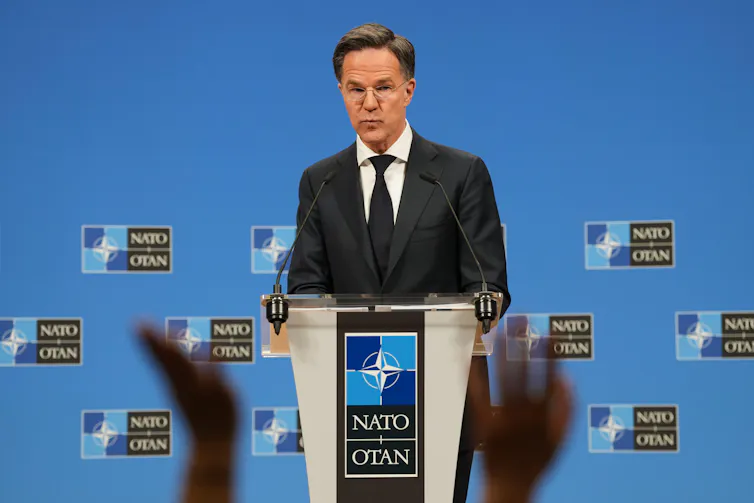
But the 2014 annexation of Crimea (which raised the possibility of Russia’s “little green men” crossing the border into Narva in Estonia, a member state) and the full invasion of Ukraine in 2022 further underlined the need for Nato to have a strong focus on defence against a newly aggressive Russia.
The question is whether, as Rubio, Vance and Hegseth have all suggested – and as the national security strategy released by the Trump administration last November spells out – the US no longer sees European security as either its responsibility or its focus. Or, as Trump appears to believe, whether an alliance that won’t do his bidding is worth America’s while.
Read more: What the US national security strategy tells us about how Trump views the world
But even in the cold war, Nato was not involved in its members’ military adventures. The US actively worked against the UK, France and Israel during the Suez Canal episode in the mid-1950s. Britain refused to join the US in Vietnam. Precedents such as these would suggest that the Iran war would ordinarily not be a place for Nato involvement, even if individual member-states could contribute.
Nato has been through crises before, but the fact that its European members have heeded the US president’s demands for them to increase their defence budgets shows that for them, at least, the alliance has enduring importance. For it to fall apart after nearly 80 years over Iran would be an unbecoming end to one of the most important collective defence arrangements the world has ever seen.






















Comments are closed.