


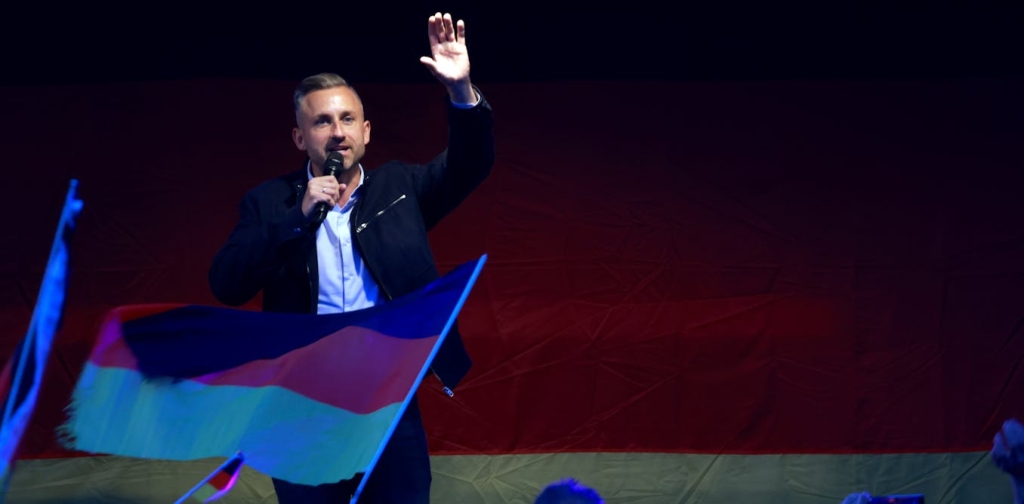

Germans in the eastern state of Saxony-Anhalt will go to the polls on September 7 to elect a new parliament.
With forecasts indicating that the Alternative für Deutschland (AfD) is on course to win around 40% of the vote, which would double its support there compared to five years ago, there is a real chance the far-right party could take over a state government for the first time.



Former East Germany, which was under Communist rule between 1949 and 1989, has proven fertile ground for the far right. The AfD won 34.6% of the vote there in the 2025 federal election, while in Saxony-Anhalt that figure was 37.1%. This was far higher than mainstream parties on the left and right.
Much has been written about the reasons for far-right success in eastern Germany. Deindustrialisation, demographic change and depopulation, especially in rural areas, are all drivers. So too is the fact there is far stronger disagreement in the east with Germany’s support for Ukraine in its war with Russia than is in evidence in the west, as well as higher levels of opposition to refugees.
Perhaps above all, there is a strong sense in the east of feeling “second-class citizens” in modern Germany, even more than three decades after reunification. Unemployment in Saxony-Anhalt is above the German average, standing at 8.2% in August compared to a national average of 6.5%. The median wage in full-time employment was also around €48,300 (£41,400), below the national level of about €52,000.
The election in Saxony-Anhalt takes place at a time when the AfD is already leading nationwide polls, and when the federal government and chancellor Friedrich Merz are vastly unpopular (with around 85% of voters dissatisfied). It is also happening in a part of the country where the far right tends to do best.

The AfD has come top in a state election once before, in Thuringia in 2024. But it did not get a majority of seats. Mainstream parties rallied around and formed a government between the centre-right Christian Democratic Union of Germany (CDU), left-populist Bündnis Sahra Wagenknecht (BSW) and Social Democratic Party of Germany (SPD).
They rely on the support of Die Linke (the Left Party) to function and pass legislation. The CDU has long ruled out any cooperation with the Left Party at the state or national level because of the latter’s historic links to the communist regime in East Germany and continued ideological disagreements. But in practice, in Thuringia and the national parliament, this anti-cooperation line has softened.
In Saxony-Anhalt, as in most other states in Germany, parties need at least 5% of the vote to win any seats in the state parliament. If they fall below that level, they don’t get any. So all eyes will be not only on the result of the AfD, the CDU (which polling suggests is set to take 23% of the vote) and the Left Party (forecast to take 13%) but also smaller parties.
Polling has had the SPD hovering around the 5% mark, although its support seems to have picked up. The same goes for the Greens, while the liberal Free Democratic Party (FDP) looks set to miss out. If the only parties making it over 5% are the AfD, CDU and Left Party, the AfD could win an overall majority of seats. The BSW, which is hovering around the 5% mark, has also made it clear it would not block the AfD entering government.
The AfD’s proposals
The AfD’s manifesto in Saxony-Anhalt is extremely right-wing. Proposals such as ending the right to asylum and a moratorium on non-EU immigration could not be implemented. They are matters for the national not state government.
But other AfD proposals are legally feasible. These include changing the school curriculum to downplay the significance of the Nazi era – a programme one AfD politician, Hans-Thomas Tillschneider, sums up as: “More Bismarck, less Hitler”. This was a reference to Otto von Bismarck, who oversaw the unification of Germany in 1871.
The AfD has also suggested introducing the routine singing of the German national anthem in school assemblies and ending what it calls “inclusion” in mainstream education for children with special needs. Defunding the protestant church, which the AfD has accused of being too focused on social not theological questions, would also be a real possibility.
A particular worry is around Germany’s “constitutional protection” or secret services. There is consideration being given to setting up parallel offices in Saxony-Anhalt to protect sensitive operations in the event of an AfD administration. Many branches and elements of the AfD are under observation by German intelligence agencies on the basis of suspected extremism.
There will almost certainly be wider political ructions from this election if the AfD tops the poll, and even more so if it wins outright control of the state government. Any major changes at the top of German politics will probably wait until after elections in Berlin and Mecklenburg West Pomerania later in the month.
Mainstream parties will want to keep some appearance of unity until then for fear of losing yet more votes. But, at the very least, rumours of an early challenge to Merz are likely to step up a gear.





















Comments are closed.