


We often think of microbes as organisms that live around us, like the salmonella bacteria and flu viruses that cause illness. But some of our most intimate relationships are actually with the microbes living inside of us.
Incredibly, about half of the cells in the human body are actually microbial inhabitants. Scientific attention to the microbiome has helped us understand how many of them support our health; for example, by helping us digest food or by supporting our immune system.



Elsewhere in the animal kingdom, microbes forge even more remarkable partnerships with their hosts. They help generate energy for coral and deep sea tube worms, and break down stubborn molecules like cellulose and lignin within animals as varied as cows and termites.
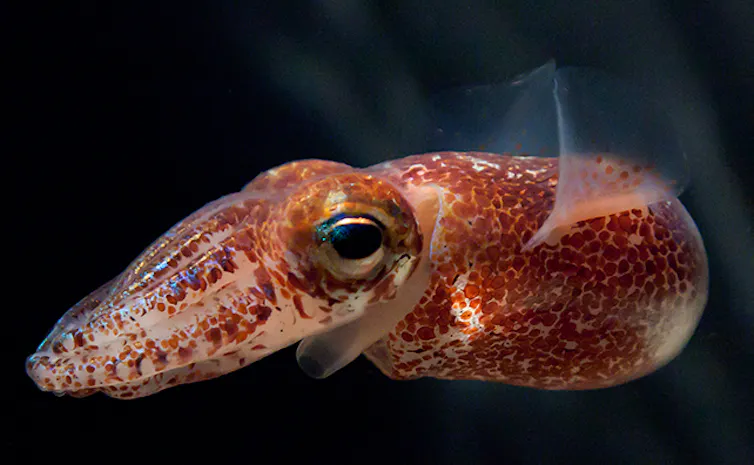
They even help squid camouflage themselves.
But how long have such partnerships existed? New research led by Zhenfei Wang and Yongbo Peng from Nanjing University, on which I was a co-author, has now found evidence of these close relationships between animals and microbes in a 550 million-year-old fossil from southern China.
Prior to this, the earliest evidence of symbiosis was documented in fossils 100 million years younger.
An ancient tube-shaped fossil
Tracing animal-microbe symbiotic relationships back hundreds of millions of years is extremely challenging. The fossil record is altered, incomplete and biased toward organisms and environments that preserve well.
Even exceptionally preserved fossils rarely retain evidence of the microbes that once lived within an animal. This fact makes ancient symbiotic relationships very difficult to identify.
Given these challenges, our international research team sought to explore geochemical fingerprints of past microbe-animal interactions. We specifically focused on the tubular fossil conotubus that lived during the Ediacaran period, which extends from approximately 635 million to 541 million years ago.
Occurrences of Ediacaran-aged fossils like the conotubus are rare.
Extremes temperatures on Earth
Sedimentary rocks deposited during the Ediacaran period showcase the first large animal fossils that one can see with the naked human eye.
This period of Earth’s past also covers a critical time. It begins in the wake of global Snowball Earth glaciations — when the surface of the Earth was entirely, or almost entirely, covered in ice — and transitions to possibly the hottest temperatures experienced by the planet in the past two billion years.
Despite these extremes, the Ediacaran environment eventually settled into one where early animals could thrive.
A key feature of this period was that oxygen levels were much lower than they are today. In certain marine environments, this allowed hydrogen sulfide to build up to levels highly toxic to animals.
Comparing chemical fingerprints
In our research, we analyzed sulfur and molybdenum isotopes in remarkably well-preserved fossils from southern China. Isotopes act like chemical fingerprints. They can reveal not only what elements are present, but also how biological or other processes alter specific isotopic ratios.
To interpret these fingerprints, we compared ancient signatures from conotubus with those produced by organisms and environments today.
Our results suggest that conotubus lived in partnership with bacteria that could use hydrogen sulfide as an energy source.

Hydrogen sulfide produces the familiar smell of rotten eggs. At high concentrations, however, it is extremely toxic to animals. Ancient oceans that were low in oxygen would have had regions rich in hydrogen sulfide, and these would have been extremely challenging environments for animals to survive in.
A symbiotic relationship with a sulfur-oxidizing bacteria may therefore have turned a hostile environment into an ecological opportunity for conotubus — providing nutrition while helping the animal tolerate the sulfide-rich waters.
Survival, where other struggled
The evolution of Earth’s biosphere is perhaps one of the most captivating stories that we have uncovered from the fossil record.
We usually tell the story of early animal evolution through innovations in animals themselves. We focus on new body plans, movement, feeding strategies and skeletons.
Our findings add another character to that evolutionary story: microbes. By the end of the Ediacaran, microbial partnerships were already helping some early animals exploit challenging environments. For conotubus, partnering with microbes may have opened a frontier where other animals struggled to survive.
More than 550 million years later, animals still rely on microbes to do things they cannot do alone. Our fossils suggest this partnership reaches remarkably deep into animal evolutionary history.





















Comments are closed.