




For four decades, a controversial idea has shaped how autism is understood by researchers, healthcare professionals and the public: the claim that autistic people are “mind blind”. The phrase suggests an inability to grasp what others think or feel. It is simple, memorable – and wrong.
The claim rests on a concept called “theory of mind”. In everyday terms, theory of mind is the ability to recognise that other people’s thoughts, beliefs and emotions may differ from your own. This idea explains why someone understands that a joke can fall flat, that a promise can be broken, or that a friend can be mistaken without lying. It is often presented as the key to how people make sense of one another.



The idea entered psychology in the late 1970s, when researchers began asking how children learn to reason about other minds. Simple stories were designed to test this ability, often involving a character who holds a false belief. If a child could predict that the character would act on that belief, they were taken to have a theory of mind. These tasks quickly became a standard tool in developmental research.
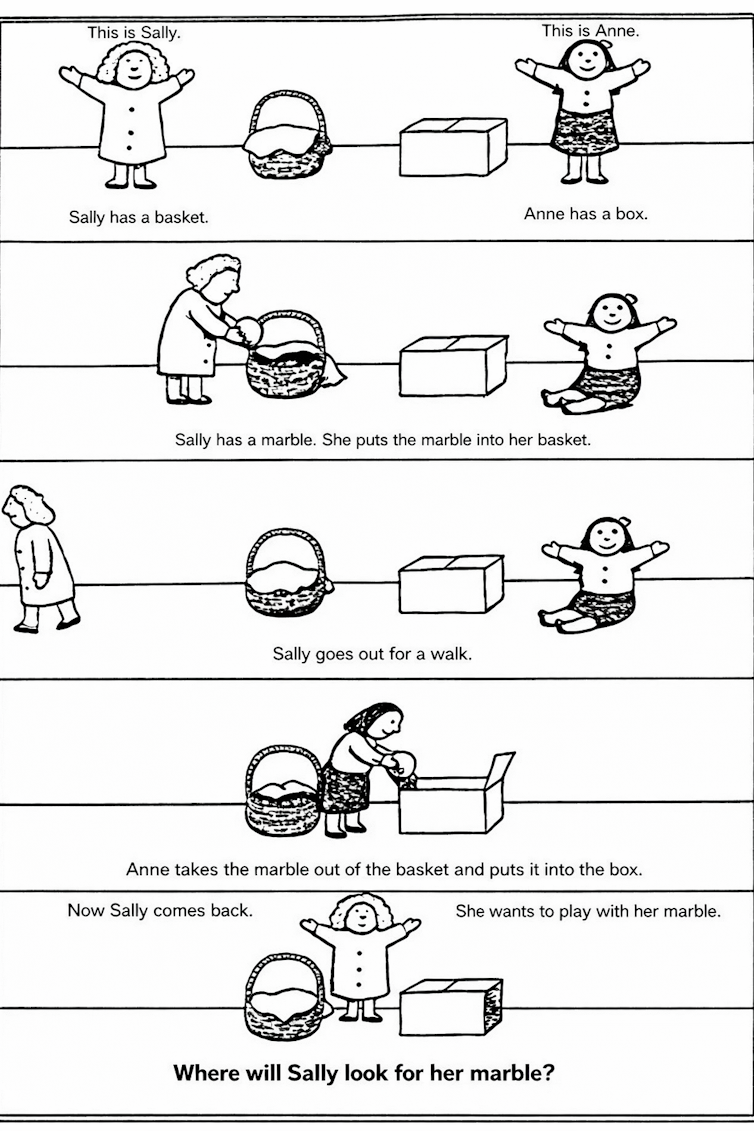
In 1985, one such test was used in a study of autistic children. In the “Sally-Anne” task, a doll (Sally) hides a marble, leaves the room, and returns after another doll (Anne) has moved it. Asked where Sally will look, many autistic children in that study gave the “wrong” answer. This finding was interpreted as evidence that autistic children lacked theory of mind.
The Sally-Anne test
From this experiment, a vast research programme followed. New tasks multiplied: reading emotions from photos of eyes, interpreting short stories, judging intentions from animated shapes.
Across the late 1980s and 1990s, scientific papers and popular media represented autism as defined by a core failure to understand minds. The theory stuck, appearing in academic articles, textbooks, court rulings and popular science writing.
The problem is that the evidence never supported the claim. Even in the original study, one in five autistic children passed the task. Later research found huge variation. Some studies showed most autistic participants passing theory-of-mind tests; others found little or no difference between autistic and non-autistic groups. A theory meant to describe a key deficit kept running into exceptions.
More troubling is the tests themselves. Many rely heavily on language. Performance is often better predicted by vocabulary level than whether someone is autistic.
Different theory-of-mind tasks also fail to line up with one another, suggesting they are not measuring a single underlying ability at all. If an ability cannot be measured consistently, claims about its absence become doubtful.
At this point, a straightforward scientific response would have been to reconsider the theory. Instead, it was repeatedly patched.
When autistic people passed a task, researchers argued that the task was too simple. New, more complex tasks were introduced, which produced the same mixed results. When findings contradicted the core idea, the definition of “theory of mind” quietly expanded to include eye contact, joint attention, or social motivation.
When science stops testing
This pattern matters because of what it says about how science works. Drawing on the philosophy of science, my recent analysis argues that theory-of-mind research in autism has become “degenerating”. Rather than generating new, risky predictions, the theory survives by shifting definitions and goalposts to avoid being disproved. When no possible result counts against a theory, it stops being scientific. In a subsequent response to commentators, I explore why the theory-of-mind paradigm has persisted despite its deep empirical and conceptual difficulties.
Questioning this idea did not come from a single paper or field. Psychologists, linguists, and philosophers all raised concerns. So did autistic people, whose everyday experiences often flatly contradicted the idea that they lacked insights into others.
Studies began to show that non-autistic people are just as poor at interpreting autistic expressions as the reverse. Social misunderstanding, it turns out, goes both ways.
That insight helped fuel alternative approaches. One approach frames communication breakdowns as mutual mismatches between different styles of thinking and communicating, rather than deficits located in autistic people.
Another focuses on differences in attention and interest, offering an explanation of perception, motivation and learning. These approaches generate new, testable questions and align more closely with people’s actual experiences.
Today, the field is at a crossroads. The idea that autistic people are mind blind lacks a secure foundation. Its empirical support has weakened, and its assumptions are increasingly questioned. What remains is its influence. When educators or healthcare professionals assume a lack of empathy, they are less likely to trust autistic people’s own accounts or involve them in decisions that affect their lives.
Abandoning this myth does not weaken autism science. It strengthens it. Social understanding is not absent in autism; it is shaped differently, expressed in different contexts, and often overlooked when the wrong tools are used. Autistic people are not mind blind. They think and understand differently, and the evidence has pointed that way for some time. It’s time science reflected that.

















Comments are closed.