


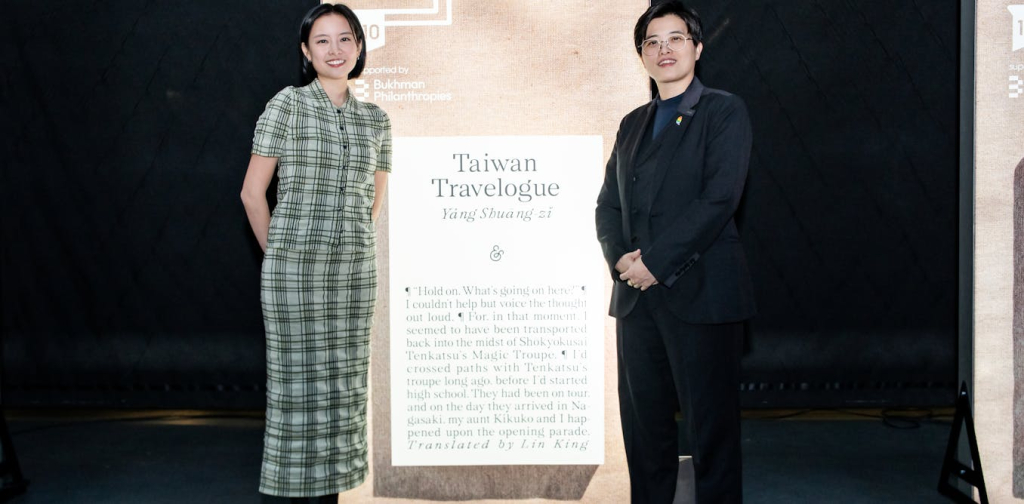

Set in 1930s Taiwan under Japanese colonial rule, Taiwan Travelogue follows fictional Japanese novelist Aoyama Chizuko and her Taiwanese interpreter, Ō Chizuru (or Ông Tshian-ho’h), as they journey across colonial Taiwan by rail, encountering its diverse local food cultures. But Taiwan Travelogue is far more than a historical travel narrative. Through meals, translation and silences, Yáng explores colonial power, intimacy and the limits of empathy.
At first glance, the novel almost resembles a cookbook. Each chapter is named after a meal shared by the two women. Taiwan Travelogue’s prose lingers over the preparation of meals, unfamiliar ingredients and the rituals of eating together. Food is not simply decorative detail, but a way of unfolding history and negotiating power.



Readers expecting a gentle culinary novel may initially miss how carefully constructed the book really is. Nearly every detail acquires new meaning in retrospect. The novel rewards rereading because Yáng quietly plants clues throughout the text, allowing seemingly ordinary moments to gather emotional and political weight over time.
Despite its engagement with colonial violence and historical trauma, Taiwan Travelogue never feels emotionally heavy handed. Much of the pleasure of reading the novel lies in its warmth and humour: the fragrant descriptions of food, the characters’ banter and their small moments of laughter and companionship. Yáng has a remarkable ability to smuggle larger political questions into scenes of everyday intimacy. Reflections on empire and power emerge gradually through conversations about local dishes, cooking techniques or dining etiquette.
One of the book’s most striking features is its meta-fictional structure, which layers a fictional author, a fictional translator and a fictional contemporary introduction, written as though by a real person. This is not merely stylistic play, but a structural argument about mediation: who is authorised to produce knowledge, whose voice is foregrounded and whose remains partial or silent. Unreliability here is not a narrative flaw but a reflection of how colonial power shapes what can be known and said.
This framing matters because the novel is deeply concerned with who gets to speak, who gets represented, whose feelings are recognised and whose knowledge remains hidden. Chizuko, the Japanese “mainlander” novelist, may appear to guide the narrative, but much of the novel’s emotional and political force lies in what the Taiwanese “islander” interpreter Chizuru chooses not to say.
One of the most striking aspects of the novel is how it handles intimacy between the two women. Their relationship is never explicitly named. Instead, Yáng renders undercurrents of queer desire through shared meals, gestures and unfinished conversations.
The restraint is precisely what makes the relationship so affecting. The novel captures how intimacy can emerge within unequal structures of power. But it never allows readers to forget the colonial conditions shaping these encounters.
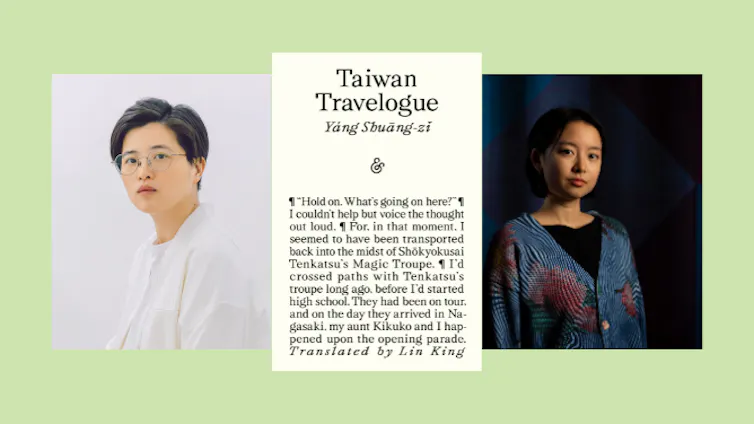
This subtle treatment of queer intimacy is characteristic of Yáng Shuāng-zǐ’s wider body of work. In the Sinophone world, Yáng is already well known for writing in the yuri (sappic/lesibian) genre, often blending queer desire with historical settings and literary imaginary worlds. Taiwan Travelogue introduces Anglophone readers to a writer whose work has long occupied an important place within Sinophone queer literary culture.
One line in particular lingered with me long after finishing the novel:
There is nothing in the world more difficult to refuse than self-righteous goodwill.
The sentence speaks not only to colonialism in 1930s Taiwan, but also to contemporary forms of neocolonialism or liberal benevolence that leave little room for refusal or disagreement. Yáng never forces present day parallels onto the reader, but the connections feel unmistakable.
The International Booker Prize recognises both author and translator. Lin King’s translation is central to the novel’s achievement. King preserves the novel’s shifting textures and layered voices while guiding English-language readers through its historical and linguistic complexities – not just Mandarin Chinese, but also Japanese and Taigi used throughout the book. Even names and terms appear in several transliterations, tracing the complex linguistic legacy produced by Taiwan’s multiple colonial histories.
As King noted in her acceptance speech, translators are often deemed successful when their presence is rendered invisible within the text. Yet her work resists that invisibility. Through carefully placed footnotes and subtle contextual guidance, she makes translation feel less like a transparent bridge and more like an ongoing process of cultural negotiation and interpretation.
What makes Taiwan Travelogue stand out is the subtlety of its political vision. Yáng avoids dramatic revelations or moral certainty. Instead, she asks readers to sit with ambiguity: with partial understanding, unequal intimacy and the uneasy coexistence of everyday banter, affection and colonial violence.
It is this quiet complexity that makes the novel so memorable. Taiwan Travelogue begins as a richly sensory journey through food and travel, but gradually opens into questions of identity, history and geopolitics. Though set in colonial Taiwan, its reflections on cultural power, democracy and whose stories get told feel strikingly relevant today.
This article features references to books that have been included for editorial reasons, and may contain links to bookshop.org. If you click on one of the links and go on to buy something, The Conversation UK may earn a commission.





Comments are closed.