


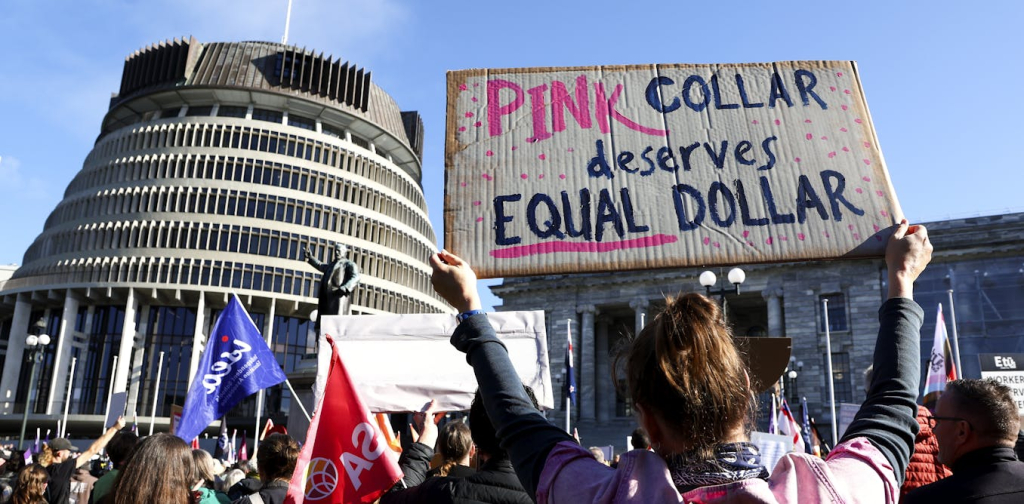

Pay equity is back in the spotlight in New Zealand, with an unofficial “people’s select committee” about to report on last year’s legislative changes that overhauled the process and cancelled existing claims.
As we await its findings, it’s a timely moment to ask what problem pay equity settlements are actually meant to solve.


Over the past 50 years, women in Aotearoa have changed where they work in big ways. They have moved in significant numbers into occupations once dominated by men, including law, medicine and management.
In many professions that were overwhelmingly male a generation ago, women are now well represented. But the change has been largely one-way. Men have not moved in comparable numbers into jobs traditionally done by women.
These occupations, such as teaching, nursing, and care and support roles, remain heavily female dominated. That enduring imbalance is important, because it raises the question at the heart of pay equity: have roles historically performed by women been systematically undervalued?
Our research, drawing on five decades of Census data, tracks occupational segregation patterns in New Zealand over time.
While the overall picture has shifted, the persistence of female-dominated occupations tells us why pay equity – and robust settlement processes – still matter.
Progress, but mostly in one direction
Overall, New Zealand’s labour market is less segregated by gender than it was in the 1970s and 1980s. Women now work across a much wider range of occupations, and many barriers that once limited their choices have fallen.
This represents real progress. Across the economy, much of this change reflects women moving into jobs once dominated by men. Health provides a clear illustration.
The share of female doctors has risen sharply, from just 12% of GPs in 1976 to 57% in 2023. The reverse shift has been far weaker: men have moved into nursing only marginally and the occupation remains overwhelmingly female, with 89% of registered nurses women in 2023.

This imbalance helps explain why pay equity exists at all – and why it is often misunderstood. Pay equity is often confused with equal pay, but they address different problems.
Equal pay is about paying people the same for doing the same job. By contrast, pay equity, is about equal pay for work of equal value. It is a fundamental human right. It addresses whether different jobs – often in different industries – are being paid fairly relative to each other, given the skill, responsibility, effort and conditions involved.
When women are concentrated in undervalued occupations, equal pay within these jobs does not close the overall gender pay gap across the economy. If an entire occupation is underpaid relative to comparable work, equal pay within it simply preserves that imbalance.
Addressing this requires pay equity processes that allow comparisons across occupations, both within and outside the industry, so that female-dominated roles can be properly assessed against comparable work elsewhere in the labour market.
A problem of structure, not just productivity
Last year, changes to New Zealand’s pay equity legislation were passed under urgency, raising the bar for bringing and progressing claims and making it harder for workers in female-dominated occupations to have potential inequities assessed.
The subsequent “people’s select committee” inquiry, launched by ten former women MPs to allow for public submissions and closer scrutiny of those changes, has created an opportunity to revisit how pay equity operates and what it is meant to achieve.
Our research helps explain why these processes exist at all. Even after decades of change, the gendered structure of work remains.
There is often an assumption that wages simply reflect productivity – that workers are paid according to their “marginal product”, or what an extra worker adds to output. In practice, pay is shaped by more than productivity alone.
Bargaining power, pay-setting institutions and long-standing norms all matter, especially in occupations where output is difficult to measure or price. This is particularly true in care, teaching and support roles, where the value of work is real but not easily captured in market prices.
Pay equity is designed to deal with that reality. It recognises that if wages reflect institutional history as well as productivity, then undervaluation can persist even in a well-functioning labour market.
Over five decades, progress toward gender equality at work has been real – but uneven. Women have moved into many new roles. Men have not followed in the same way.
That imbalance continues to shape pay outcomes across the economy, and pay equity settlement processes were designed in response to that structural reality. As debates about pay equity continue, it is worth keeping that original purpose in view.
Pay equity is not about special treatment. It is about ensuring that work is valued fairly in a labour market where the division of jobs by gender has narrowed, but not disappeared.




















Comments are closed.