


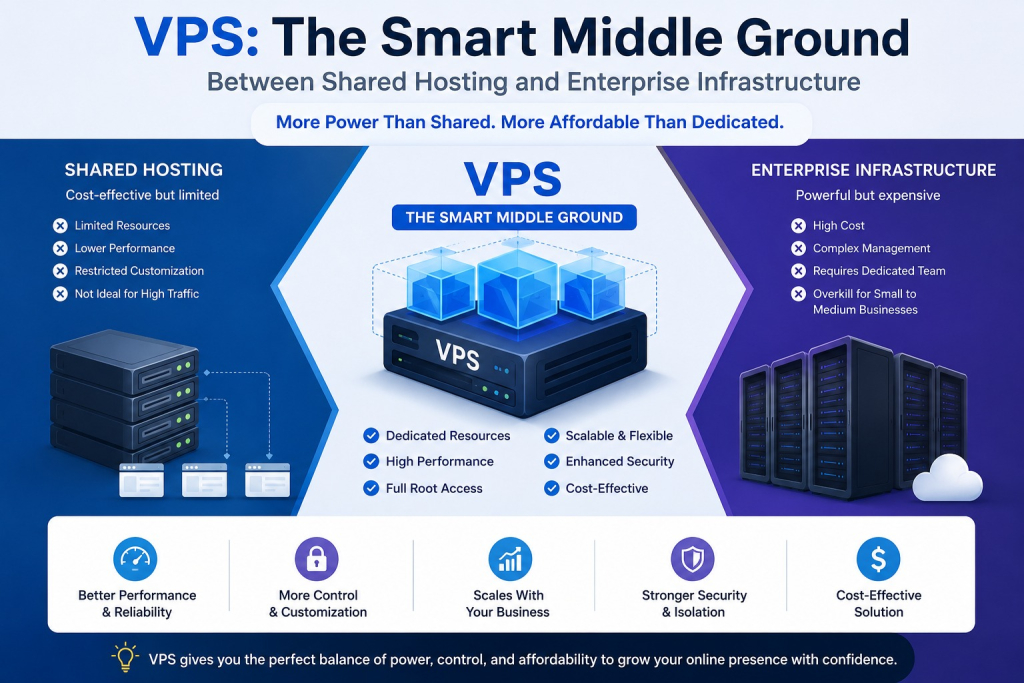

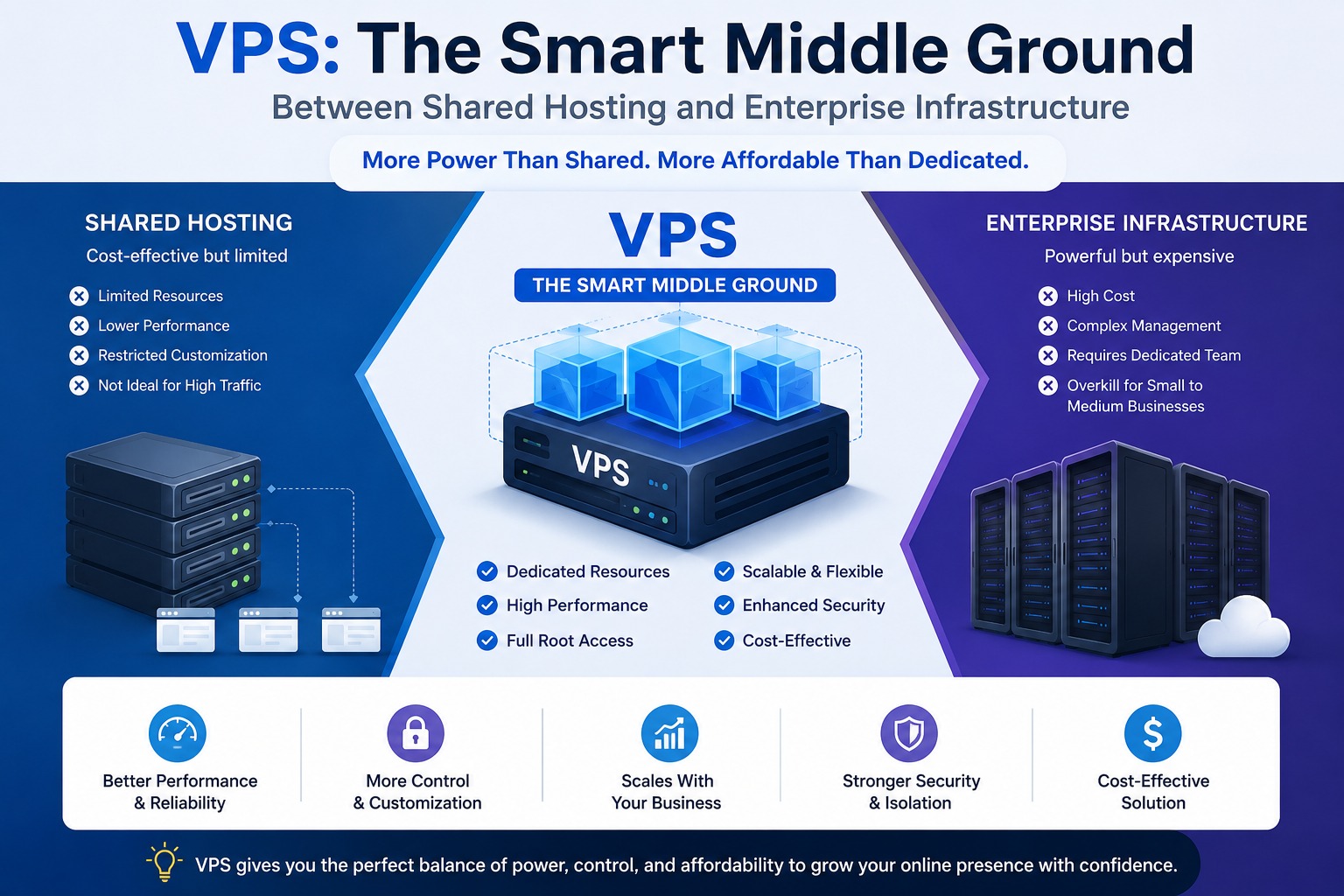
Most businesses start their online journey with shared hosting. It’s affordable, easy to set up, and perfectly fine for a new website with modest traffic. But as a business grows, that same hosting plan can start working against it: pages load slower during busy periods, traffic spikes strain shared resources, security concerns multiply, and the lack of control becomes frustrating. This is usually the point where businesses discover VPS hosting — a solution built to bridge the gap between basic shared plans and costly enterprise infrastructure.



Let’s take a look at why a Virtual Private Server is often the right next step, helping businesses gain better performance without paying for resources they don’t yet need.
Why Shared Hosting Eventually Becomes Limiting?
Shared hosting places many websites on a single server, all drawing from the same pool of CPU, memory, and storage. It’s a practical starting point, but the trade-offs become clear as a site grows. Traffic spikes can slow everyone down, not just the site that caused them. Resources are capped, leaving little room for customization or heavier workloads. Because the environment is shared, one site’s security issue can potentially affect others on the same server. And as a business adds new features, applications, or customers, shared hosting simply isn’t built to keep pace. Eventually, most growing businesses need something more capable — without jumping straight to expensive enterprise infrastructure.
What Makes VPS Different?
A virtual private server still runs on shared physical hardware, but the similarities end there. Through virtualization, each user gets a dedicated slice of that hardware — their own allocated CPU, RAM, and storage that no one else can touch. This means businesses get far greater control over server settings, better isolation from other users, and more consistent, reliable performance. Instead of competing for resources, a business hosted on a VPS server operates in its own private environment while still benefiting from the cost efficiency of shared infrastructure. For growing websites and applications, this translates into steadier uptime and fewer unexpected slowdowns.
VPS vs Shared Hosting: Which Businesses Benefit Most?
The right choice depends on what a business actually needs. An ecommerce store seeing more daily visitors needs consistent speed to avoid losing sales during checkout. A SaaS product adding new customers needs resources that scale with demand. Agencies managing multiple client websites need isolation, so one site’s traffic doesn’t affect another.
Businesses running custom applications need more processing power and flexibility than a shared plan allows. In the ongoing comparison of shared hosting vs VPS, shared hosting can still make sense for small personal websites or simple blogs. But for businesses with growing traffic, transactions, or applications, VPS offers the stability and flexibility that shared plans can’t match.
When Dedicated Servers May Be More Than You Need
Dedicated servers offer maximum resources and complete control, but that comes at a price — literally and operationally. An entire physical server means a higher upfront investment, resources that often go underused, and the added burden of full server management and maintenance. For many SMEs and startups, this level of infrastructure is more than necessary at their current stage of growth. This is where VPS vs dedicated server comparisons become useful: VPS delivers many of the same benefits — dedicated resources, greater control, improved performance — without requiring the same financial or operational commitment. It’s a middle path that lets businesses scale intentionally rather than overinvest early.
Business Situations Where VPS Makes Sense
Several common scenarios point toward VPS as the logical upgrade. Rapid traffic growth calls for resources that won’t buckle under pressure. Expanding ecommerce operations need reliable uptime during peak shopping periods. Businesses hosting customer portals or internal applications need consistent performance and better security. Development and testing environments benefit from the isolation VPS provides, keeping experiments separate from live sites. And companies running multiple websites can manage them more efficiently on a single, scalable setup. Across these examples, scalable hosting allows a business to grow without constantly switching platforms, making VPS a practical fit for website hosting for businesses at this stage.
How VPS Supports Business Growth Over Time
Beyond solving immediate performance issues, VPS supports growth over the long term. It offers more predictable performance as traffic increases, room to add resources when needed, and better stability during high-demand periods like sales campaigns or product launches. This reliability translates directly into a better customer experience — fewer slowdowns, fewer outages, and more consistent service. Instead of overhauling their entire hosting setup every time the business expands, companies can simply scale their VPS resources to match new demands, keeping growth smooth and manageable.
Conclusion
Hosting needs tend to evolve in stages: businesses often start with shared hosting, move to a virtual private server as they grow, and eventually consider enterprise infrastructure only if their scale truly demands it. For most SMEs, startups, and growing digital businesses, that middle stage offers the best balance — combining affordability, performance, flexibility, and room to expand. Before committing to any hosting upgrade, it’s worth taking an honest look at your website’s current performance, traffic, and future plans to determine which stage your business is really in.





















Comments are closed.