




Bincangperempuan.com- That afternoon, the sun felt different from usual. The heat was humid and clung to the skin, making sweat bead almost instantly. This kind of heat is no longer just a daily weather phenomenon; it is part of a change that is slowly shaping how people in Seluma Regency struggle to survive.
That change does not always appear in statistics or climate graphs. It takes form in quiet decisions made by poor families simply to get by, among them, the decision to marry off daughters at a very young age.



In the dirt-floored kitchen of a semi-permanent house, an inheritance from her late mother, Sari (not her real name) lifts the lid off a pot of rice. Her lunch that day is modest: plain white rice and stir-fried vegetables. Just enough to keep hunger at bay.
Sari is a young mother with a five-year-old daughter. Most of her time is spent at home. Occasionally, she joins other women in the village to play volleyball. This coming March, Sari will turn 20. If nothing stands in the way, she and her husband will receive their official marriage book, a formal acknowledgment by the state of a marriage they have already been living in.
After completing her elementary school education, Sari decided to marry. She was only 13 years old at the time. Speaking to Bincang Perempuan, she recounted her closeness to a peer who was 16 at the time. Without much consideration, Sari chose marriage, holding on to one simple hope: a better life economically.
“All I thought about was how not to become a burden,” she said.

Sari grew up in a family with severe economic limitations. Her mother passed away when Sari was still in the fourth grade of elementary school. After that, her father, who worked odd jobs, remarried.
After getting married, Sari had to live independently. Her husband also completed only elementary school, leaving him with very limited job options. On top of that, their age became another barrier. Business owners were generally reluctant to hire them; despite being married, both were still legally considered children.
Her hope for a better life gradually faded. If time could be turned back, Sari said she would not want to marry at such a young age—especially when she sees her peers still able to continue their education. But at that time, her choices felt extremely limited. Circumstances seemed to leave her with very little room to maneuver.
“At that time, it truly felt like there was no other choice,” she said.
Even so, Sari remains grateful. According to her, her husband has sincerely tried to make their small family happy. He never abandoned her, even when their marriage was, for a long time, recognized only religiously. Today, Sari holds tightly to one hope for her daughter.
“I don’t want my child to end up like me,” she said. “She has to finish school first, and only then get married.”
Not much different from Sari, Eles (33), a mother of two, is also married at a relatively young age. The difference is that, when Eles married, the state still set the minimum legal ages for marriage at 16 for women and 19 for men, as stipulated in Law No. 1 of 1974 on Marriage. As a result, Eles’s marriage was officially registered from the start and did not require a court dispensation.
Eles, a resident of Talang Prapat Village, West Seluma District, Seluma Regency, Bengkulu Province, said she married after completing junior high school. Her wish to continue to senior high school had to be abandoned due to her family’s economic constraints. Her parents could not afford further education, and marriage was considered the most realistic option at the time.
“At that time, I had already finished junior high school. To continue to senior high, my parents didn’t have the money. They could have gone into debt to pay for my schooling, but how would we repay it later? The harvest from the rice fields is not always good,” Eles recalled.
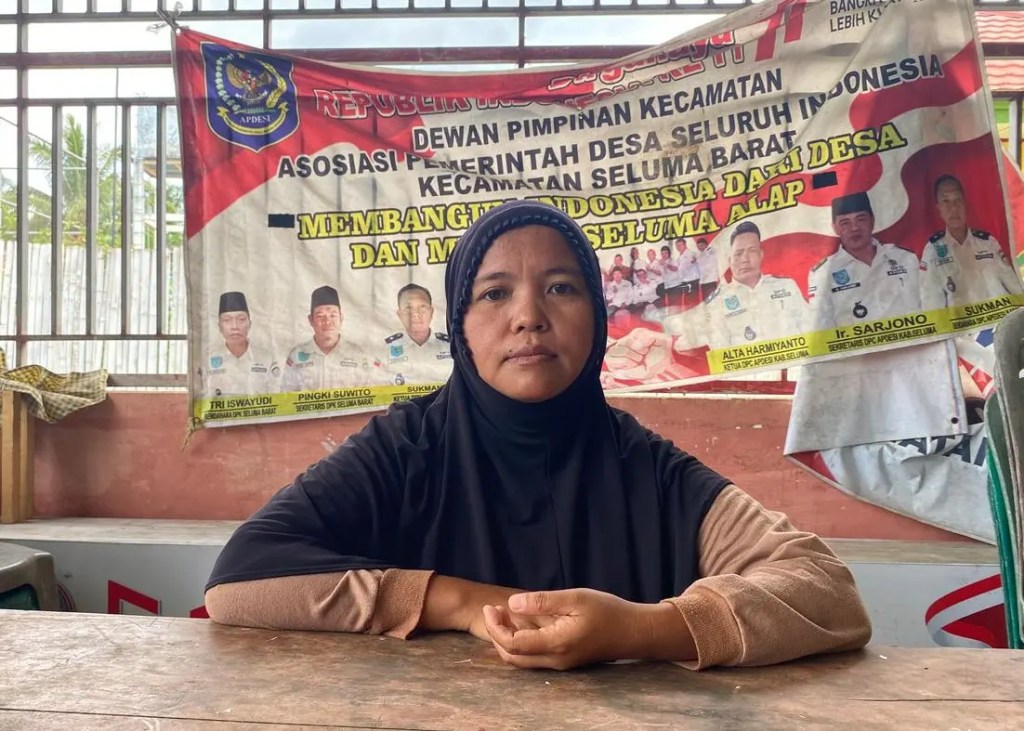
For her, marrying young was not an easy decision. Moreover, both she and her husband came from families with limited economic backgrounds. Uncertain income forced their household to carefully calculate daily expenses, including education costs.
In those conditions, marriage was seen as the most feasible path, even though its consequences were felt only after they lived through it.
Now, with the distance of time and life experience, Eles views that decision differently. “I regret marrying young, and I don’t want my children to repeat my mistake,” she said briefly.
Baca juga: Ketika Negara Absen di Jalan Desa: Buramnya Akses Kesehatan Perempuan di Bengkulu
Rising heat becomes a new driver of poverty
The experiences of Eles and Sari are a warning for the future. In Seluma Regency, the economic pressure that pushes girls into child marriage is no longer caused only by poverty, but is also increasingly influenced by climate change. Rising temperatures have become an alarm for new economic pressure because they can worsen farming conditions and force farming families to make difficult decisions to survive.
Data from the Class I Climatology Station of Pulau Baai show that extreme temperatures in Bengkulu Province have increased significantly over the last three decades. Days with maximum temperatures above 35 degrees Celsius have become more frequent, especially since 2011 until now.
“During the period 1991–2000, extreme temperatures above 35 degrees Celsius happened only twice. But in 2011–2020, they increased to nine times, and from 2020 until now, they have already been recorded eight times, with the highest temperature reaching 36.6 degrees Celsius,” said Anang Anwar, Head of the Data and Information Section at the BMKG Class I Climatology Station of Pulau Baai, Bengkulu.
Not only air temperature, but also extreme rainfall in Bengkulu, shows a fluctuating pattern. From 2020 until now, extreme rainfall above 150 millimeters has been recorded four times, with the highest intensity reaching 270 millimeters. This condition indicates that Bengkulu is experiencing two extremes simultaneously: prolonged heat and heavy rainfall in a short period.
According to Anang, Bengkulu’s climate, which is located in the equatorial region on the west coast of Sumatra, makes the dry season more unpredictable. “The start and peak of the dry season now tend to shift. This is related to global climate dynamics, including strong El Niño events,” he said.
BMKG recorded that strong El Niño events in 1997–1998, 2015–2016, and 2023–2024 directly caused decreased rainfall in Bengkulu. The impact is felt not only in agriculture, but also in higher risks of drought, forest and land fires, and public health problems.
Facing the potential of a strong El Niño in 2026, BMKG is encouraging mitigation efforts across sectors. In agriculture, farmers are advised to adjust planting patterns by using drought-resistant crop varieties and planting earlier before the peak of the dry season. Local governments are also urged to improve the use of reservoirs, drilled wells, and weather modification technology to maintain the water supply.
“This is not just about the weather. It is about food security and public safety,” Anang stressed.
BMKG also projects a long-term rise in temperatures in Bengkulu. For the period 2020–2049 compared to 1976–2005, the annual maximum air temperature is expected to increase by up to 2.52 degrees Celsius, under both moderate emission scenarios (RCP4.5) and high emission scenarios (RCP8.5).
Anang warned that without serious mitigation efforts, the impacts of climate change will be felt more strongly at the local level. “People need to actively follow official information from BMKG and start to adapt. Extreme heat is no longer an anomaly, but a new pattern,” he said.
Climate Impacts on Livelihoods
Gita Mulyasari, an academic from the University of Bengkulu, said that rising temperatures in Bengkulu are likely to affect the agricultural sector. Food crops that depend on seasonal conditions and water supply, such as rice, are expected to yield less because of higher temperatures and reduced water availability.
Meanwhile, the impact on plantation crops is not felt immediately, but will appear in the coming years. “For oil palm, continuous drought can affect fruit formation and may reduce harvest production,” she said.
These conditions have already been felt by farmers in several areas of Seluma. In Semidang Alas District, Seluma Regency, about 200 hectares of farmland that support local livelihoods have reportedly suffered crop failure since 2022.
“My land is now only 1.5 hectares. In normal conditions, one hectare could produce about 80 sacks, but now it no longer does,” Murdan recalled.
The same problem is also faced by rice farmers in Sukaraja District, Seluma Regency.
“In 2023, the hot weather lasted for two months, and the rice fields became completely dry. As a result, the harvest failed,” Kustiyah explained.
Data from the Central Statistics Agency (BPS) show that the harvested area of rice in Seluma Regency has continued to decline over the past seven years, from 13,316 hectares in 2018 to 9,978 hectares in 2024. This reduction in farmland has raised concerns about local food security, especially since Seluma Regency is the second-largest rice supplier in Bengkulu Province.
Based on field observations, climate change is one of the main causes. Unpredictable rainfall, flooding during the rainy season, and prolonged drought have rendered some rice fields unproductive. These conditions have led farmers to convert their land to oil palm plantations, which are considered more profitable and better able to withstand extreme weather. This shift has accelerated the decline in rice-harvest areas.
Baca juga: ASN Dilarang Bercerai? Helmi Hasan Lupa Negara Bukan Penjaga Rumah Tangga
Child marriage rates remain a concern
According to data from the Bengkulu Provincial Religious High Court (PTA), Seluma Regency has recorded the highest number of child marriages over the past three years. The Tais Religious Court approved 184 child marriage dispensations in 2023, then fell to 154 in 2024 and rose again to 156 in 2025. Meanwhile, as of January 17, 2026, 10 applications for marriage dispensation had already been approved.
Retno Wahyuningtyas, a sociology academic from the University of Bengkulu, said that the high rate of child marriage in Seluma Regency is not caused by a single factor. Besides poverty, it is also influenced by social and cultural factors, low levels of education, and the lack of effective protection, which allows child marriage to continue from one generation to the next.
Retno added that the economic vulnerability of communities is made worse by the impacts of climate change. Lower agricultural yields and uncertain livelihoods, caused by unpredictable seasons, longer hot periods, and difficult-to-predict rainfall, put pressure on the incomes of farming families who depend on fields and gardens.
According to Retno, when income becomes uncertain, families face multiple economic pressures. Basic needs such as food, education, and health must be prioritized, while children’s education costs are often the first expenses to be cut. In this situation, some families eventually “allow” their children to marry as a strategy to reduce the economic burden, even though this decision carries serious risks for the future of girls.
From an ecofeminist perspective, the exploitation of nature caused by the climate crisis goes hand in hand with the marginalization of women, including through child marriage. Both place women as the most vulnerable group and limit their chances to become empowered. Although women are often forced to adapt as actors in life after marriage, their very young age makes their struggle harder because they lack knowledge, access, and resources. “Moreover, Seluma is consistently recorded as the poorest regency in Bengkulu Province,” Retno said.
Based on data from the Central Statistics Agency (BPS), the poverty rate in Seluma Regency is consistently higher than the average in Bengkulu Province, with a gap of about 3.5 to 4.2 percentage points.
Retno stressed that although child marriage is often seen as giving short-term “benefits” for parents, such as temporary economic stability or reducing their moral responsibility for their daughters, this practice actually brings harmful long-term impacts, especially on reproductive health, education, and the future of girls.
Government efforts to reduce child marriage
Lesmi, S.Kep., Head of the DP3AL2KB Division in Seluma Regency, said that many factors, including juvenile delinquency, pregnancy outside marriage, family economic conditions, and the influence of smartphones and social media, influence the high rate of child marriage.
“Most of the children we counsel say they are influenced by social media. Parents and parenting styles also play a role. There is still a belief that once a child is married, the parents’ responsibility is finished,” Lesmi said.
She added that most parents of children who marry early come from low-income families and provide little supervision because they work in the fields from morning until evening. “Parents feel that by marrying off their children, they no longer need to pay much attention to them,” she explained.
Lesmi said her office has conducted outreach and awareness programs to prevent child marriage in schools and villages. In a single budget year, these activities typically reach up to five villages. “In the near future, we will declare a child marriage prevention program, although we are still limited by the budget,” she said.
Regarding marriage dispensation cases, she explained that DP3AL2KB is often asked by villages to act as a counseling resource, but the final decision remains with the Religious Court.
- All children’s identities have been changed to protect their safety and privacy.
- The production of this report was supported by Climate Resilience For All.




















Comments are closed.