


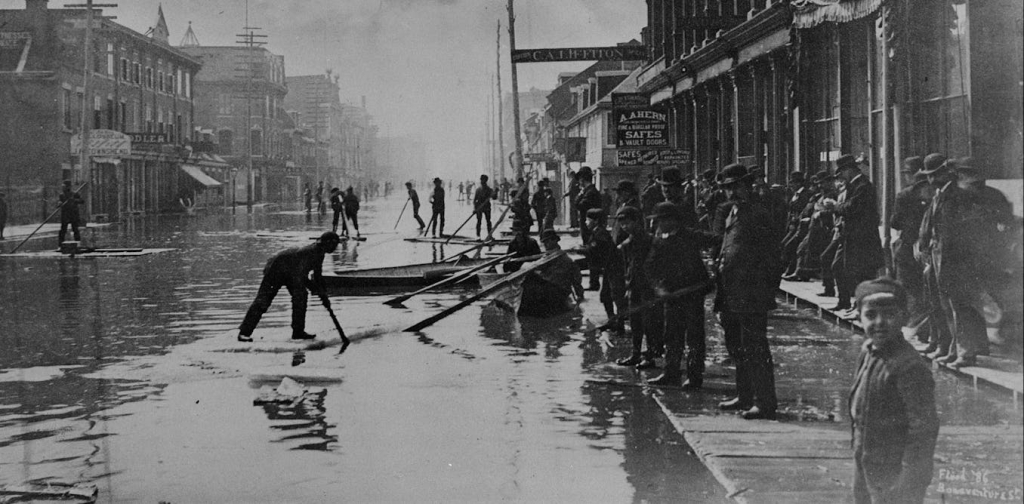

Tornadoes, floods, wildfires and storms have all been in the news recently, and all are taken as harbingers of a coming climate catastrophe. The word “unprecedented” is often used in such reports, but are these disruptive weather events unusual for the various climates of Canada? How can we tell? It feels as if we are adrift in a sea of events, statistics and crises, with no anchors or waypoints.
As with many disciplines, we climatologists turn to history to stabilize ourselves in a constantly churning sea of change. Flood markers and rain gauges date back millennia, while modern thermometers and barometers were invented near the middle of the 17th century. People have been recording weather and climate ever since, leaving us with several centuries of historical weather diaries and climatic records.


In Canada, the earliest instrumental records date to the first half of the 18th century, with recordings from Hudson Bay in the 1730s and Québec City in the 1740s. We have records stretching back centuries.
With these records, we can gain insights on an incredible scale, over both time and space. When we can access the original documents, we can look at weather recordings taken at intervals of only a few hours. This means we can track everything from intense but brief events, such as sudden downpours leading to flash flooding, to the slow variability and change that occurs over centuries.
In 2020, colleagues and I started a not-for-profit called Open Data Rescue, with a mandate to locate, transcribe and analyze these historical weather and climate records.
With support from Environment and Climate Change Canada, we found records of Canadian weather and climate from 50 locations in archival sources outside of Canada, mainly from the National Archives and Records Administration and National Centre for Environmental Information in the United States and the Meteorological Office Library and Archives in the United Kingdom.
Our research

We faced a host of challenges transcribing 18th- and 19th-century weather records and using them for climate analysis. For one thing, many of the records kept in Canada’s north and northwest were sent via post to the Smithsonian Institution in Washington, D.C. as monthly registers.
One can only imagine the journey they must have gone through via canoe or dog sleds from, say, Fort Rae on Great Slave Lake to York Factory on the western coast of Hudson’s Bay, and then to Washington. The documents are appropriately tattered, torn and ink-smudged, making it difficult if not impossible to recover the original text.
Other times the observations or units are hard to convert. Before reliable anemometers were developed, wind speed was measured in a variety of ways, mostly using wind force scales derived from environmental conditions such as leaves rustling, trees swaying, smoke blowing from chimneys and other such cues such as the Beaufort wind scale.
The Royal Engineers, being engineers, recorded the wind force in pounds per square inch, using pounds and ounces. Converting all these to metres per second required considerable research.
Our analysis of sub-daily weather records in the St. Lawrence Valley region led to the counter-intuitive conclusion that while it was getting less cold — there is a distinct warming trend in the coldest winter temperatures — it’s not clear that it’s getting warmer during the daytime in summer in southwestern Québec than in the past.
Even as we experience heat domes and higher temperatures, descriptions of past hot summers, severe droughts, heatwaves and fire resonate today. Looking beyond headlines, we may need to concentrate as much on the impacts of warmer winters, such as repeated freeze-thaws leading to icy surfaces and increased accidents, as we do on heatwaves as our climate continues to change.
Read more: Warmer weather is leading to vanishing winters in North America’s Great Lakes
The 1826 Red River flood
Flooding is another challenge that has always been present. The 1826 flooding of the Red River in what is now Manitoba was catastrophic. Coming at the end of two years of poor harvests, an already stressed and even starving population had to contend with what was likely one of the biggest floods of the past 500 years.
This led to the relocation of the Hudson’s Bay Company headquarters from Upper Fort Garry in present-day Winnipeg to the more flood-proof Lower Fort Garry 40 kilometres north. Flood defences were built around the city after subsequent 19th-century floods, helping mitigate future catastrophes.
It is somewhat reassuring that many of the events we’re facing now have been faced in past by our predecessors, who had far fewer resources at hand. It may be that we will need to undo some of their work order to find a better balance between our desire to control our environment and the inevitable facts of living on an active planet.
Restoring wetlands in place of concrete flood defences is an example that comes to mind. We have been adaptable and resilient in the past. We must continue to be so into the future, while becoming ever more mindful of the consequences of our actions.



















Comments are closed.