




Job searching has never been more accessible — or more confusing. Platforms like LinkedIn, Indeed and employer career pages let candidates submit applications with just a few clicks. What happens after they click “submit,” however, has become fertile ground for misinformation.
Social media is filled with “career influencers,” resume writers, recruiters and companies promising insider knowledge of how hiring really works. Much of this advice focuses on misinformed claims about applicant-tracking systems (ATS) and artificial intelligence.


These services profit from job seekers’ uncertainty and convincing people they need specialized services, tools and products to “beat” the ATS and secure interviews.
The result is that many job seekers spend time and money following advice that has no basis in evidence. Here are four common myths about the job application process, and what the research actually says.

No one’s 20s and 30s look the same. You might be saving for a mortgage or just struggling to pay rent. You could be swiping dating apps, or trying to understand childcare. No matter your current challenges, our Quarter Life series has articles to share in the group chat, or just to remind you that you’re not alone.
Read more from Quarter Life:
Myth 1: 75 per cent of resumes are rejected
Perhaps the most widely repeated claim online is that 75 per cent of resumes are automatically rejected by an ATS before a human recruiter ever sees them.
The statistic originated from a 2012 sales pitch by Preptel, a resume optimization company that went out of business the following year. No methodology was ever published, yet the figure has spread widely.
In reality, an ATS is software that helps employers manage applications, and its capabilities vary widely. Some systems function as digital filing cabinets, simply storing and organizing applications.
Others automatically screen for basic requirements, such as mandatory eligibility questions. At the most sophisticated end, systems use AI to rank applicants, recommend candidates and analyze asynchronous video interviews.

The advanced AI-powered tools are typically found in large organizations, including many Fortune 500 companies, which receive enormous volumes of applications. In Canada, most employers do not use AI in hiring, and small businesses — which employ more than 60 per cent of the workforce — are especially unlikely to rely on ATS.
Small businesses typically lack both the application volumes that make ATS worthwhile and the procurement infrastructure to adopt and maintain them.
For most Canadian job seekers, the better strategy is to focus on clearly communicating how their skills and experience match the role, and on building relationships within their profession.
Myth 2: AI can write a winning resume
A common message from career influencers is that AI can generate a tailored resume or cover letter that dramatically improves your chances of getting hired. While AI can help candidates prepare application materials more efficiently, it is not a shortcut to a stronger application.
As more candidates rely on the same tools and prompts, applications increasingly sound similar and recruiters take notice.
Far from providing a competitive advantage, AI-generated applications may have the opposite effect. Seventy-four per cent of hiring managers report identifying them, and 80 per cent view them unfavourably.
The best approach is to use AI to augment your own voice. That means using it to refine and sharpen your draft, not replace its substance.
Research on Canadian hiring suggests candidates secure more interviews when their applications contain more detail, clarity and structure. Since today’s recruiters review a myriad of applications that look and sound the same, they tend to respond to the ones that stand out by communicating qualifications in an authentic voice.
Myth 3: Use ‘ATS-friendly’ resume templates
Resume writers and career influencers claim that using an “ATS-friendly” template is essential for “beating” the ATS. Some even sell templates that promise to “optimize” your resume to secure interviews.
In reality, there is no universal ATS-friendly resume because the software employers use varies widely from one company to another. Additionally, modern ATS can extract information from common resume layouts, including columns or tables.
Their main limitation is that they are designed to process text, not images, graphics or icons. That means a clean, readable resume should be the actual target, not a template bought online.
If ATS doesn’t automatically reject resumes the way the influencer economy claims, then optimizing for a system that largely doesn’t work that way is solving the wrong problem. The real audience for your resume is a person, not an algorithm.
The better approach is to write for both systems and people. Use clear headings, relevant keywords and concrete examples that show how your experience matches the role.
Myth 4: More applications, more interviews
Another myth is that, with the right prompts, the job search can be fully automated, allowing candidates to submit hundreds of applications with little effort. More applications should lead to more interviews, the logic goes.
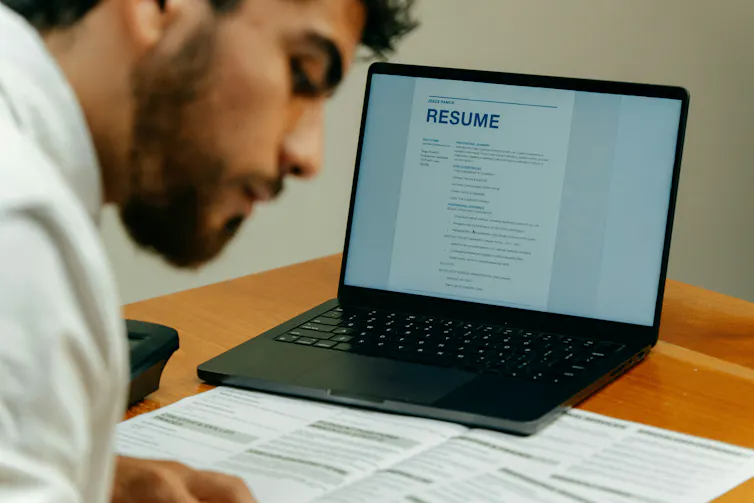
In practice, this approach often comes at the expense of thoughtful job-seeking, such as identifying positions and employers that genuinely match your skills and interests, and crafting applications that reflect that fit.
AI is most effective when it enhances, rather than replaces, a candidate’s work, helping to avoid what has become known as “workslop” — a term for generic, AI-generated content.
Candidates are best served by using AI for brainstorming and polishing while ensuring the final version accurately and authentically reflects your experiences, accomplishments and voice.
The fundamentals haven’t changed
Today’s labour market may look different, but the fundamentals of a successful job search haven’t changed much. In that sense, the best thing job seekers can do may be to ignore most of what they’re being sold.
The strongest applications are those that clearly connect a candidate’s experiences to the role, provide concrete evidence of their abilities and communicate in an authentic voice.
Technology may help employers manage applications, but hiring decisions are ultimately made by people. That makes professional networks, trusted referrals, strong communication and leadership skills more valuable than ever.
Put the time you’d spend on template optimization into one good conversation with someone in your field. The research suggests it’ll go further.



















Comments are closed.