


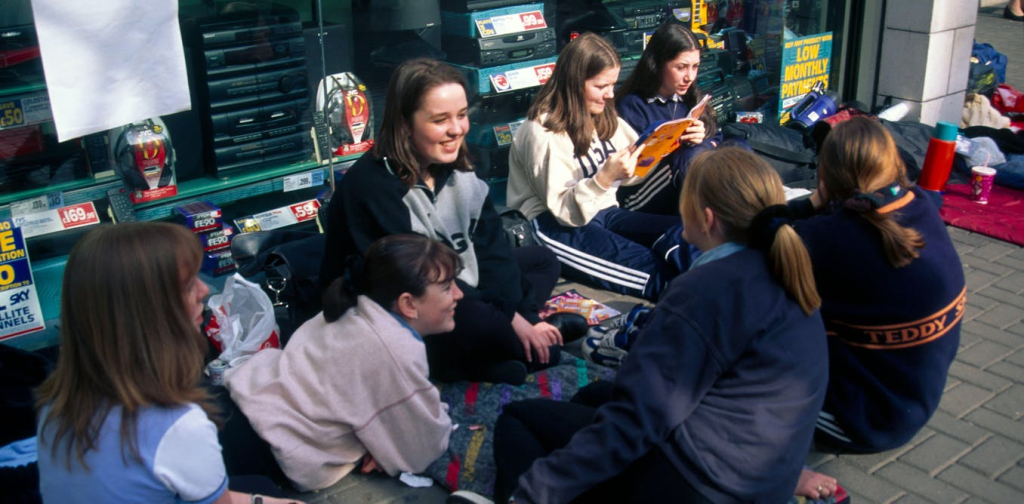

During the Troubles, a harrowing 30-year conflict over the constitutional status of Northern Ireland, music opened up alternative ways of understanding identity.
Along with boxing and greyhound racing, music offered a rare site of cross-community interaction. Musical identities also offered a powerful counterpoint to the media’s depiction of young people in Northern Ireland as either vulnerable victims or potential recruits to paramilitary organisations.


This spirit of resistance through culture has deep roots. In the decades preceding the Troubles, Belfast had boasted a vibrant jazz and R&B scene, with venues like the Maritime Club and Sammy Houston’s serving as cultural hubs.
However, as conflict intensified into the 1970s, international artists became increasingly reluctant to play in Northern Ireland. While traditional showbands (dance bands that played a mix of pop covers, rock and roll, country and traditional Irish music) continued to tour, they failed to appeal to the evolving youth culture.
Rather than disengaging, young people sought alternative ways to connect with the music they loved. They would cross territorial boundaries between Protestant and Catholic communities for band practice, house parties or underground gigs – and constructed their own subcultures through homemade clothing, DIY fanzines and scrapbooking. In doing so, they forged entirely new ways of identifying with what it meant to be from Northern Ireland.
As the decade went on, the arrival of punk and emergence of local bands such as Stiff Little Fingers and The Outcasts brought young people from both communities to venues such as The Pound and The Harp, and the Good Vibrations record shop. These spaces provided a third space as an alternative to the hostility and violence of everyday life.
Scrapbooking as sanctuary
Scrapbooking, in particular, offered an important way to construct this alternative sense of identity. Over the past year, I have studied a fantastic collection of music scrapbooks held at Belfast’s Oh Yeah! Music Centre, created by teenager Carol Clerk between 1970 and 1973. Clerk went on to become a leading journalist for the music magazine Melody Maker.
Within the pages of her scrapbooks, Clerk meticulously documented the early career of her musical hero, Irish blues-rock guitarist Rory Gallagher. She compiled hundreds of newspaper cuttings, photographs and handwritten notes.
In doing so, she shut out – if briefly – the everyday realities of military checkpoints, curfews and violence, creating an alternative world structured entirely around music as a space of refuge.

In the early 1970s, Gallagher was one of the few artists to continue performing in Belfast, returning every Christmas for a concert at the Ulster Hall. For fans, these concerts offered a chink of light, where young people from both communities could unite under a shared passion, rather than a political or religious identity.
Today, a statue of Gallagher sits outside the venue, serving as a permanent testament to the reconciling power of music.

Clerk’s scrapbooks preserve these fleeting moments of unity through intimate keepsakes including ticket stubs, autographs, and even a packet of chewing gum from which Gallagher had taken a piece. Most poignant, however, is her inclusion of letters to newspaper and magazine editors written by young fans in 1972 – one of the bloodiest years of the conflict.
One boy from Newtownabbey, writing to the Belfast Telegraph, vividly described the “elation” inside the Ulster Hall, and how the streets outside were temporarily filled with “dancing happy teenagers” and “excited voices”. This was “a very welcome change from the usual sounds we have come to associate with Belfast”.
Another fan recounts to Disc and Music Echo how “tears clouded [his] eyes” due to the joyous atmosphere inside the venue, while a letter in Sounds poignantly asks: “When are other artists going to realise kids still live here and are hungry for music?”
Reimagining belonging
These historical insights still have important implications for how people in Northern Ireland think about identity and belonging today.
Research has shown that younger generations are often more comfortable with complex and overlapping identities than previous generations. Many move between multiple forms of belonging, identifying as British, Irish, Northern Irish or combinations of all three. Others increasingly define themselves through interests, communities and cultural affiliations that extend beyond traditional political categories.
Naturally, the technologies through which musical identities occur have changed dramatically since the 1970s. Young people no longer cut up music magazines or glue newspaper clippings into scrapbooks. Instead, they curate personalised playlists, create TikTok content, participate in online fandoms and build digital communities around shared interests. Yet the underlying impulse remains remarkably similar.
Like Clerk’s scrapbooks, these practices allow young people to tell stories about who they are and where they belong. They create connections that are not necessarily determined by neighbourhood, religion, ethnicity or politics.
Ultimately, music continues to offer invaluable opportunities to imagine different forms of community – reminding us, just as it did during the darkest days of the Troubles, what unites us rather than what separates us.













Comments are closed.