


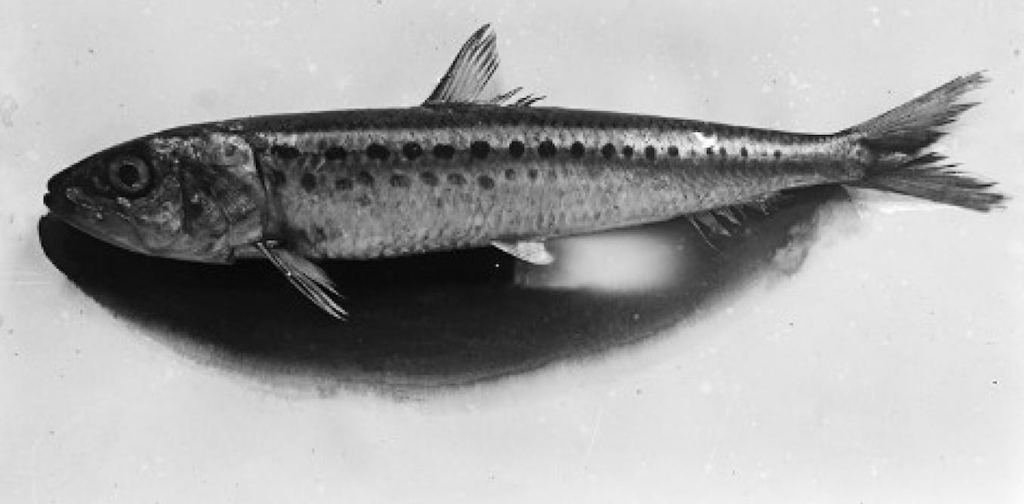

Empires have risen and fallen in their pursuit of precious resources such as oil, gold, tea or spices. But in the first half of the 20th century, an increasingly assertive Imperial Japan relied on a fishier form of wealth to build its military and industrial base: the sardine.
In Japan, sardines are among a group of fish fondly known as “the people’s fish.” Along with Japanese anchovy and round herring, they are collectively known as “iwashi” and have long been a common ingredient in the Japanese diet, whether consumed raw or used in a variety of dishes.



But this small fish, named in records from early 20th century Imperial Japan as “ma-iwashi,” was more than just food. Beginning with the Meiji Restoration in 1868, Japan embarked on its modernization project and aggressive empire-making to become an imperial power. Despite being a latecomer to imperialism, through military annexation and invasion Japan took control of large swaths of Asia.
As a scholar studying the history of the Japanese empire, I have profiled the key role of sardines in the making of Japanese imperialism. With a high fat content, a significant portion of the sardine catch was processed into fish oil, serving as a primary raw material for the empire’s war-oriented chemical industry.
From fish oil to dynamite
Prior to the demand for sardines for chemical manufacturing, sardine oil had long been a byproduct of processing the fish into fertilizer. Through the trading company Suzuki Shoten, the smelly oil was originally exported to Europe, where it was turned into a solid, odorless fat through a process called hydrogenation.
The technique was introduced to Japan in the early 1910s. Hydrogenated oil, after chemical processing, would become nitroglycerin – the main ingredient of dynamite.
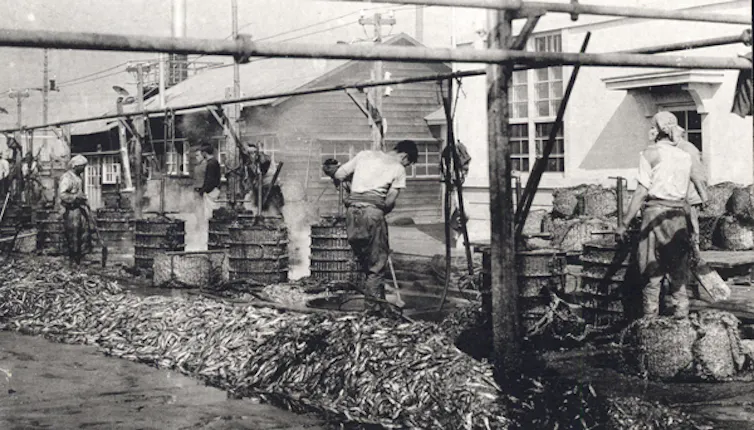
Using fish oil to produce military weapons was not unique to Japan. In fact, it was a trend in imperial warfare during the early 20th century, as seen in Nazi Germany’s wartime operations as well.
Japan’s employment of sardines for this application meant it had to seek such a natural resource beyond its archipelago. For Imperial Japan, the relationship between sardines and its empire-making was twofold: Expanding territory facilitated its larger yield of the fish, which in turn allowed for more oil for the empire’s war apparatus. And placing waters around the Korean peninsula under control was key.
Korea’s ascension
Japan annexed Korea in 1910. But the year 1923 has been recognized as a watershed for sardine fishing in the region. That year, massive schools of sardines were reported off the coast of northern Korea. This was possibly due to ocean current changes following the Great Kanto Earthquake, newfound knowledge of sardines’ value among fishermen, or changes in the sea surface temperature.
With the sardine migratory route along the eastern coast of the Korean peninsula allowing for a nearly year-round fishing season, the colony’s importance within the empire grew as its rich sardine resources became key to Japan’s military ambitions.
Aggressively extracting oil from its iwashi resources, Imperial Japan became the world’s largest harvester of the fish. Its catch in 1931, including yields from colonies such as Korea and Taiwan, which was under Japanese control from 1895 to 1945, accounted for roughly 44% of the global total, according to Japan’s Fisheries Bureau.
As the data showed, the harvest from colonial Korea and the entire Japanese empire were, respectively, nearly three times and 10 times that of the United States, which was second behind Japan that year.
Underscoring the importance of sardine oil as an industrial raw material, a 1939 article in the Dong-A Ilbo newspaper extolled the fish as the “Darling of the Century” as it celebrated a record-breaking catch in North Hamgyong Province of present-day North Korea.
The weaponization of sardines
Sardines went from dinner tables to battlefields and fueled Imperial Japan’s continental aggression, beginning with the 1931 invasion of Manchuria in northeast China and culminating in the Marco Polo Bridge Incident in 1937 – an event that served as a precursor to World War II in Asia.
Dynamite used in both military operations and the full-scale war later were likely sourced from the empire’s sardines.
By then, colonial Korea’s Hungnam region had become the hub that produced such fish-sourced weapons. It centered on the Hungnam Complex, a massive chemical industrial facility that had been established as part of the Chosen Nitrogenous Fertilizer Corporation. Initially built as a chemical fertilizer plant, the complex grew into an expansive establishment encompassing glycerin and explosives factories by 1935.
As a self-sufficient production facility, turning locally caught fish into dynamite using chemicals produced within the same manufacturing center, the Hungnam Complex shortened the supply line for delivering dynamite to Manchuria. Previously it had to be shipped from Japan.
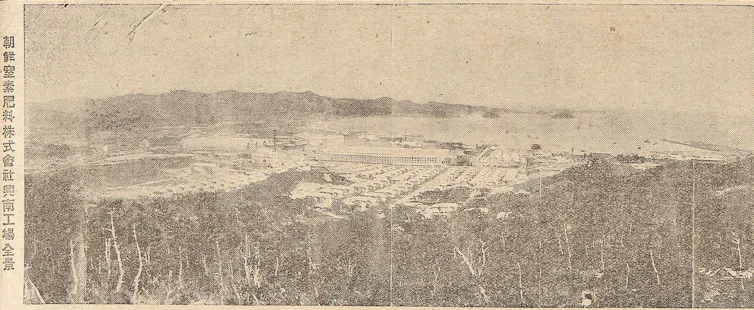
With Korea’s ascension from sardine-fishing hub to chemical industrial powerhouse, sardines were no longer the “people’s fish.” Instead, they became the “militarized fish.”
But the weaponization of the fish did not last long into World War II. Studies suggest Imperial Japan’s sardine catch declined drastically and even ceased during the early 1940s, constraining the empire’s military power relying on fisheries resources.
Japan’s defeat in the war ended its imperial ambitions shaped by sardines. But the industrial use of sardines continues today. According to Japanese government statistics cited in a Toyomi Fish Museum article, as recently as 2020 more than 70% of sardines were used for nonedible purposes, such as oil, fertilizer and fish feed.
The story of sardines feeding Japan’s war machine illustrates the convergence of technology, environment and imperialism. Even a tiny fish could be reconfigured as a foundational raw material that fueled a modern empire’s machinery.



















Comments are closed.