




Competitors in the Tour de France Femmes raised eyebrows recently after it was alleged that some riders were stuffing their bras to go faster during the time trials. Race organisers started checking riders’ clothes more closely before the race.
While this story sounds like a joke, there is a real reason that competitors would do this – and it all comes down to winning.



Adding extra chest padding is a strategy known among triathletes and cyclists as chest fairing. By changing the shape of your chest, it alters how air flows around the body. In cycling, less air resistance means you go faster – so even a small change can help.
But the Tour de France scandal is not the only time something like this has happened this year.
Earlier this year, some Olympic ski jumpers were accused of using injections to make their penis look bigger before getting measured for their suits.
Bigger measurements meant they could wear bigger suits, which create more lift in the air. The story drew enough attention for anti-doping officials to investigate.
The details may sound bizarre, but the reason behind them is not. As someone who studies human body size, shape and composition, I find these stories fascinating. They remind us that sport depends on body shape as much as fitness and hard work.
It’s pretty well accepted that athletes from different sports have different body shapes. Rowers are often tall with long arms and legs. Gymnasts are usually small and compact. Sprinters are strong and muscular. Long-distance runners tend to be lean. None of this is random. Certain body shapes make certain movements easier.
However, sport keeps getting more competitive. Most professional competitors have access to the right training, good coaching, proper nutrition and recovery. So athletes increasingly have to chase marginal gains – tiny advantages that mean little alone but add up when combined.
Anything from a slightly better racing position, a lighter piece of equipment or different clothing could provide some marginal gain for competitors. On their own, these do not seem like much. But added together, they can make a big difference.
Take padded bras. In 2024, scientists ran a computer simulation study to test how chest fairing changes drag on a bike. The best shape (of the chest) they tested cut drag by 3.6%. During a 15-mile time trial, that could save about 19.5 seconds, which is certainly enough to win or lose a race.
Cycling’s rule-makers already ban this. The Union Cycliste Internationale, known as the UCI, has clear rules against it. One rule says clothes cannot be used to change a rider’s body shape. Another bans anything hidden under clothes to cut wind resistance.
Riders have tried to get around these rules for years. Some have hidden water bottles or radios down their jerseys to do the same thing.
Triathletes have tried it too. In 2023, tests reported by the publication Triathlete found that hiding a water bottle in a jersey cut drag by 5-7%.
The ski jumping story follows the same pattern. Scientists tested how suit size affects a jump. Making a suit just 2cm bigger increased lift by 5% and drag by 4%. That added about 2.8 metres to a jump for every extra centimetre. In ski jumping, medals are won or lost by centimetres, so that is a big deal.
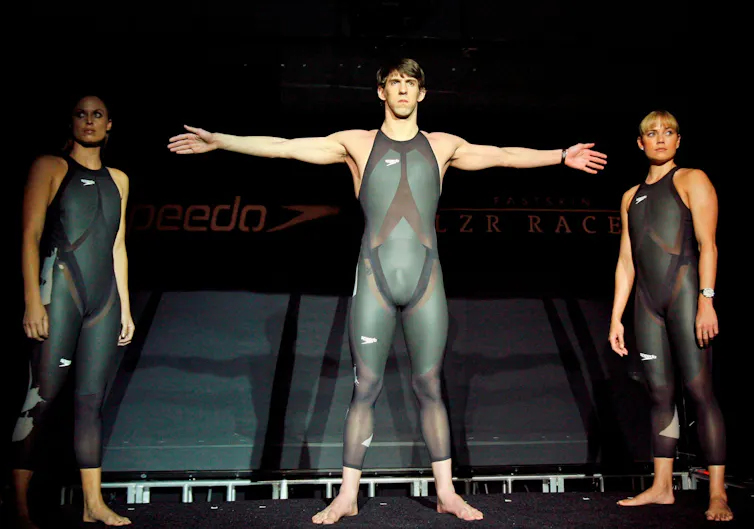
Swimming had its own version of this. In 2008, Speedo released a full-body suit called the LZR Racer, built with help from Nasa. The suit squeezed swimmers into a smoother shape and trapped air to help them float higher in the water, which allowed swimmers to go faster.
Swimmers wearing it won 94% of the medals at the Beijing Olympics and broke dozens of world records in two years. Swimming’s rule-makers banned full-body suits like this in 2010, saying the sport should test the swimmer, not the suit.
All of these tiny details matter because races can be won by fractions of a second. That is why stories like the Tour de France one get so much attention. The real question is whether athletes are changing their bodies in ways the rules do not allow.
Most people think athletes should be free to get better through training, nutrition and practice – as long as everyone can use similar strategies and they follow the rules. But even that isn’t as clear cut.
Someone can follow the rules but still have access to things that aren’t available to everyone, such as a better wind tunnel, a custom suit or a full-time biomechanics team. These cost money most athletes don’t have. So a rule that looks fair on paper can still hand an advantage to whoever can afford the best equipment and testing.
The real problem is telling the difference between cheekily pushing the boundaries and cheating. Then sports officials have to decide if something is a clever idea or an unfair advantage.
Athletes will always look for an edge and some will try new ways to go faster, jump further or perform better. Sometimes that leads to real scientific discoveries – while sometimes it leads to strange headlines.
Either way, these stories illustrate the same thing: winning in sport depends on understanding the body and how it moves through the world, not just on talent and effort. At the highest level, every gram, every centimetre and every second can matter, which is exactly why these weird stories get so much attention.




















Comments are closed.