


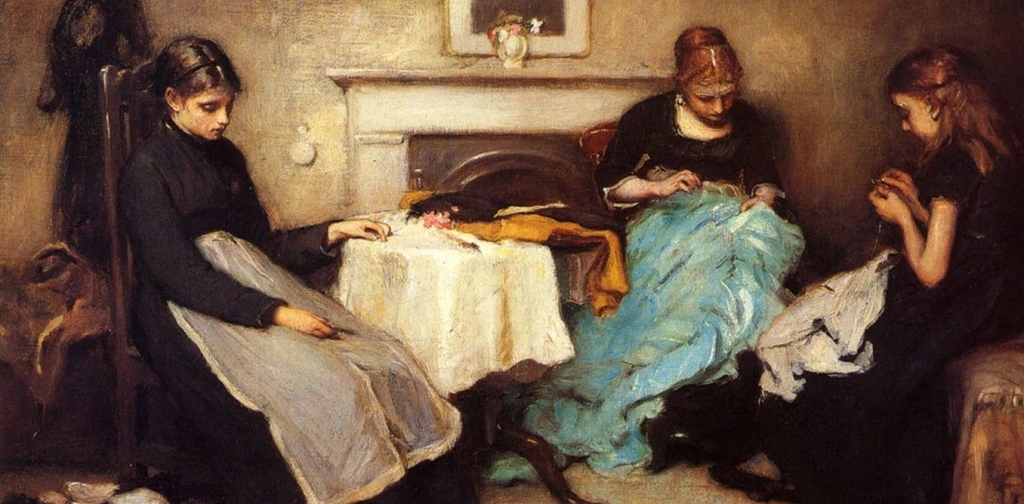

Embroidery is a way to embellish textiles by stitching patterns and images onto them with thread. It has a long history with the earliest examples dating to ancient times. Since then, it has developed into myriad forms around the world.
Many embroidery techniques are steeped in history. In early medieval Europe, embroidery was predominantly a female occupation and was considered a feminine virtue. However, in the same period in the ancient Greek city of Byzantium there were both male and female embroiderers.

From the 12th century, guilds known as livery companies in cities such as London began to control who could train and work as an embroiderer within city limits. As a result, men began to play a more dominant role in this industry, which served the wealthy and the church. As embroidery evolved into a domestic craft during the 17th and 18th centuries, it again became a female art even though men continued to stitch.
Hobbies can bring joy, wellbeing and focus to our busy lives, but so many of us don’t have one. If you’re ready to replace scrolling with stitching, or hustle with horticulture, The Hobby Starter Kit (a new series from Quarter Life) will help you get going.
In other parts of the world the division between who embroiders varied. Across Africa, for example, men traditionally stitched and it is only in recent times that women joined them.
How to get started
Today there are many embroidery techniques, which means knowing where to start might seem a little confusing for a beginner. It’s worth trying different techniques, because you will probably find that you like and excel at some more than others.
Here are four techniques I think are good for beginners. They are traditional forms, but can be given modern twists, as many publications and online videos demonstrate.
1. Canvas work
Canvas work is stitched on a stiff-ish open weave fabric. There are many stitches, most of which are counted. This means you bring the thread to the front of the canvas, count a set number of holes and take the yarn to the back of the canvas in set sequences.
These steps create not only different embroidery stitches but also textures. You can use a variety of threads including stranded cottons, wool and metallic yarns. Canvas work can be created in everything from monochromes through to bright colour ranges and can be flat or 3D.
You can also embroider traditional patterns using this technique such as Berlin wool work, which uses coloured wool threads sewn onto an open-weave canvas in tent stitch. The pattern can be copied from a colour image printed on to a paper grid or it can be drawn out onto the canvas, and you simply fill in the shapes.
2. Crewel work
Crewel work was originally popular in the 17th century. Its popularity has waxed and waned since then.
It was originally used for bedding and soft furnishings and now tends to decorate cushions, bags or be made as a picture. It is free work, which means the stitches are not counted.
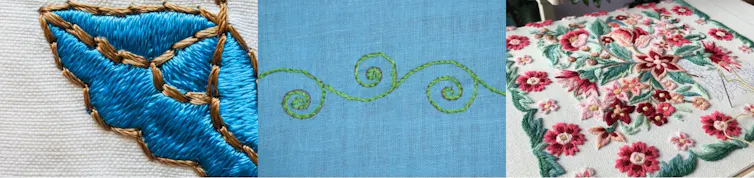
A variety of stitches are used, creating patterns and fillings within motifs. They include satin stitch, stem stitch and laid and couched, the first form of which is found on the Bayeux tapestry. Crewel work is worked on a linen twill fabric in wool threads called crewel yarn.
3. Blackwork
Blackwork is first cited in Geoffrey Chaucer’s The Miller’s Tale (circa 1380s–1390s). However, it became popular in England when Catherine of Aragon brought it with her from Spain, when she married Henry VIII.
It is a counted technique worked on an evenweave linen in black thread. Blackwork patterns range from simple to complex. Traditionally they were worked in a uniform thickness of yarn but modern blackwork incorporates varying thicknesses of thread that are “blended” together within a stitch to create shading. As a result, very complex lifelike images can be created. Today blackwork is sometimes worked in coloured threads as well.
4. Silk shading
Silk shading, sometimes called “painting with a needle”, originated in China between the 10th and 13th centuries.
Traditionally, silk threads were stitched on silk fabric but today stranded cottons are also used. Only two stitches are used, stem stitch to set the design’s outline, which is then sewn over with long and short stitch. The long and short stitch creates staggered rows of colour so when new stitches are worked into them, a blended or shaded effect is created, forming a life-like image. If you like making realistic artwork, this could be the embroidery technique for you.
There are numerous other embroidery techniques besides these. Whitework, for instance, uses white thread on white fabric and can incorporate areas where the threads of the ground fabric are pulled or cut away. Coronation gold is a complicated form of three dimensional gold embroidery used primarily to embellish the coronation robes of monarchs. Among the many techniques from other parts of the world is Aari, which originates from India, and is formed of rows of continuous chain stitch created with a special hooked needle.
But if you start with the four techniques I’ve suggested, there are various ways you can get started with any of these techniques. If you prefer to learn from a book, the RSN essential stitch guides by Search Press are a good place to start. These have been written by specialists in each embroidery technique and include guides to materials and equipment and step-by-step instructions.
If you prefer a video, you can search for specific starter guides on YouTube; just make sure the tutor has been trained and is qualified. You can also buy kits. If you decide to use a kit, please make sure you purchase one from a legitimate designer or retailer. There is a growing number of counterfeiters selling cheap kits with stolen ideas and poor-quality materials and instructions, who should be avoided.
You can also attend beginners’ classes. Some are taught by independent tutors while others are run by institutions, and they often have face-to-face and online courses. An internet search should bring up options in your local area.
Whichever way you decide to start your embroidery adventure, I wish you many happy hours of stitching.












Comments are closed.