


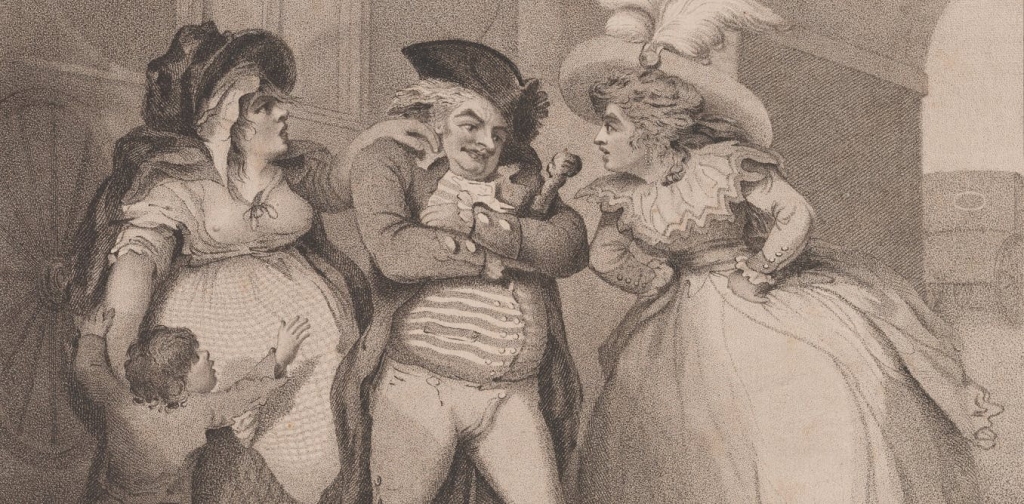

The historical source material on bigamy depicts an awful lot of weeping. Sometimes the tears are behind the scenes – the reaction of a deserted first wife or deceived second wife to the revelation of her husband’s crime.
On occasion they are tears of contrition, as the bigamist begs for forgiveness or at least not to be prosecuted. Although one unmoved 18th-century wife suspected her bigamist husband, William Bury, had just “spit on his fingers” to counterfeit tears and prosecuted him anyway.



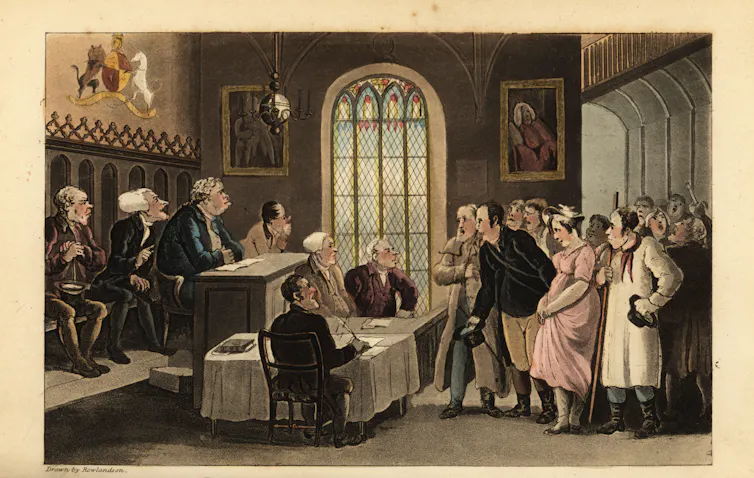
And sometimes the tears are shed publicly, at the trial – reflecting fear of the potential punishment, or, for some, relief at an acquittal. Both reactions are understandable given that bigamy was potentially punishable by death when it was first made a crime in 1604.
While few were sentenced to execution, my research, published in my books Double Trouble and Double Lives, shows that bigamy was still harshly punished. Until the end of the 18th century, convicted bigamists were usually branded on their hands.
The early 19th century saw around a quarter of bigamists (254 people) being transported to Australia and even after that practice declined, sentences of imprisonment were rarely nominal. Thomas Hall, for example, cited by historian Lawrence Stone as having been sentenced to a single day, in fact got four months. Only in the 20th century do we see shorter sentences becoming the norm.
Yet tears are not usually the first thing that comes to mind when we think of bigamy. Stone described one case of a man abandoning his first wife to marry a second as effectively “divorce by mutual consent”, simply because the first wife agreed not to prosecute him in return for financial support. Such language frames bigamy as a victimless crime – a more-or-less socially acceptable solution to marital breakdown at a time when divorce was unavailable and cohabiting with a new partner unacceptable.
And culturally, the idea of bigamy has often had a comic dimension, exemplified in Ray Cooney’s 1983 farce Run For Your Wife. The central character, John Smith, is a London cabby with wives in different parts of the city.
Yet even Run For Your Wife has a darker edge to it. Smith may be depicted as an essentially lovable character (helped by being played by Richard Briers in the original West End production and Danny Dyer in a 2012 film adaptation) – but he is living a double life and deceiving both of his wives.
Read more: The sex lives of Presbyterians in 18th- and 19th-century Ulster were surprisingly colourful
A juggling act
Of course, few bigamists were able to juggle two households simultaneously: it was generally too complicated, too tiring and too expensive to do so. One 20th-century bigamist, who bicycled across London between his two families, lasted only a few months, finding it difficult to maintain both homes on his weekly wage of £2 and seven shillings.
Even so, deception plays a much bigger role in the history of bigamy than most accounts have credited. Time and again, bigamists – usually, it has to be said, men – either lied about their marital status or simply let it be understood that they were free to marry.
Some, no doubt, were genuinely hoping to make a new life with their second spouse and hoped the truth would never come to light. You have to have some sympathy for George Harrower, prosecuted in 1816, whose first wife was confined in a lunatic asylum. Or for Benjamin Griffiths, whose wife cheated on him with his nephew and who in 1847 bigamously married the woman who was caring for his children.
Others were just in it for the sex, and went back to their first spouse after a brief dalliance. John Mase Smith probably holds the record for the briefest second marriage, heading back to his first wife at 5am the morning after his bigamous wedding in 1849.
And some particularly nasty men made a career out of inveigling women into marriage, fleecing them of their money and abandoning them for their next victim. One of the most prolific of these was John Woodgate Kinsella, prosecuted in 1900, 1908 and 1918, who used lonely hearts adverts to dupe more than a dozen young, working-class women into marrying him and giving him their hard-earned savings. If he was around today he would almost certainly be involved in online romance fraud.
The sheer extent of deception revealed in the reports of trials disproves the claims that have been made about the acceptability of bigamy as a solution to marital breakdown: if it was acceptable, why was any deception necessary?
My analysis of where bigamous weddings took place also shows that bigamists were generally trying to avoid detection, rather than assuming that their actions would be accepted. Very few took place in the same church unless the person in question either believed that they were entitled to remarry or thought they would escape notice.
Most bigamists put a significant distance between their two ceremonies, particularly in rural areas. And from the mid-19th century, many chose the greater privacy of a register office. No wonder, then, that so many second spouses were genuinely shocked and distressed on discovering another existing marriage.


















Comments are closed.