


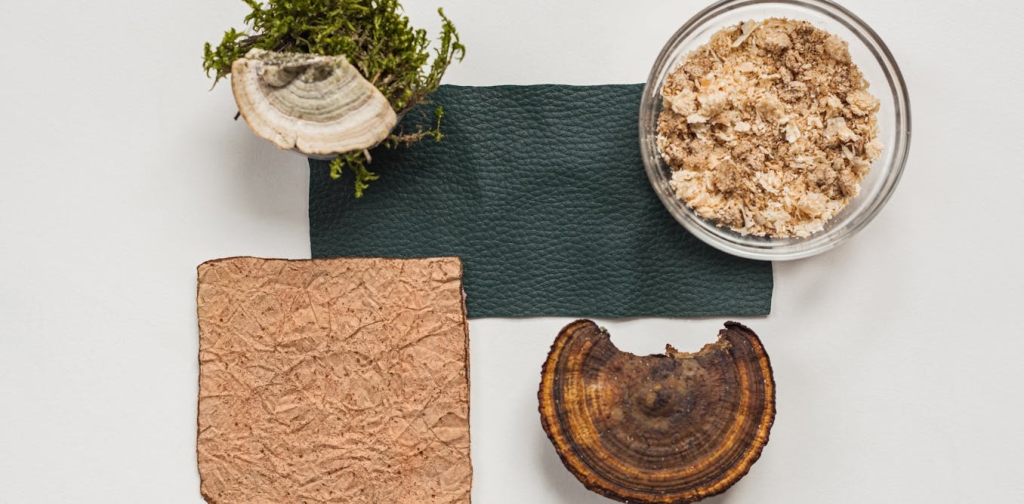

Walk around any major fashion exhibition and you might get the impression that biofabricated materials are about to transform fashion. Grown using living organisms, they’re often showcased as the next generation of sustainable materials — promising alternatives to leather, polyester and other conventional textiles.
This year’s Première Vision Paris international textile trade show highlights biofabricated materials as part of fashion’s future. It is showcasing innovations grown from fungi, bacteria and agricultural waste alongside discussions about artificial intelligence and next-generation manufacturing.



This may give the impression that the next generation of clothing is just around the corner. Yet open almost any wardrobe and you’ll find the same fibres that have dominated for decades: cotton, polyester, wool and leather.
So why is there such a gap between the headlines and the high street?
It’s easy to assume the answer is cost. Biofabricated materials are often associated with luxury fashion and concept collections, making them seem out of reach for everyday consumers. Cost certainly matters, but is definitely not the whole story.
Developing a new material is only the first step. Convincing an industry built around traditional textiles to adopt it is a very different challenge. The science has moved faster than the fashion system it feeds into.
Research into biofabricated materials has accelerated rapidly over the past decade. Scientists can now grow sheets of bacterial cellulose, produce leather-like materials from fungi and transform agricultural waste into fibres with remarkable properties.
From a scientific perspective, these advances are extraordinary. But science alone doesn’t put a new material into people’s wardrobes.
Every new biofabricated material enters a world in which existing textiles have already been refined over decades, and in some cases centuries. Leather has been optimised through generations of tanning and finishing, while cotton has benefited from continuous improvements in spinning, weaving, dyeing and finishing. Polyester has been engineered to be durable, affordable and easy to manufacture at enormous scale.

New biofabricated materials are often – unrealistically – expected to compete immediately with all of that. But growing a material is only the beginning. They then need to be dried, coloured, finished, tested, manufactured consistently and produced at a scale that global fashion brands can rely on.
Mainstream fashion manufacturers need repeatability – the same material, colour and performance every time. Living systems don’t always behave like that. Small changes in growing conditions can produce different outcomes, creating challenges that don’t exist with established synthetic manufacturing.
As with conventional textiles, sustainability depends on the entire life cycle of a material — not simply where it originated. “Bio” doesn’t automatically mean environmentally friendly. Many biofabricated materials still require chemical treatments, coatings or additional processing to achieve the durability and performance consumers expect. Others rely on energy-intensive manufacturing or solvents to convert raw materials into usable fibres.

Bridging the gap
Perhaps the biggest challenge facing biomaterials isn’t the science. It’s the gap between the laboratory, the designer, the manufacturer and, ultimately, the consumer.
Fashion designers rarely begin with a sketch; they start with materials. The weight, flexibility, texture and behaviour of a material all influence what eventually becomes a garment or accessory. But most fashion designers rarely get the opportunity to handle or design with biofabricated materials.
The fashion industry doesn’t lack innovative new materials. It lacks the systems, supply chains and opportunities needed to translate these innovations into products that people can actually buy, wear and understand.
If biofabricated materials are to fulfil their promise, the question should not simply be whether they can replicate or replace materials such as leather. Researchers, designers and manufacturers need to understand where biomaterial properties offer something genuinely useful, how they can work within – or reshape – existing manufacturing systems, and whether they deliver environmental benefits across their entire life cycle.
The biofabricated fashion revolution may still be coming. But getting from the laboratory to our wardrobes requires much more than clever science alone.




















Comments are closed.