


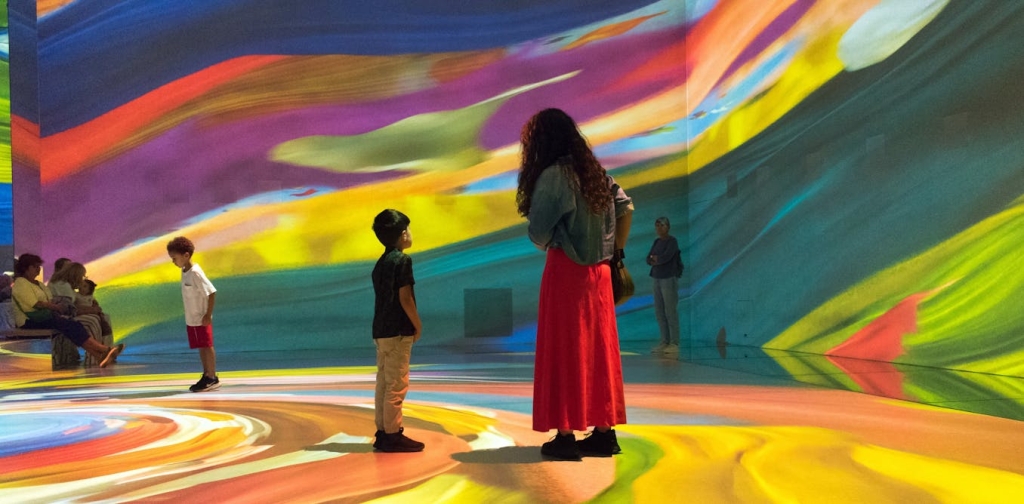

Stand in front of Turner’s Sun Rising Over Water (1825-30) and something odd tends to happen. The painting holds you, even though observers might struggle to say why. Maybe it is the colour, the balance, the composition, or the strange stillness the artwork seems to carry.
Whatever it is, you feel it long before you can explain why. And the stranger next to you, looking at the same canvas with the same awe in their eyes, very likely feels it too.



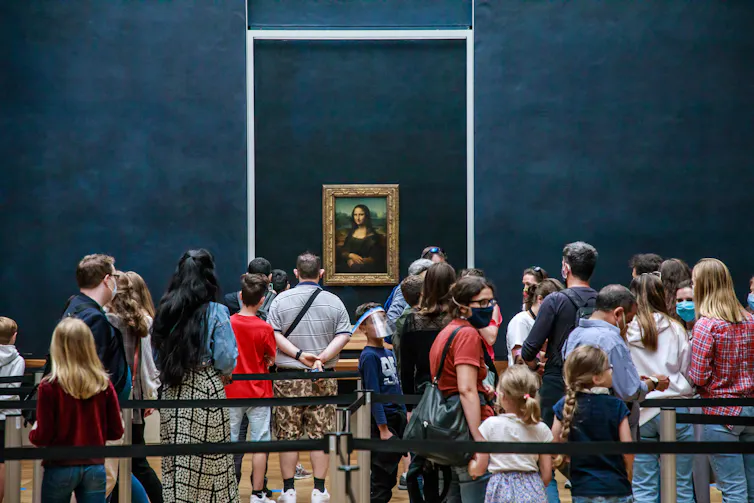
We often say that beauty is in the eye of the beholder. Yet show almost anyone a misty Chinese Song-dynasty mountain landscape, or the softly brushed figure of the Mona Lisa, and nearly everyone agrees that something striking is unfolding before them.
Beauty feels intensely private, and, at the same time, we keep discovering that we collectively share it. That contradiction is one of the longstanding puzzles in “neuroaesthetics” – the science of how the brain responds to art and beauty. How does our sense of beauty actually take shape in the brain?
In our latest study, published in Nature Communications, we tried to map that shared experience. We found that instead of representing it as a single entity, the brain instead splits aesthetic experience into two major strands. One strand handles what an image shows, whether a landscape, an object or a figure.

The other tracks how much pleasure it gives us, drawing on the same circuits that respond to food or money. These two separate neural systems combine to shape every judgment of beauty we make when viewing visual artworks.
Neuroscientists have long argued about this question, from positions that compete as often as they overlap. One camp focuses largely on perception, on how the brain takes in composition, contrast and form.
Another emphasises evaluation and reward, placing beauty in the brain’s value circuitry. A third looks to the brain systems behind imagination and self-reflection. Each account captures something real, but they had rarely been tested together in a single study.
Algorithms for art
We asked 34 volunteers to look at 96 traditional Chinese watercolour paintings inside a 7T MRI scanner, powerful enough to pick up the small shifts in blood flow that track the brain’s activity. Once they were out of the scanner, each participant rated how the paintings made them feel.
Instead of working straight from those raw ratings, however, we borrowed a tool from somewhere less obvious: the recommendation engines that power services such as Netflix and Spotify.
Known as collaborative filtering algorithms, these tools excel at detecting patterns of agreement buried in people’s preferences. When applied to our aesthetic ratings, they pulled out two dimensions running underneath everyone’s responses.
The first sorted the paintings from most figure-like to most landscape-like, a measure of what each picture conceptually depicts. The second sorted them from most disliked to most liked across all participants, a measure of emotional value, or hedonic value (the sensory enjoyment someone gets from an experience).
Despite their complementary contribution to the overall aesthetic experience, the brain kept these two dimensions remarkably separate. Visual content was read out along the visual pathways, the familiar circuits that let us tell a face from a scene.
Hedonic value, on the other hand, was decoded somewhere else, within deeper regions that handle reward and pleasure. Put simply, the brain seems to judge a visual painting with much the same machinery it uses to judge the rest of the world around us.
Changing the brain
We also found that how strongly the brain encoded this two-dimensional aesthetic landscape depended on a person’s expertise in visual arts. In particular, the difference showed up in the default mode network, a system of connections in the brain tied to imagination, consciousness, self-reflection and meaning-making that several leading theories place at the heart of aesthetic experience.
These results suggest that, beyond mere exposure, training in visual arts appears to change how the brain represents beauty in the first place.
This last point carries significant weight. If aesthetic experience has a measurable structure in the brain, and if making and viewing art can reshape it, then arts education starts to look less like enrichment and more like a kind of training that alters how perception, emotion and meaning are wired together. The clinical implications run along the same line.
Art-based therapies for depression, trauma and dementia have long been valued on instinct and anecdote. A clearer neural account gives us a way to test and sharpen them. Finally, as more of the images around us, in advertising, in design and on our screens, are generated by machines, knowing what beauty looks like inside the human brain matters more than ever.
Most often, we tend to treat beauty as something purely personal and assume that asking scientific questions about it misses the point. Building on pioneering work in the field of neuroaesthetics, our results suggest otherwise.
Beauty has a structure, and that structure says something about the kind of creature we have become over countless years of evolution. We do not simply look at the world, instead we cannot seem to stop judging it for its beauty.






















Comments are closed.