


In the early hours of Wednesday morning August 5 the upper stage of a Falcon 9 rocket crashed into the Moon in an uncontrolled collision.
No damage was caused, other than the creation of a new crater several metres in diameter, but the event highlights the increasing problem of space junk left in orbit when it has completed its intended purpose.



Natural impacts occur on the Moon daily. On average, Nasa estimates that 33 metric tonnes of meteoroids (space rocks) hit Earth every day, but most of this burns up in the atmosphere before hitting the ground. A smaller proportion make it through and reach the surface as meteorites.
Most of the human-made space debris that falls back to Earth also burns up on its way through the atmosphere. The Moon has no atmosphere, so any debris – either natural or human-made – on a collision course will hit the surface.
First identified and reported as an upcoming collision months ago, the object in this case was the upper stage of the SpaceX Falcon 9 rocket on a mission to ferry two robotic landing craft to the lunar surface. These were Blue Ghost Mission 1, manufactured by Texas-based firm Firefly Aerospace and Hakuto-R, built by the company ispace, which is headquartered in Tokyo, Japan.
The first stage of the rocket did what it was designed to do, took the second – or upper – stage and the payload of spacecraft into low Earth orbit, detached, and returned safely to a landing pad on Earth to be refurbished for reuse.
The upper stage engines then ignited and took the spacecraft on their intended trajectory to the Moon. However, once it had released the spacecraft, its job was complete and it was left in a high elliptical orbit around the Earth.
In a statement, SpaceX said that, for most missions, the company carries out a controlled de-orbit of the Falcon 9 second stage, so that it safely re-enters Earth’s atmosphere over the ocean. However, the company added that for payloads headed to the Moon, like this one, the de-orbit manoeuvre is not always possible.
On August 5, 2026, its orbit coincided with the position of the Moon and it crashed into the lunar surface, generating a new crater and excavating a large amount of lunar rock and dust. South Korea’s Danuri spacecraft, which entered orbit around the Moon in December 2022, has taken images of the impact site, showing traces of material (ejecta) thrown out across the lunar surface.
With an estimated mass of four tonnes (its exact mass depended on how much unspent fuel was left on board) it was travelling at 2.43 km/s (1.51 miles per second) at the point of impact. This is far slower than most space rocks in the solar system, but fast enough to do some serious damage if it had hit anything of value.
While this was an accidental impact, astronomers made plans to observe the event to advance our understanding of crater formation on the Moon. Given that we know the size, shape and mass of the rocket body, studying the resulting crater will help us better understand the lunar surface and its impact history.
Seismometers (to measure ground motion) deployed during the Apollo landings in the 1960s and 70s, helped us understand the frequency of meteorite impacts on the Moon. But we can only estimate the properties of the impacting object after the crater has formed.
This, as well as other accidental – and deliberate – impacts can help us better understand lunar surface material. As part of an international campaign to observe the impact, the University of Manchester’s Jodrell Bank Observatory used the 76-metre Lovell Telescope as the receiving element in a bistatic radar experiment, where the transmitter and receiver are separated by a large distance.
Radio transmissions from Nasa’s Deep Space Network station near Madrid were directed towards the impact region, while the Lovell Telescope listened for faint radar echoes reflected from the resulting plume of dust and debris excavated from the lunar surface. The observations also included tracking the Falcon 9 upper stage during its final approach to the Moon.
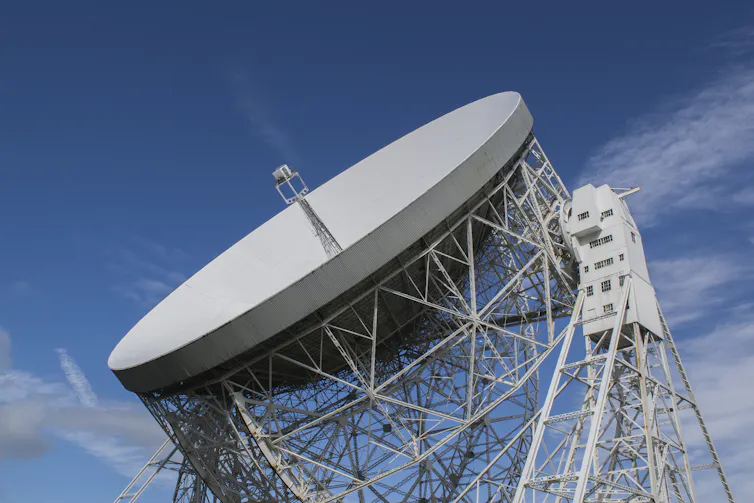
Detecting radar returns from an impact plume at lunar distance is extremely challenging, although the Lovell Telescope has previously demonstrated its radar receiving capability on similarly demanding experiments, both for tracking and characterising objects in orbit and detecting radar echoes from a near-Earth asteroid.
Developing these techniques will be increasingly important for monitoring hazards and protecting future infrastructure and human activity in space.
Keeping space free of clutter is becoming increasingly important, both in low Earth orbit where there are now more than 16,000 active satellites but more than 1.2 million pieces of debris larger than 1cm in size, and around the Moon where more infrastructure is planned.
With several countries aiming to put humans on the Moon for long duration missions, the problem of space debris and impacts will become increasingly pressing. There is also the risk of accidentally destroying sites of historical and cultural importance – such as Neil Armstrong’s first footprint at the Apollo 11 landing site.
Space treaty
The Outer Space Treaty provides the basic framework for international space law. It states that “states shall be liable for damage caused by their space objects”. This applies on the Moon as much as it does around Earth. So, hypothetically, if a US rocket part hit a Chinese lunar base, the Chinese would expect the US to take responsibility, and vice versa.
This principle applies to collisions in low Earth orbit too, as well as to falling debris that survives re-entry. Commercial companies are developing methods of catching and removing defunct satellites and other hazardous pieces of debris before they can cause a collision or crash.
Increasing awareness of this problem is pushing companies and nations to improve how they dispose of their rockets and satellites once they reach the end of their operational lifetime. There are some regional regulations on the disposal of such material, but it is currently far from universal.
In its statement, SpaceX said: “For higher energy missions like those to a lunar transfer orbit, nearly all performance on the vehicle is devoted to successfully placing the payload in the intended orbit, and a controlled disposal manoeuvre is not always possible.”
The company added: “We actively work to be as responsible as possible with hardware left in space to ensure space safety, including for more complex missions. In this case, solar activity and gravity led the second stage toward the Moon.”
Nasa’s Artemis II mission, which carried four astronauts on a loop around the Moon in April 2026, showed that there is significant public interest in sending humans back to the Moon.
This incident illustrates a significant risk that future lunar missions will need to address, both in terms of keeping astronauts and infrastructure safe from old debris, but also looking towards a future where governments and (increasingly) private companies are more responsible with their equipment once it has completed its mission.
Right now, there are no humans on the Moon so there is no risk to life. On this occasion, there were no landers or other equipment in the projected impact location.
But as more and more missions head to the Moon, increasing numbers of spent rocket parts will end up on potential collision courses with the Moon – if we are planning to build a base and have it crewed long term, the last thing you want is for it to be accidentally damaged by a piece of space junk.





















Comments are closed.