




Across Canada, every province and territory agrees: outdoor and land-based play belongs at the heart of children’s early learning.
Curriculum frameworks affirm in varied ways that outdoor environments are rich, intentional learning contexts, not supplements to the real program.



British Columbia’s framework embeds the First Peoples Principles of Learning. The Northwest Territories grounds its vision in Indigenous world views and learning from and with the land (land-based pedagogy). Alberta calls for healthy risk-taking. New Brunswick requires outdoor play in all weather.
However, as we learned in a study about regulating outdoor and land-based early learning programs across Canada, commissioned by the Lawson Foundation, words supporting outdoor play and land-based learning are unambiguous, but the policy infrastructure tells a different story.
We examined cross-Canada licensing regulations, curriculum frameworks, standards of practice and post-secondary preparation, and found a four-way structural disconnect.
The four components are each developed independently, with no accountability mechanism requiring any of them to align. This is a structural gap that runs through every jurisdiction in Canada.
The compliance checkbox problem
All provinces and territories require outdoor play, but each one frames it the same way: daily time minimums, fenced spaces, standardized and approved surfacing for play areas and mandatory line-of-sight supervision.
What’s absent is equally striking: no envisioning of outdoor environments as learning contexts, no risk-benefit guidance and no outdoor-specific competency expectations.
Read more: Why kids need risk, fear and excitement in play
No jurisdiction treats outdoor or land-based practice as a defined professional competency. It appears in none of the three jurisdictions — British Columbia, Ontario and Nova Scotia — with formal standards of practice for early childhood educators.
And it barely appears in post-secondary preparation: only about seven per cent of early childhood education programs include any outdoor content.
In Ontario, only about four per cent of college programs include mandatory Indigenous studies coursework, with similar patterns reported nationally.
The child-care equity crisis
Canada is building a landmark universal child-care system that targets $10-a-day care, a substantial reduction in cost for families.
Read more: Child-care affordability is coming at the expense of equity — and it’s time governments acted
But universal means all children, not only those in licensed indoor programs.
Because outdoor and land-based programs cannot meet indoor facility requirements, they cannot obtain a licence, and therefore cannot access earmarked federal funds.
A licensed facility-based program can take children to a forest on a field trip with no additional scrutiny; a program for which that forest is the entire model cannot operate within the licensed system at all.
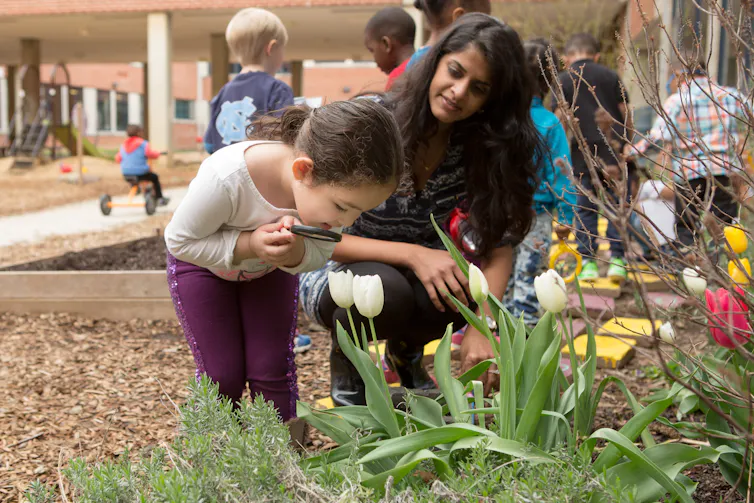
For Indigenous communities, the exclusion is compounded: land-based pedagogy is absent from regulations nationwide, despite Canada’s commitments under the Truth and Reconciliation Commission’s Calls to Action, UNDRIP and the Indigenous Early Learning and Child Care Framework.
Read more: Children make connections to Aki (Earth) through Anishinaabe teachings
Six expressions of the same gap
Our analysis identifies six cross-cutting themes showing how the four-way disconnect plays out nationally.
First, the framework-regulation gap: curriculum frameworks are consistently more progressive than the regulations governing delivery. The gap is widest in the territories.
Second, Indigenous land-based pedagogy remains absent from regulations and standards of practice, even where frameworks, in British Columbia, the Northwest Territories and Nunavut, affirm Indigenous ways of knowing most strongly. Again, this gap is most acute in the territories, where Indigenous Peoples are the majority.
Third, ecological literacy is absent as a defined educator competency everywhere in Canada, despite the country’s ecological diversity and its stated commitment, through Canada’s National Framework for Environmental Learning, to building the knowledge and agency required for climate action.
Fourth, risk-benefit assessments are absent from licensing requirements everywhere. This is despite strong evidence that children denied adventurous, challenging play miss chances to build resilience and self-regulation, and despite the availability of Canadian toolkits built to support exactly this shift.
Fifth, children’s rights under the UN Convention on the Rights of the Child — including Article 31’s right to play with risk and adventure — are acknowledged in frameworks but absent from daily regulatory practice.
Sixth, no accountability mechanism requires any of the four components to align.
These are not isolated problems. They are six expressions of one structural gap.
Many models can inspire Canada
The path forward is well established. Washington State has created a permanent licensing framework for outdoor, nature-based programs. Germany and Denmark have integrated forest kindergartens into public education for decades.
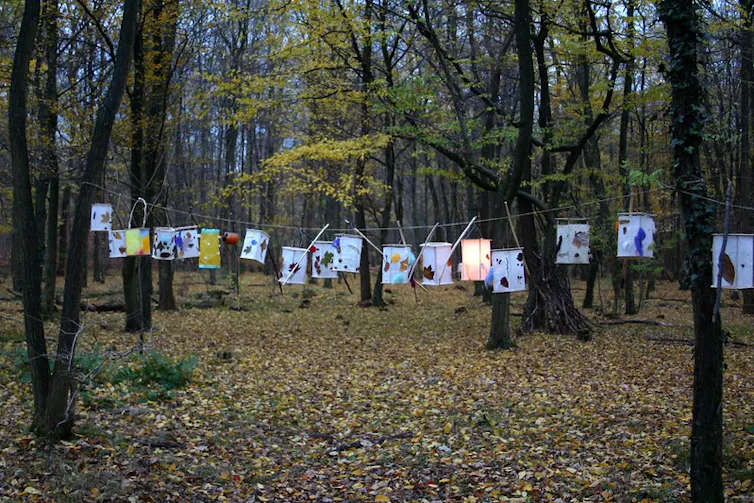
Scotland recognizes outdoor learning as a quality indicator in its national inspection framework. Australia has documented the benefits of “bush kindergarten” within its National Quality Framework. None of these are experiments. They are working models directly relevant to Canada.
What needs to happen
Closing the disconnect requires co-ordinated action. Regulatory reform falls to provincial and territorial governments with federal partners. This should be concerned with replacing a focus on eliminating hazards with asking centres to conduct risk-benefit assessments, which help educators take a balanced approach to risk and safety in children’s outdoor play.
It should also ensure licensed outdoor and land-based programs can access federal early learning and child-care funding on equal terms.
Developing frameworks must proceed in genuine nation-to-nation partnership with Indigenous governments. Educator preparation must make ecological literacy and Indigenous perspectives core curriculum, not elective enrichment — and the same is true for competency in assessing risks and benefits of outdoor play.
Aligning the varied systems requires government-led accountability mechanisms so no single component can advance while others stall.
Making progress in all four areas (licensing regulations, curriculum frameworks, standards of practice and post-secondary preparation) simultaneously is what the evidence requires.
Canada’s curriculum frameworks have already articulated the vision. Canada’s commitment to countrywide early learning and child care provides the policy opening.
The four-way disconnect is a structural problem, and structural problems require structural solutions, pursued together, with urgency.


















Comments are closed.