


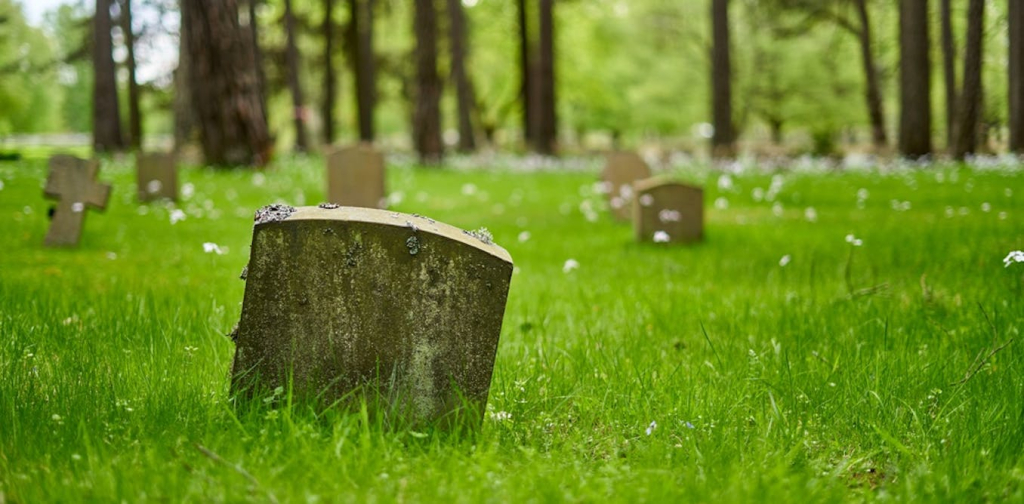

There’s a growing interest in alternatives to traditional burials as well as making the process more environmentally friendly in many countries. For many people it’s about the environmental impact of the funeral industry globally.
In the US, for instance, a surface equal to the size of Hawaii (1.6 million hectares) is deforested each year for manufacturing coffins. The amount of wood used is equal to building 4.5 million homes. Other costs include approximately 1.6 million tons of cement for graves. Carbon emissions from a single cremation are equivalent to those released by a private car driven for 3,369 kilometres.



Another factor is that many countries are running out of space in graveyards.
Discussions about the environmentally friendly aspects of dealing with death often take in woodland burial sites, memorials with bird boxes and using different coffin materials.
Two methods, burial and cremation, have been used in Europe for centuries. But a much wider range of burial techniques such as composting and water cremation are now starting to be offered more widely.
Water cremation, also called alkaline hydrolysis, is where the body is treated with 170°C hot water and an alkali-based solution, the results are then dried out, and ground down into a powder. These remains are then returned to relatives in an urn. This was introduced in Scotland as an option in March 2026 and is being discussed in England and Wales. It is also allowed in other countries including Australia, South Africa, some US states, Canada and Ireland.
Scotland’s public health minister Jenni Minto described this option as an “environmentally friendly alternative”.
Read more: Water cremation: sustainable body disposal is coming to Scotland – here are the benefits
Natural organic reduction or composting is already used in Ireland and Germany as well as Australia. In this form of human composting the body is placed in dry material such as hay, straw or wood-chips in a sealed container where microbes decompose the body into soil. This is then broken up into tiny particles and buried in a wooden vessel.
Are they better for the environment?
But how environmentally friendly are these newer methods compared with the conventional ones? To determine this, one must consider several factors. These include the choice of flowers for the funeral, the coffin, shrouding and embalming.
Another factor is the working conditions for employees in the funeral industry, since traditional treatment of the dead body often includes handling toxic chemicals in embalming, for example. The greatest environmental cost comes from transport: not only of the deceased, but also the number of mourners attending the funeral and how they travel.
Other factors can complicate comparisons. Crematoria differ widely between countries, both in terms of emissions and the process itself, depending on whether biofuels or diesel are used.
Different cultures also have different burial practices. In the United States, for instance, there is a practice of perpetual grave rights, where graves are supposed to last for eternity, combined with concrete burial vaults. This leads to a significantly high environmental impact.
In a report published in 2023, research from Linnaeus University in Sweden, examined composting, cremation and burial in Sweden. The study examines a wide range of factors beyond the disposal of the body itself. The findings show that all three methods mentioned above have relatively similar levels of environmental impact. When waste heat from crematoria is recovered and used for district heating (a form of centralised heating widely used in parts of Europe), cremation emerges as the best environmental option. Once again, like every method, it is the surrounding arrangements and transport that account for the greatest environmental impact.
Other research highlights how different funeral options are attempts to appeal to people’s desire for sustainability and naturalness. But reliable data on green disposal methods is hard to find and therefore can be difficult to analyse.
The ways in which dead bodies may also be handled are strongly shaped by cultural and religious beliefs. The most environmentally friendly method, dismembering bodies and placing them in nature, still used in Buddhist Tibet for instance, is unlikely to be acceptable in most modern societies, for both practical and emotional reasons.
Freezing in Sweden
In one bid to try something different, and more green, bodies in Sweden were kept frozen while awaiting the implementation of cryomation or freeze-drying. Twelve of them remained in storage for more than ten years.
In 2013, a legal decision on this case eventually required conventional burial, and the last bodies were buried in 2016.
In this case, the desire for an environmentally friendly disposal of the bodies, resulted instead in prolonged frozen storage with considerable environmental impact.
Read more: Gin Lane by William Hogarth is a critique of 18th-century London’s growing funeral trade
Cultural considerations are often important. The promotion of cremation around the turn of the 20th century, for example, reflected a society in which it was seen as hygienic and modern.
Today’s promotion of alternative methods similarly mirrors contemporary discussions in which environment and nature have become more regular debating points.
Ultimately, the question is not simply which method is the most environmentally friendly, but how societies negotiate the balance between ecological responsibility, cultural values and respect for the dead. Any meaningful shift towards what might appear to be greener choices will depend not only on technological innovation, but also on a broader cultural willingness to rethink what constitutes a dignified and meaningful farewell.
















Comments are closed.