


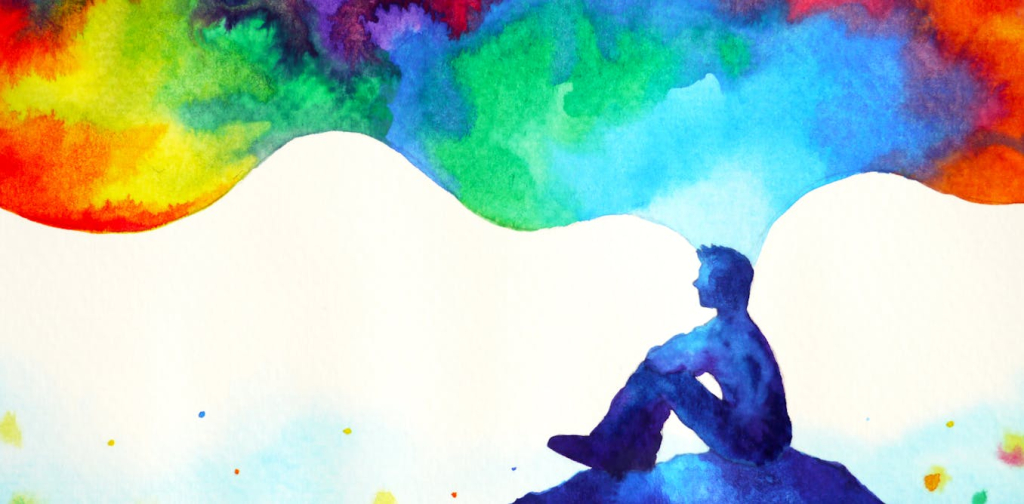

As we go through life, our brains run different processing modes. Some – the attention and sensory systems – result in very similar experiences of the world: what colour the sky is, how warm the day feels.
But there is another, deeper side to the brain which weaves together your memories, goals, beliefs and emotions into a continuous sense of self. This allows you to experience the world not as it is, but as it matters to you personally.


This unique inner world is supported by the brain’s default mode network (DMN). This links together several areas including in the prefrontal cortex (at the very front of the brain) and the parietal lobe (at the back).
These areas of the DMN are, in evolutionary terms, relatively recent. As human brains expanded dramatically between around 800,000 and 200,000 years ago, those regions grew in size and complexity compared with our closest primate relatives. They are more likely to express genes that are uniquely human, related to brain development and function.
Our latest research explores to what extent the DMN explains what makes each of us unique. Put another way, we are attempting to understand what makes you “you”.

What makes us human?
While ancient deep regions of the brain, shared with all vertebrates, support basic experiences such as fear and thirst, the more recent and complex DMN is important for what makes us human.
To better understand the differences, we asked 16 adult volunteers to listen to an excerpt from the Hollywood film Taken (2009) while we recorded their brain activity. Using the audio alone enabled us to compare each person’s activity when both conscious and unconscious. Our volunteers were scanned using functional magnetic resonance imaging (fMRI) while awake and under general anaesthetic, as the same story was played to them.
Each time, we tracked the shifting patterns of communication between brain regions. In particular, we monitored changes in each person’s attention, sensory and default mode networks, and compared these with changes in subjective experience that participants reported.
When participants were conscious, we found their DMN activity patterns became both more complex and more dissimilar to each other as they listened to the story. In contrast, when unconscious, their individual signatures diminished – becoming simpler and more similar to those of the other volunteers.
But their attention and sensory networks showed the opposite pattern. These were more similar when awake, reflecting common mechanisms for gathering sensory information and interpreting the external world through sight and sound.
Our results reinforce that the DMN carries the more personal side of consciousness, changing from moment to moment to reflect each person’s thoughts, memories and inner experiences.
However, different parts of the DMN contribute in different ways. Some subregions, both deep in the back of the cortex and in the front of the brain, help us reflect on ourselves, imagine possibilities, and weave experience into a personal story. Others, especially those linked to memory in the deep temporal lobe regions, help reconstruct scenes and recall past events, and make sense of ideas and how they connect.
Understanding our uniqueness
Why does the DMN vary so much from person to person? Because it underpins deeply personal characteristics that define us, such as personality and values.
This echoes ideas like that of pioneering psychologist William James, who wrote: “Every brain-state is partly determined by the nature of this entire past succession … It is out of the question, then, that any total brain-state should identically recur.”
The DMN interacts with the rest of the brain to enable us move fluidly between the world as it is, and the world as we conceive it. Some studies suggest that disrupting DMN activity can blunt originality in creative tasks.
Altered DMN connectivity has been linked to many mental health conditions, particularly those involving self-narrative, memory and social cognition. If we can map a person’s DMN dynamics, we may be able to better understand their specific difficulties – for example, with memory or socialising – in a way that could one day lead to more personal forms of therapy.
But achieving high-quality brain maps requires lengthy scans and complex analytics. That is where precision functional mapping (combining a variety of methods including fMRI) and artificial intelligence come in.
Precision mapping can handle large amounts of data per person to chart individual networks. Machine learning models may then be able to combine these maps with genetics and symptoms to guide diagnosis and treatment.
But deeper questions need answering too. Humans are highly social animals living in complex societies. If every person’s inner world is unique, what does that mean for ethical decisions such as managing criminality or prioritising treatments?
The DMN is key to enabling our ability to imagine different futures. This includes the precise role that brain science can and should play in them.




















Comments are closed.