


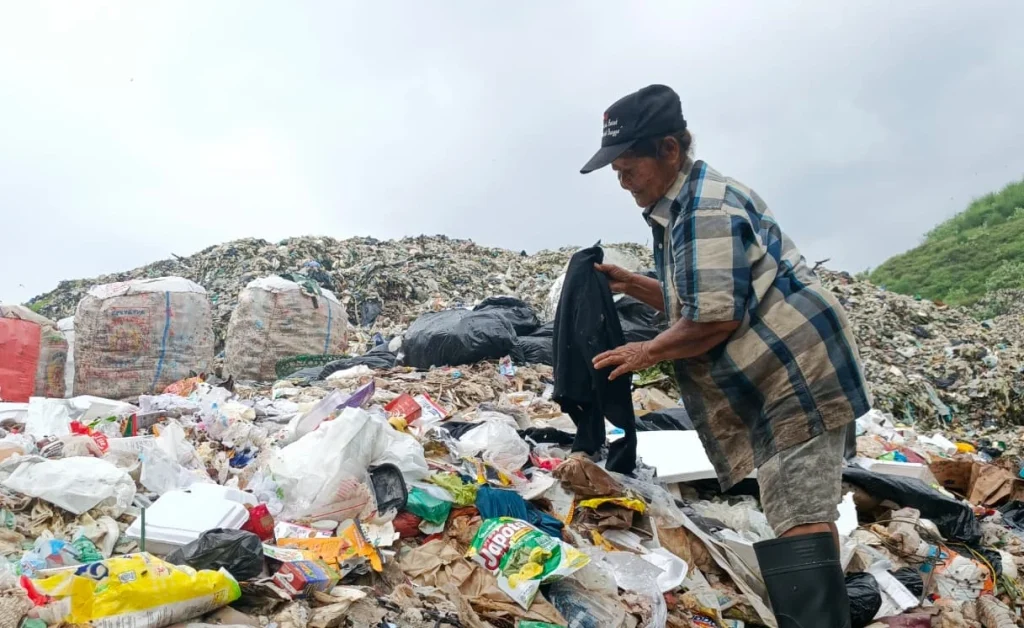

Every morning, Manah (48) immediately begins scavenging trash in Bantar Gebang, Bekasi.
The trash he collects is located not far from his small, dilapidated shack.
The trash piles are so high that Sani (56) was once buried in trash. He is grateful that he did not die from being buried in trash.
“I was once buried in trash” – Sani (56).
Manah and Sani are two residents who live among trash. Sani once thought, “Why are people like us no different from trash? They are discarded, abandoned, and left to rot.”
Meanwhile, the government is increasingly eager to proclaim that the National Strategic Project (PSN) is a waste-to-energy project to tackle garbage. However, scavengers and residents there say that it is all fake.
Read More: Why Period Poverty Is a Social Justice Issue
Indonesia is currently declared a country in a waste emergency. An emergency that deals with daily waste tonnage, and is intertwined with the normalization of the suffering of millions of people who are forced to make waste their daily breath. These mountains of waste are also used as a source of livelihood, mixed with polluted water as a source of life.
In Bantar Gebang and even more than 343 open dumping sites in Indonesia, scavengers sort through city waste for wages that are far below the daily minimum wage.
Faced with this situation, the state then offered a technocratic solution through the Waste to Energy (PSEL) project, which was signed as a national strategic project (PSN). This project is claimed to be able to handle waste and provide financial funding for waste management. However, this project, which is managed by Danantara, has received criticism because it does not solve the problem at its source, but instead creates new problems.
Given this situation, Konde.co then investigated three cities to see how this waste problem could occur. The three cities are Jabodetabek, Medan, and Surabaya.
What is saddening is that Jakarta once received the Adipura award as the cleanest city in waste management in 2023 from the Indonesian Ministry of Environment and Forestry. Surabaya received the Adipura Kencana Cup as the cleanest city in 2024, and Medan received the Adipura Award for its cleanliness efforts throughout 2022.
The Mountain of Trash in Bantar Gebang
That afternoon, Rona (65) had just climbed down from a garbage mountain about 3 meters high at one of the waste disposal sites in Bantar Gebang, Bekasi.
She took shelter under the eaves of a hut about 1 meter away from the garbage mountain because the rain had started again.
“When it rains, I’m afraid of catching a cold, so it’s better to rest,” Rona told Konde.co on Thursday (1/22/26).
Rona usually starts her work sorting trash with her husband, Minan (71), at around 6:30 a.m. This daily activity is done after she finishes cooking and completing her household chores.

Read More: Why Gender Sensitivity Matters for Disaster Risk Reduction in Indonesia
The mother of two ends her trash sorting activities around 5:30 p.m., just before sunset. Usually, Rona and Minan take a short break at midday to eat or simply stretch their legs or lean their backs against the wooden bench in front of their shack.
Together with her husband, Rona, who is from Tambun, Bekasi, has been a scavenger in Bantar Gebang since 2007. Starting from an invitation from her neighbor who had already been scavenging in Bantar Gebang, Rona and Minan also began to earn a living from the piles of garbage discarded by the residents of DKI Jakarta.
They work for a scavenger boss who provides shacks made of wooden planks for them to live in. Each of these wooden structures measures approximately 3 x 4 meters, standing in a row next to mountains of trash. Every time Rona steps out of her shack, the sight that greets her is the piles of trash from Jakarta’s hospitals. Garbage trucks arrive at the location every 2-3 days at dawn.
At the beginning of scavenging trash, they needed time to adapt to the pungent smell of trash, maggots, and the surrounding environment. For days, they couldn’t even swallow food.
“We collect trash while vomiting because of the smell here. We don’t want to eat because there are so many maggots. It’s trash, after all,” said Rona.
Even after washing their hands after sorting the trash, the pungent smell still lingered. The unpleasant odor seemed to cling to their hands even after washing them repeatedly with soap. Rona and Minan sorted the trash with their bare hands and without masks. The only work equipment available was boots.
“Every time you smell your hands, they stink,” said Minan.
For at least the first ten days, they survived by drinking only water.
Read More: No More Silence, Let’s Talk About Unwanted Pregnancy
A fellow scavenger who had been working there longer gave them some advice that they found effective. If they felt nauseous from the smell of garbage, when sorting through the trash and finding fruit such as oranges, salak, or other items that were still in good condition, they should just eat them, he advised. Rona and Minan followed this advice. After that, the smell of garbage was no longer a problem for them, and they were finally able to eat.
“Now we eat on top of the bulog (mountain of trash) without noticing the smell; the important thing is to wash our hands,” said Minan.
Working for about 11 hours every day sorting trash, Rona and Minan can collect one large sack of used plastic beverage bottles, plastic bags, paper, and cans. Their boss picks up the sorted items every two weeks.
Used plastic beverage bottles are priced at seven thousand rupiah per kilo, while plastic bags are priced at four thousand rupiah per kilo. In two weeks, Rona and Minan can earn an average of 1.2 million rupiah. If their health is good and the weather is favorable, they can earn up to 1.4 million rupiah. This income is usually deducted by 300 thousand rupiah for their food expenses for two weeks.
In their twilight years, Rona and Minan still work to meet their daily needs. They also have the responsibility of caring for their two grandchildren, who have been orphaned since their daughter died of illness several years ago. At that time, their grandchildren were still in elementary school.
One of their grandchildren graduated from vocational school two years ago but is still unemployed because they haven’t found a job. The second grandchild is still in school in Tambun, Bekasi.
“I take care of them from here, pay for their expenses, provide food, and pay for their schooling,” said Rona.
More than half of the wages they receive every two weeks are sent to her grandchildren through a transfer service in the Bantar Gebang area. With wages less than half of the Bekasi City minimum wage, Rona and Minan have to be very frugal. Rona admits that she eats small fish (salted fish) or tempeh every day.
Read More: The ‘Fault’ in Our Feminism: Rethinking The Conceptions of Gender Empowerment and Failure
Sometimes, while sorting through trash, they find vegetables that are still in good condition and can be cooked for meals. Such as chayote, beans, spinach, or a bag of mixed vegetables for a sour soup. In addition to collecting from piles of trash, Rona sometimes buys vegetables from a traveling vegetable vendor.

In addition to food, Rona has to set aside money to buy drinking water. She usually buys refillable gallons of water for six thousand rupiah per gallon, which lasts for 3-4 days. In addition to drinking, the gallon water is also used for cooking. Meanwhile, for bathing and washing, Rona and the scavengers living in the area use well water. The well water there smells bad, so they have to buy water for drinking.
“Here (the leachate—waste liquid) has seeped into the ground, so the well water smells bad,” she said.
Despite the foul smell, Rona and Minan claim they have never experienced itching or skin complaints. As for electricity, they do not have to pay for it because it is covered by the scrap collector boss.
Unlike Rona and Minan, who left their grandchildren in the village, Manah (48), Rona’s neighbor who lives next to her shack, brought her school-aged child to live in the shack.
Manah and her husband Warno (56), who are from Karawang, West Java, have only been scavengers in Bantar Gebang for two years. Initially, they worked as farm laborers, cultivating land owned by the scrap collector boss in their hometown.
However, the poor conditions in the village due to crop failure forced them to migrate, leaving their hometown in search of a livelihood. Moreover, the cost of their children’s education was increasing as they progressed through school. Therefore, Manah and Warno decided to try their luck in Bantar Gebang. They got information about jobs in Bantar Gebang from a friend from their village who was already working there.
Read More: 2025 Year-End Edition: A Season of Persecution Without Transition in the Age of #DemocracyApocalypse
Manah has two children, the first is a married woman who is already working, while the second is still in school. They came to Bantar Gebang after their second child graduated from junior high school and continued on to vocational school in Pedurenan, Bekasi.
Like Rona, Manah also felt nauseous and had difficulty eating when she first started scavenging for trash in Bantar Gebang. She tried to persevere for about a week and eventually adapted to the smell. She scavenges for trash without a mask, wearing gloves, boots, and a hat.
The mother of two usually wakes up at dawn to tidy up the house and do the laundry. At 6 a.m., when her children leave for school, Manah climbs the mountain of trash and starts scavenging. She stops to cook and eat at 11 a.m., then continues sorting trash at 1 p.m. She finishes her work at around 3 p.m.
During her two years working and living in Bantar Gebang, Manah has never complained of illness. However, she admits to having a history of headaches when standing up suddenly upon waking, even before living in Bantar Gebang.
“If I’m startled when I wake up, I feel dizzy, but that’s normal. I had seven illnesses before I came here. In my village, they call it ‘seven headaches,’” said Manah.
Read More: 2025 Year-End Edition: Women’s Resistance in the Season of Arrests and the Year of #DemocracyApocalypse

When she experiences the seven symptoms, Manah usually takes medicine and feels better afterward. Manah admits that she is the type of person who rarely gets sick. She said that when she first moved to Bantar Gebang, her child complained of itching and red skin. She treated it by applying eucalyptus oil. Manah is unsure whether the cause was the well water used for bathing or caterpillars from the large tree near the kitchen behind the hut, which sometimes had caterpillars on it.
Like Rona and Minan, Manah and Warno earn 1.2 million rupiah every two weeks. Manah feels that this wage is not enough to cover her family’s needs. For her child’s schooling, she needs at least 20,000 rupiah every day to buy gasoline and pocket money. Because of this, she sometimes borrows money from her eldest child, who also works.
Meanwhile, Sani, who has considerable experience as a scavenger in Bantar Gebang, once invited her children to join her in scavenging for trash. Sani followed her husband Wandi, who has been scavenging in the Bantar Gebang trash mountain since 2000. At that time, the trash mountain there was only about 2 meters high, not like today where it exceeds 40 meters in height.
Wandi, who is from Cilegon, brought his wife and four children to Bantar Gebang after three months of scavenging there. The six of them lived in a single shack. When scavenging, his children would join him, and if they found food that was still in good condition, they would cook it to eat.
“We cook the food that is still good using old biscuit tins. My child said, ‘It’s delicious, isn’t it, Mom? ‘ ‘Yes, it’s delicious,’ I replied,” said Sani.
Read More: Stop Tech Misogyny: Misinformation on Social Media Used to Trap Victims of Human Trafficking

According to Wandi, the food comes from supermarkets. It is usually still tightly wrapped, like fish.
When he came to Bantar Gebang, Wandi brought important documents such as his ID card, family card, marriage certificate, and so on. After living in Bantar Gebang for about a year, Wandi applied for an ID card to move to Bantar Gebang.
“When I came here, I brought all the necessary documents, so I went straight to the sub-district office. At that time, it was still easy to process, no need for a transfer letter from my place of origin,” explained Wandi.

With their new Bekasi ID cards, they had no trouble enrolling their children in school. Three of their children attended elementary school, while the youngest graduated from vocational school. After their children went to school, they joined in scavenging at Bulog after school hours.
Before leaving, Sani told his children that their mother was carrying a flag and asked them to look for it when they followed her to Bulog. The flag served as a marker for where their parents were scavenging that day.
Read More: Stop Tech Misogyny: When AI Becomes a Tool for Manipulating Women’s Bodies
When she first started scavenging in Bantar Gebang, the price for a plastic bag of scavenged items was around 200 rupiah. Currently, the price for a plastic bag of scavenged items is four thousand rupiah. Scavengers simply accept the price given by the scavenging boss or the market price. This price tends to fall more often than it rises.
In the early years of living in Bantar Gebang, Sani used well water taken from the mosque for all purposes, from drinking and bathing to washing. For drinking, the well water was boiled first. However, during the rainy season when it was difficult to find firewood for cooking, Sani admitted that they drank the water directly. Wandi is grateful that so far there have been no complaints of diarrhea, vomiting, or the like.
When his children joined him in scavenging at Bulog (the garbage mountain), Sani admitted that they had complained of feeling sick.
“The children have been sick before. ‘Mom, my stomach hurts, I feel cold, I have a cold,’ that’s what they said,” said Sani.
“Well, it’s normal for children to get wet in the rain and catch a cold, but thank God they’ve never had to be hospitalized,” added Wandi.
Sani said they started drinking bottled water around 2010. She usually buys refillable bottled water for five thousand rupiah per gallon, which lasts one to two days. She admitted that the need for drinking water is quite high because, in addition to herself and her husband, there is her youngest child who is already married and lives with them. There is also her grandchild from another child whom she takes care of because the parents are divorced.

Read More: More Women, Same Inequalities: How Symbolic Violence Quietly Persists in Indonesian Diplomacy
Wandi experienced being hospitalized when he had stomach problems. At that time, he worked as a garbage truck driver transporting garbage from markets throughout Jakarta. With irregular working hours, because the queue of trucks from the weigh station to the landfill in Bantar Gebang could take hours, Wandi admitted that his body was tired and he caught a cold, which then caused stomach problems.
At that time, the trucks needed about 8 hours to wait in line to dispose of waste, but now the waiting time has gotten longer, sometimes up to 24 hours.
Sani has also experienced stomach problems. After returning home from work, Sani felt hungry, but when she arrived home, she still had to cook. After grilling salted fish on a wood stove and finishing her meal, she soon felt stomach cramps and her vision became blurred, with everything she saw appearing enlarged.
She was then taken to the hospital on a borrowed motorcycle, which was quite a distance away. At the hospital, Sani was given two bottles of IV fluids and asked to be treated as an outpatient. She was then prescribed medication for three days and sent home. Sani refused to be hospitalized because she was worried that the costs would be expensive while her money was limited. At that time, she had to spend almost 400 thousand rupiah for medical expenses.
Sani admitted that at that time she had a lot on his mind, often daydreamed, and rarely ate. She was eager to scavenge so she could earn money to provide for her children, sometimes even skipping meals. She even lost weight. As someone who had never attended school, Sani was burdened with thoughts of how to prevent her children from experiencing the same condition as her.
In 2006, when the mountain of trash collapsed, Wandi had just finished unloading trash from his truck, so he avoided danger. At that time, Wandi’s salary was 500 thousand rupiah. Additionally, there was a 95,000 rupiah transportation allowance for buying fuel. Each trip cost Wandi 50,000 rupiah for diesel. Meals were usually provided by market vendors. Thus, Wandi could bring home 45,000 rupiah for his wife.
After quitting his job as a garbage truck driver in 2014, Wandi returned to scavenging. From scavenging with his wife, Wandi usually brings home 150,000 rupiah per day.
Read More: Stop Tech Misogyny: The Long Chain of Gender-Based Cyber Attacks and Disinformation
However, if there are no items to collect at the garbage dump, their daily earnings can be less than 100,000 rupiah. On the other hand, if there are plenty of items to collect, they can earn up to 300,000 rupiah a day from selling their finds.
These valuable scavenged items are types of items that have high or stable selling prices, such as gallon water caps, or what they call emberan, and used infusion bottles. The valuable scavenged items are usually set aside and collected separately by the scavengers. This becomes a kind of savings for them.
When they need a large amount of money, such as for their children’s school fees or for a relative in the village who has a special occasion, they sell these items. With relatively stable and high prices, scavengers can earn a relatively large amount of money.
Currently, Sani no longer scavenges at Bulog; only Wandi still does. Sani has switched to being a kuli nyobek, or sorting scavenged items. As a kuli nyobek, Sani works from 6:30 a.m. to 4 p.m. He works six days a week and earns a weekly wage of 300,000 rupiah.
The items that have been sorted by scavengers are then taken to dealers to be sorted again, separated based on type. Not everyone has this sorting ability. From the dealers, the items are sent to the mill. In this section, the items are sorted again correctly and only then are they ground. The result of the grinding process is plastic ore that is ready to be reprocessed.
So, in addition to scavengers, Bantar Gebang also has dealers who collect items from scavengers and sort them before taking them to the grinding mill. Wasdin (25), a daytime warehouse worker, was sorting items from scavengers that afternoon.
He separated the items into different containers. White plastic beverage bottles were collected together, while colored ones were separated. The same was done with plastic containers, glass bottles, and so on. The pouring rain was no reason for Wasdin to stop working, as there was a tarp installed to protect him from the raindrops.

The waste collectors where Wasdin works usually receive deposits from scavengers who come once a month. After being sorted at the waste collector’s, the waste is then taken to the mill by truck every two months.
That Thursday afternoon, Wasdin was working alone, as his two friends were off work due to other commitments. Wasdin said he had been working as a waste collector in Bantar Gebang for about three years. Previously, he had worked as a factory worker in North Jakarta for about a year. With only a junior high school education, Wasdin tried his luck and looked for work in the city because in Karawang, his hometown, there were not many job opportunities.
“In the village, there aren’t many options for making a living,” said Wasdin.
Wasdin admitted that an acquaintance who had been working in Bantar Gebang invited him to seek his fortune there. It took him about a month to learn how to sort items according to their categories.
As a market worker, Wasdin lived in a hut provided by his boss with his wife and young child, who was still in kindergarten. He worked from morning until evening, taking a short break at noon. He earned 100,000 rupiah per day.
With that wage, Wasdin admitted that it was very tight to meet his family’s needs. Especially since, while living in Bantar Gebang, his child had been sick with a fever several times.
“Children are physically weak, and living in a place like this doesn’t help,” said Wasdin.
Usually, when his child falls ill, he takes them to a clinic and has to pay out of pocket for the examination since he doesn’t have BPJS health insurance.
Punctured by Syringe Waste Until Toxin Normalization in the Body
Bagong Suyoto, Chairman of the Indonesian Environmental Education and Waste Management Foundation (YPLHPI), who has been assisting scavengers in Bantar Gebang for decades, believes that there are serious problems with waste management in Bantar Gebang.
The conventional approach of open dumping or collecting, transporting, and piling up waste is no longer adequate. Moreover, the burden on the Bantar Gebang TPST (formerly the Final Processing Site or TPA) is getting heavier.
Currently, the volume of waste entering Bantar Gebang can reach 7,500 to 7,800 tons per day. According to Bagong, this amount will double during floods, reaching 12,000 tons per day. However, the amount of waste that can be processed is still limited.
“Of the total waste that comes in, only about 15-20 percent can be processed,” explained Bagong.
This situation poses serious environmental, health, and social problems for waste pickers and local residents.
Bagong explained that there is a long process involving many parties in waste management in Bantar Gebang. In this process, scavengers are the ones who suffer the most and are often sacrificed despite their significant role in waste management.
Scavengers often experience work accidents due to risky working conditions, while occupational safety and health (OSH) aspects are neglected. This situation is closely related to the position of scavengers, who are often considered to be working in the informal sector and not even considered workers.
As a result, there are no written employment contracts between waste pickers and their bosses, nor between laborers and market stall owners. They usually work based on verbal agreements. This means they have no social security, such as BPJS Employment or BPJS Health.
The work done by scavengers is also high risk. They are vulnerable to broken glass, bottles, and the like, as well as used needles or skewers. This was experienced by Rona, Minan, Sani, and Wasdin.
About a week ago, Rona was cut by broken glass on her finger. The cut was quite deep, and she bled profusely. She said that when she gets injured like that, she usually washes the wound with dirty water and applies mosquito repellent lotion.
“If you apply Soffel (mosquito repellent lotion), the wound usually heals quickly,” said Minan.
Minan also once got cut by broken glass and treated it the same way as Rona, self-medicating with mosquito repellent lotion. Rona and Minan collect trash without wearing gloves, so the risk of injury from sharp objects is quite high.


Manah experienced a different situation as she sorted trash wearing gloves. In two years of scavenging, she claimed to have never been injured by sharp objects. Unfortunately, personal protective equipment (PPE) for work safety is not provided. According to Wandi, they get boots or army shoes from the piles of trash they collect while scavenging.
Wasdin once experienced a serious work accident involving a sharp object. His right knee was torn by broken glass. At the time, Wasdin was carrying a sack of sorted trash when he slipped and fell, landing on broken glass. His coworkers immediately rushed him to the nearest health center.
The wound was quite wide and deep, requiring stitches, and he had to rest and not work for a week. During his time off work, Wasdin did not receive any wages, but he asked his boss for money to cover his daily needs while he was sick. His medical expenses were also covered by the boss of the shop where he worked. Wasdin admitted that he did not have BPJS health insurance.

Work accidents are not always covered by the costs of examination or treatment by the boss of the scavenger or vendor, as experienced by Sani. Not long ago, his right finger was pierced by a used syringe. At that time, he was sorting through trash and was about to take the sorted items from inside a sack, but there was a used syringe in the trash that injured his finger. He bled profusely.
At that time, his boss treated him himself by tying his wrist with a cloth and scraping the needle puncture wound with a knife. The blood continued to flow. The wound then swelled and began to subside after two days. When we visited his home, the swelling in his finger was still visible. He endured the pain and continued his activities, even going to work. If his finger was touched even slightly, the pain would immediately spread.
Actually, Sani has a BPJS card, but she doesn’t use it to seek medical treatment. Her boss also doesn’t take Sani to the health center or clinic for treatment. Sani admits that she is worried that she will be asked all sorts of questions at the clinic because of his injury. This is because she once heard a story from a friend who was asked all sorts of questions when seeking treatment using a BPJS card.

The use of mosquito repellent lotion as a remedy for various types of wounds seems to be common knowledge among scavengers. As Sani mentioned, her feet were infested with rangen or water fleas.
During the rainy season like now, her workplace is often flooded. The floodwater causes itching on her feet because it mixes with sewage. Sani already wears boots, but her boots are torn, allowing floodwater to enter and causing his feet to become damp and develop rangen.
She usually treats it by applying mosquito repellent lotion to the itchy areas of her feet. After applying the lotion, the itching disappears, so for them, mosquito repellent lotion is an effective remedy.
Even though her boots were torn, Sani still kept them because she believed that it was better to use her money for household needs or for her grandchildren.
The threat of workplace accidents also looms over scavengers who sort through mountains of trash. This is because heavy equipment such as bulldozers and excavators are also operating in the mountains of trash to level and compact the waste. The scavengers remain determined to sort through the trash near the bulldozers in order to find the materials they are looking for.
They are aware of the risks and understand that there are regulations governing the minimum distance between bulldozers and scavengers. However, they claim they have no other choice, as Wandi explained.
“Actually, there are rules, a minimum distance of 15 meters from the excavator. But if we don’t get close, we won’t get anything,” she said.
Sani admitted that she had once been hit by a bamboo pole used by the garbage truck, causing a bump on her forehead. However, the next day, Sani returned to scavenge near the garbage truck. She had even once been buried in garbage when the garbage truck was arranging piles of garbage. At that time, she was immediately helped by fellow scavengers.
“I was buried in trash, only my head was visible, and I shouted, ‘Help, help!’” Sani recounted.

With high work risks, low wages, high exposure to pollution, and neglected workers’ rights, the position of scavengers in the waste management chain can be said to be at the bottom and vulnerable. To rise to the position of scavenger boss is not easy.
“Scavengers are at the bottom of the structure and are the most exploited,” said Bagong.
In addition to the lack of recognition of their rights as workers, their bargaining power is also very weak. They cannot determine the selling price of plastic and other items they sort. So they simply accept the price given by the waste picker boss or the scrap dealer boss. Similarly, the scrap dealer boss cannot control price fluctuations.
As is currently the case, the price of used plastic bottles has plummeted from 13,000 per kilo to 6,000 per kilo. This price issue is a factor beyond their control. According to Bagong, one of the contributing factors is the large amount of imported waste entering Indonesia.
Although the government, through the Minister of Environment, stopped waste imports in 2005, in practice, the practice still continues secretly. The imports are carried out through paper factories, not plastic factories.
“The waste is still being imported secretly. It enters through paper factories, not plastic factories,” he explained.
Meanwhile, Bagong continued, imported plastic ore tends to be cheaper and of better quality for recycling. As a result, it is 80% better than domestically produced plastic ore.
The large volume of waste entering Bantar Gebang has reached critical capacity. In fact, the mountain of waste there has reached a height of 40-50 meters. With this height, the threat of landslides, especially during the rainy season, is high.
This is what happened recently. At the end of December 2025 and early January 2026, the mountain of waste in Bantar Gebang collapsed due to heavy rain and overload. This incident caused three garbage trucks to fall into the Ciketing River. There were no fatalities, but this incident blocked road access.
The environmental conditions there are also increasingly worrying. Since 2003, the DKI Jakarta Provincial Government has begun to provide compensation, both directly to residents—especially those with Bekasi ID cards—and to the Bekasi City Government to build infrastructure, but this does not mean that the problem has been solved.
This is because the compensation, commonly referred to as “smell money,” is only intended for residents with Bekasi ID cards, so residents who have lived there but still have ID cards from other areas or do not even have ID cards cannot access these funds. These residents include scavengers from outside Bekasi.
Environmental pollution in Bantar Gebang has also spread, not only in the Bantar Gebang area where the TPST is located, but also to other areas. This is because leachate has entered the river system.
According to Bagong, waste management using the open dumping model is also prone to corruption, both in the transportation process and in management at the TPST site.
“Waste money is the most stolen and manipulated money. That is why there needs to be an environmental audit of the DKI Jakarta government’s assistance to the Bekasi government regarding the Bantar Gebang TPST,” said Bagong.
Thousands of scavengers who depend on activities at the Bantar Gebang TPST rely on waste collection as their main source of livelihood.
On an average workday, they can collect around 100–200 kilograms of waste, or equivalent to 1–2 tons per week. With the relatively low selling price of raw waste. For example, plastic bags are priced at around Rp400 per kilogram, so the daily income of waste pickers ranges from Rp40,000 to Rp80,000. When calculated on a monthly basis, this figure only reaches around Rp1.12 million to Rp2.24 million, which is far below the Bekasi City Minimum Wage (UMK).
This condition reflects a high level of economic vulnerability, even though scavenging continues to be practiced because it is perceived as a source of income that is always available and able to provide quick income, albeit in limited amounts.
Above scavengers in the waste economy chain are small and large-scale dealers who act as collectors and sorters. The collected waste is then distributed to recycling entrepreneurs who have access to stronger capital, technology, and market networks.
Throughout this chain, the economic value of waste increases dramatically. Plastic bags, which are only worth hundreds of rupiah per kilogram at the scavenger level, can reach prices of up to Rp18,000 per kilogram after being processed into plastic pellets or other derivative products. This value gap reveals an unequal distribution of profits, with actors at the upstream bearing the greatest physical and health risks, while the greatest added value is accumulated at the downstream level of the recycling industry.
At the same time, the presence of large vendors and recycling facilities also creates job opportunities for the surrounding community, especially as sorters, machine operators, and packaging workers. This shows that the waste ecosystem in Bantar Gebang is not singular, but complex and layered. This area functions as an economic space that absorbs labor and supports the livelihoods of thousands of people, but still maintains a pattern of structural inequality. Social vulnerability, health risks, and economic insecurity continue to plague the lowest groups in this chain, making Bantar Gebang a clear example of how the waste economy coexists with the reproduction of injustice.
Jeanny Sirait, Greenpeace Indonesia’s Climate Justice Campaigner who was involved in field research in the Bantar Gebang community, explained that in addition to the economic impact, damage to basic needs such as water is inevitable in the open dumping scheme that continues to occur there. Water damage is the foundation of a series of health problems that are just waiting to happen.
“We all know the health impacts of waste accumulation, which is leachate, especially during the rainy season. So, if waste accumulates and organic waste in particular mixes with rainwater, the effect is leachate,” she said.
Annabel Noor Asyah, a researcher at the SMERU Institute, warned that this contamination is progressive and widespread. The problem of leachate is just one of many examples of ecological violence that occurs in waste management.
The World Bank, in its report What a Waste 2.0, notes that more than 60 percent of landfills in Indonesia are still open dumps, without adequate leachate collection and treatment systems. In Bantar Gebang, where daily waste exceeds the design capacity of , the volume of leachate produced is far greater than can be managed.
“Groundwater contamination around Bantar Gebang is spreading. This is related to the infiltration of leachate or water produced by the waste piles. Especially if leachate control and wastewater treatment plants are not improved, it will get worse in the next 5-10 years, because even now, the presence of leachate means that the community in Bantar Gebang cannot use groundwater for their daily lives, as it is already contaminated,” explained Annabel.
Findings on the quality of borehole water around the landfill show strong indications of chronic pollution closely related to leachate seepage from waste piles. Leachate is a liquid resulting from the percolation of rainwater and the decomposition of waste, containing various hazardous compounds, ranging from heavy metals and toxic organic compounds to pathogenic microorganisms. When the base lining, collection, and leachate treatment systems do not function optimally or experience leaks, these contaminants have the potential to seep into the soil and contaminate the shallow aquifers that are the source of water for residents.
The high number of bore wells that exceed the TDS, pH, and iron content thresholds as recorded in the data above indicates that the contamination is systemic and long-term.
This condition puts residents living near the landfill at multiple risks. High TDS levels are an indicator of accumulated dissolved substances that can impair kidney function and accelerate damage to household appliances used to access clean water. pH imbalance increases the risk of digestive disorders and tooth decay, especially in children who are biologically more vulnerable.
Meanwhile, iron content that exceeds quality standards not only reduces the physical quality of water, but also has the potential to trigger health problems when consumed in the long term. This combination of exposures shows how the waste crisis has transformed into an environmental health crisis whose effects are not immediately visible, but accumulate slowly in the bodies of residents.
“What are the impacts and effects? First, if it is on the surface, then of course if it splashes onto the skin, for example, it will affect skin health. Then it will also potentially mix with daily consumption, food, and drinks, because once again, it is on the surface.”
“The same liquid (leachate) also seeps into the ground. So when it seeps into the ground, residents cannot use groundwater. When they cannot use groundwater, what is the effect? The effect is certainly on physical health, digestive health, internal organ health, and so on,” said Jeanny about leachate.
This situation reflects structural negligence in environmental management. Instead of ensuring that leachate control and water source protection systems are strictly enforced, landfill management tends to focus on handling surface waste.
As a result, the burden of risk is shifted to the surrounding community, the majority of whom depend on boreholes for their daily water needs. In the context of environmental justice, this condition demonstrates a sharp inequality: the groups that contribute the least to waste production bear the greatest health impacts. Without serious improvements to the leachate management system, transparent water quality monitoring, and community-centered environmental restoration, this crisis will continue to be reproduced as part of the social costs that are silenced in large-scale waste management.
Living in extreme poverty, scavengers and residents living near the landfill do not have adequate sanitation facilities, do not have living spaces isolated from their working environment, and often do not have clean water to wash their hands properly. According to Annabel, this has become the new normal for scavengers in Bantar Gebang, so that the health problems that constantly haunt them are considered normal.
“Well, this perspective (regarding health and the environment) does not actually arise because the environment is safe. Rather, it is because of continuous exposure. This normalizes the health risks they face.”
“(Residents) adapt extremely to the polluted environment. So these health complaints are not recognized as danger signals but are considered normal and reasonable conditions,” explained Annabel.
Residents in the shacks around Bulok have never really had a fair choice when it comes to water. In fact, water is a basic right of Indonesian citizens, guaranteed by the constitution through Article 33 Paragraph (3) of the 1945 Constitution, which states that the earth, water, and natural resources are controlled by the state for the prosperity of the people. The state is obligated to ensure the fulfillment of affordable clean water needs for all citizens ( ), prioritize daily basic needs, and prohibit the commercialization of water that harms the public.
Jeanny confirmed that this is a form of ecological impoverishment. Residents are only given the choice between slow poisoning or deeper poverty. She cited Bantar Gebang as an extreme example of how poor environmental management deepens structural poverty. Poor households are forced to allocate a larger portion of their expenditure to clean water, health services, and other basic needs that should be guaranteed by the state.
“But if they don’t use groundwater, there are economic impacts. What economic impacts? They have to pay extra to buy clean water that is filtered far from the Bantar Gebang area.”
The government itself has provided assistance in the form of monetary compensation, referred to as bandek or stink money by local residents. However, this compensation has never been sufficient.
“Sometimes there are sources who say that this bandek is actually not enough. It cannot support them, to compensate for what they have actually experienced during the tens of years they have lived in Bantar Gebang,” added Annabel.
Another invisible but equally deadly threat is microplastics. Jeanny explained that for residents who live and work as scavengers around the Bantar Gebang TPST, microplastics are not an abstract issue.
“Another effect is microplastics. This is also because they live there, right? They make money from collecting trash there.”
“When they finish collecting trash, they may not wash their hands properly, and then they eat. What is the effect? Microplastics enter their bodies because they live there too.”
This exposure is not only through food but also through rain and air. A 2021 Greenpeace Indonesia study found microplastics in rainwater in Jakarta and Bogor. In 2023, UNEP reported that microplastics had been detected in human blood and lungs. This means that the bodies of scavengers and poor residents around Bantar Gebang have become the final dumping ground for global plastic waste, waste that is produced and accumulates the wealth of multinational FMCG companies, but the impact is borne by scavengers and poor residents.
“We all know that microplastics also spread through the air, meaning they also have to inhale microplastics into their bodies,” explained Jeanny.
In such brutal conditions of environmental exposure, the state should be present through health protection. However, Greenpeace’s findings reveal another layer of structural violence. The large number of residents without identity documents such as ID cards, let alone BPJS health insurance, makes their health conditions even more vulnerable.
“Even though they experience significant health effects from living in that area, they cannot access BPJS health insurance. Why? Because they don’t have ID cards.”
As a human rights and environmental activist, Jeanny emphasizes that this is more than just an administrative issue; she categorizes it as the state’s denial of its own citizens’ existence. Without an ID card, citizens cannot access BPJS. Without BPJS, they cannot obtain affordable or free healthcare services. When they fall ill due to the toxic environment created by capitalists and the state, they are forced to endure their suffering.
This crisis is not gender neutral. Women scavengers appear to be the group bearing the heaviest burden.
“(The problem) is for our female friends. I think there are also many double burdens that have not been identified so far.”
“They have to scavenge while carrying their children, who sometimes still have difficulty walking. If the child can’t walk yet, imagine her having to scavenge, carrying the burden of trash on her back, while also carrying her child in front,” Jeanny explained sadly.
The workload borne by female scavengers is a result of unequal social and economic structures. This burden is often not recognized, even by their own partners, because women’s work continues to be understood as a natural extension of their domestic roles.
“Women generally work in the waste sector, sorting waste, tearing plastic, washing recyclable materials, sewing sacks, or doing other work that is usually done around the house or close to their children.”
“Women are more often in direct contact with leachate because they have to clean the waste transported by their husbands, not to mention if the waste is wet household waste, which sometimes contains sharp objects such as broken glass or needles that they miss, causing them to get injured,” said Annabel.
In the context of extreme poverty, this assumption becomes even stronger. Jeanny emphasized that poverty creates a space that amplifies patriarchal power relations.
“Poverty opens up a much larger space for patriarchy, so that in the end, women bear the economic burden at home and have to take care of their children.”
Here, it is clear how the waste crisis is intertwined with gender inequality. Women bear both productive and reproductive work without state support. Don’t expect childcare facilities, let alone special health protection.
Research by Greenpeace and SMERU also shows that the double burden on women directly threatens the safety of children.
“Sometimes, when the child can already walk, what then? We all know that mountains of trash are dangerous; if they step on it wrong, they could fall in and get buried there.”
“The choice is between taking them along with that risk or leaving them at home.”
Such choices reflect the state’s failure to guarantee children’s rights to safety and proper care. When parents are forced to choose between earning a living and protecting their children, the issue cannot be reduced to an individual responsibility ( ). What happens is a shift of the state’s burden to poor households, and within those households, the burden falls back on women.
This is a failure of the state to fulfill children’s rights to safety and proper care.
At the policy level, scavengers are not just passive victims. Ibar Akbar, Plastic Campaigner for Greenpeace Indonesia, emphasizes that scavengers are key actors who are systematically excluded from the decision-making process.
“Scavengers are actually the most skilled actors when it comes to sorting waste,”
However, this knowledge and experience are systematically ignored. Ibar notes that waste management policies are designed without involving the groups who understand waste work best and feel its impact most acutely. Waste pickers are positioned as objects of policy, not as subjects with the right to participate.
“The government neglects to involve them. This is a problem because they are actually the group most affected, but they are also the group that is not involved from the start.”
Jakarta’s Waste for Bantar Gebang
The crisis in Bantar Gebang stems from public policy. Now, in response to the increasing accumulation of waste, the government is planning to build three to five waste-to-energy (WtE) facilities in the Bantar Gebang area. This plan is part of a broader agenda, namely the development of Bantar Gebang as a National Waste Management Study Center. The area is projected to become a hub for research, technological innovation, and public education related to waste management.
Through this approach, Bantar Gebang is set to undergo a transformation from a final disposal site to an integrated waste management area that is considered more modern and productive, with claims of increased management efficiency and the creation of new economic value for the surrounding community.
Amidst this transformation agenda, the social welfare of residents living around the area remains a crucial issue. For decades, the Bantar Gebang TPST has served as the main source of livelihood for thousands of people, both locals and migrants. Recent developments show that the estimated number of scavengers has reached around 10,000 people, based on records from the Indonesian Scavengers Association (IPI). This data illustrates the scale of the informal economy that depends directly on waste management activities, while also showing the level of social vulnerability that accompanies it.
From a physical and administrative perspective, the Bantar Gebang TPST is the largest waste management facility in Asia.
The area covers more than 110 hectares, with approximately 81.91 hectares used for waste processing activities and 18.09 hectares allocated for supporting infrastructure such as operational roads, offices, and other facilities (UPST DLH DKI Jakarta). Geographically, the Bantar Gebang TPST area is located in three sub-districts, namely Cikiwul, Sumur Batu, and Ciketing Udik, all of which are directly affected by the existence and activities of the facility.

The state’s recognition of the social impact of the landfill began to emerge in 2003, when the DKI Jakarta Provincial Government implemented a compensation scheme for Bekasi ID card holders residing in the Bantar Gebang sub-district. In the initial stage, the compensation was relatively small, but it increased over time. Currently, residents receive compensation of Rp1,200,000 per family every three months. In addition to direct assistance to residents, the DKI Jakarta Provincial Government distributes compensation funds to the Bekasi City Government for infrastructure development. At the local level, this scheme is known as “bandek” or “smelly money,” a term that reflects the residents’ experience of living with the effects of pollution and environmental discomfort.
The management of the Bantar Gebang area itself has undergone significant changes over time. After operating for nearly two decades, management of the area was transferred to the private company PT Goedang Toea in 2008, which also marked a change in status from a landfill to the Bantar Gebang TPST. However, in 2017, management returned to the control of the DKI Jakarta Provincial Government. These changes show that the management of Bantar Gebang is influenced by policy dynamics and administrative interests, with direct consequences for the socio-economic life of the surrounding community.
Since it began operating in 1989, the existence of the Bantar Gebang landfill has drastically changed the livelihoods of the community. Previously, local residents depended on agriculture, bamboo crafts, and jobs based on local natural resources. Some of the land was even used as a source of materials for Jakarta’s development projects.
The operation of the landfill triggered an influx of migrants, especially scavengers from the Cilincing and Cakung areas. Gradually, the local population shifted from traditional occupations to the informal sector directly related to waste management. The low level of education at that time meant that many children were involved in scavenging activities with their families.
In the early 2000s, the development of basic infrastructure such as roads and electricity, accompanied by the continuation of compensation payments, further strengthened the community’s dependence on landfill activities.
Over time, the waste sector developed into a multi-layered economic ecosystem that included scavengers, small vendors, large vendors, and recycling industry players. Outside of this main chain, the surrounding community engaged in various supporting jobs such as trading, security, small-scale farming, or odd jobs with relatively low incomes. TPST activities create an alternative economic space that allows communities to survive when access to the formal sector remains limited. Within this structure, scavengers play a key role in reducing daily waste generation, even though this contribution is not matched by adequate social protection and welfare.
Every day, an average of nearly 7,000 tons of waste from Jakarta is dumped in Bantar Gebang, with this figure varying between 8,000 and tens of thousands of tons. This political decision has been in place for decades, confirming that cities can continue to produce waste, while the poor on the outskirts of cities are forced to bear the externalities.
The accumulation over the years has formed a mountain of waste approximately 40–50 meters high, with an estimated total volume of 55 million tons.
Based on the current trend of increasing waste generation, if projected from a business-as-usual (BAU) scenario perspective, incorporating assumptions of 5.4 percent economic growth and population dynamics in DKI Jakarta, if there are no substantial policy changes, the volume of unmanaged waste could potentially reach 16,392 tons per day by 2045.
This burden is expected to become even heavier if Bantar Gebang is designated as a regional waste management hub serving the city of Bekasi and the regency of Bogor, as the influx of waste will exceed the capacity of the existing system.
The composition of waste entering the Bantar Gebang TPST shows that biodegradable waste accounts for the largest portion, nearly half of the total waste generated.

Organic waste accounts for 49.87 percent, followed by plastic at 22.95 percent and paper at 17.24 percent. The remaining composition consists of various other types of materials such as wood, metal, glass, textiles, rubber, and even hazardous waste. The dominance of the organic fraction indicates the enormous potential for waste management through biological approaches such as composting and biodigesters. However, limitations in the capacity and distribution of processing facilities mean that this potential has not been optimally utilized, so that most of the waste still flows to final facilities and piles up in landfills.
At the same time, the proportion of plastic, which accounts for nearly a quarter of total waste, reflects the serious pressure on the environment caused by this non-biodegradable material. This fraction is also a source of economic value in the waste ecosystem, as plastic is the main material sought after by scavengers, resellers, and recycling industry players around the Bantar Gebang TPST.
Various interventions have been carried out along the waste management chain, from upstream to downstream, with the aim of reducing the volume of waste ending up in landfills.
At the upstream level, the Jakarta Provincial Government has initiated various waste management programs, including the RW-based KuPiLah program, strengthening waste banks, involving communities in composting and eco-enzyme production activities, and policies to restrict single-use plastics.
In terms of policy design, these measures are aimed at reducing waste generation at the source. However, achievements in the field show that the impact is still limited. Jakarta’s daily waste volume continues to show an upward trend and is projected to reach 8,664 tons per day by 2025. This figure indicates that widespread and sustainable behavioral change has not yet occurred, while the capacity and reach of independent management infrastructure at the upstream level ( ) is not yet strong enough to curb the rate of waste production.
At the intermediate level, the government is working to strengthen the collection and initial processing system through the construction and revitalization of TPS and TPS3R, waste management in water bodies, and the operation of pre-treatment facilities such as the Rorotan RDF Plant. This scheme is intended to reduce the flow of waste directly to downstream facilities in large quantities. However, limitations in capacity, operational continuity, and the distribution of facilities mean that the role of the middle level is not yet optimal.
In Bantar Gebang District, for example, of the four TPS3Rs recorded, only one is actively operating with a sorting capacity of around 4.5 tons per day. This capacity is very small compared to the volume of waste that continues to flow, so that TPS3R has not functioned as an effective buffer in the waste system.
Limited performance at the upstream and midstream levels has a direct implication on increased pressure at the downstream level. Most of the waste ultimately ends up at the Bantar Gebang TPST and Sumur Batu TPA, increasing the environmental and social burden in the area.
The development of technology-based downstream facilities, such as the Bantar Gebang RDF and Merah Putih PLTSa, does add to the processing options, but the available capacity still lags far behind the daily waste generated. This condition shows that an approach that relies too heavily on downstream facilities will not be able to keep up with the rate of waste production. More substantial strengthening at the upstream and midstream levels—whether through infrastructure improvements, operational consistency, behavior change supported by structural policies, or more accountable governance—is an important prerequisite for Jakarta’s waste management system to break free from its cycle of recurring crises.












Comments are closed.