


In an interview with NBC News in January 2026, Donald Trump said: “Maga is me. Maga loves everything I do.” Until recently, this statement was true. But over the past several months, cracks have begun to appear in the loyalty of the US president’s “Make America Great Again” base.
Two of the movement’s most prominent figures – former congresswoman Marjorie Taylor Greene and conservative political commentator Tucker Carlson – have voiced their discontent with the leader they previously lavished with unconditional support.


Greene’s falling out with Trump was rooted in her advocacy for releasing the investigative files related to late child sex offender Jeffrey Epstein. But it also centred on her discomfort with US support for Israel and a sense that Trump had abandoned his “America first” campaign promises.
In December 2025, Greene told CNN that “the dam is breaking” on Trump’s grip over the Republican party. As an example, she pointed to the 13 Republicans who voted with Democrats that month to overturn an executive order that allowed Trump to fire federal employees. Greene resigned from the House of Representatives in January.
Carlson’s more recent break with Trump was equally dramatic. “I don’t hate Trump,” he told the Wall Street Journal in an interview released on April 25. “I hate this war [in Iran] and the direction this US government is taking.” Carlson went so far as to apologise to the public for “misleading” them into voting for Trump in 2024.
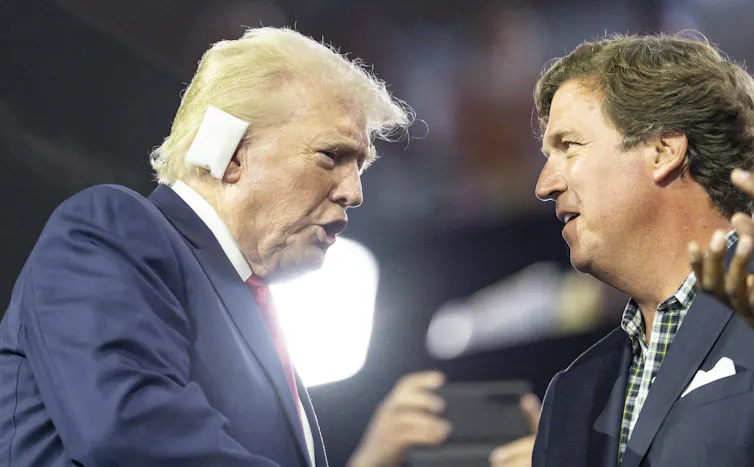
In a week when an attempt to assassinate Trump is once again headline news, we are reminded of Carlson’s take on a previous attempt on the US president’s life in 2024. Carlson had invoked “divine intervention” to explain Trump’s survival of that attempt, declaring “something bigger is going on here”.
At that point, the president had religious-right elites firmly on his side. This fervour has dissipated in recent times. But are Greene and Carlson representative of a broader problem for the Maga movement, or are they just a pair of high-profile defections and nothing more?
Putting ‘America first’
The grievances and concerns outlined by Greene and Carlson are real. When Trump ran for president in 2016, he broke with Republican orthodoxy by denouncing the Iraq war as a catastrophic mistake. He promised to extract the US from costly foreign wars and put America ahead of global policing commitments.
His first-term record was somewhat mixed, but the key takeaway was that no new major wars were initiated. On the 2024 campaign trail, Trump repeated these earlier pledges. He said he would end the Ukraine war within 24 hours and keep the US out of new conflicts. Trump has clearly reneged on these commitments.
The Iran war is broadly unpopular with the US electorate. Polls show that more people are against the war than support it. On average, 15% more people oppose than back it, and in some recent surveys that gap is even bigger, with up to 27% more people against than in favour. About 75% of US adults also now describe the economy, which is being affected by higher prices, as “very” or “somewhat” poor.
This dissatisfaction is visible among Republicans voters, though probably not to an extent that suggests support for Trump is in danger of imminent collapse. Recent polling by the Associated Press and NORC Center for Public Affairs Research indicates that, while dropping by 13 percentage points compared to a year ago, 38% of Republican voters still “strongly” approve of Trump’s presidency.
At the same time, there are some signs that Trump’s core Maga base remains largely steadfast in its support, despite the very vocal dissent from some. The same poll found that roughly 90% of Americans who self-identify as “Maga Republicans” approve of Trump’s overall job performance. Another survey by NBC suggests that 87% of these people currently approve of his handling of the war in Iran.
While these surveys are unlikely to capture the full range of sentiment within the Maga movement, they still indicate that Trump retains a solid core of support from members of this group. However, if the conflict drags on and economic pain deepens, the room for elite dissatisfaction to percolate down to the base is likely to widen.
Presidential ambitions
There may be other reasons explaining why Carlson, in particular, has broken with Trump. As Jason Zengerle, a journalist at the New Yorker magazine and the author of a biography of Carlson, put it recently when discussing Carlson’s reversal on Trump: “He’s also sort of making a political move.” Various media outlets have suggested that Carlson may be eyeing a 2028 presidential run.
Some commentators, including White House counterterrorism adviser Sebastian Gorka, have drawn parallels between Carlson and Pat Buchanan. In the 1990s, Buchanan challenged President George H.W. Bush over the Gulf war and reshaped the Republican party’s ideological trajectory even without winning its presidential nomination.
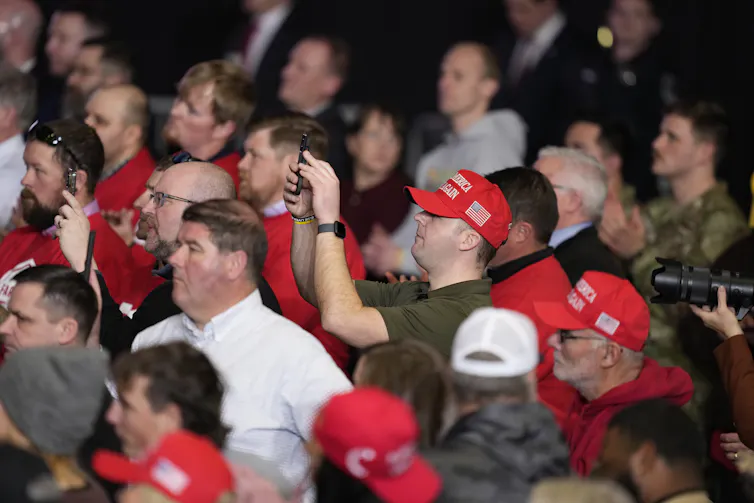
Greene has floated Carlson for president. In a social media post in March, she wrote: “I SUPPORT TUCKER. Trump doesn’t even know what Maga is anymore.” Carlson, for his part, has publicly dismissed a presidential bid.
But this rebranding exercise, of attempting to seize the Maga label from Trump and attach it to a new vessel, is a significant development. It suggests that “America first” is no longer exclusively synonymous with one figure.
The looming question is whether this seed of elite discontent can grow into something organisationally meaningful before 2028, when Americans elect their next president.





















Comments are closed.