


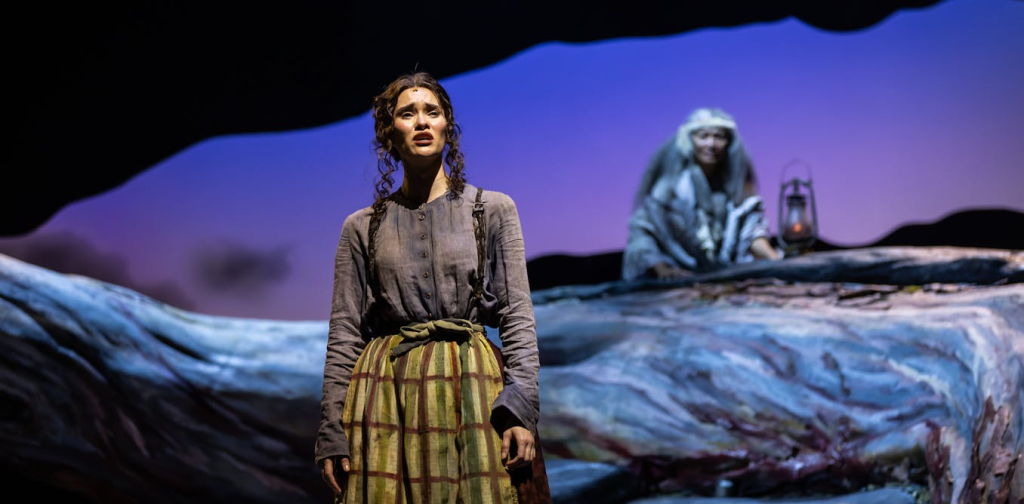

Leah Purcell has told the story of The Drover’s Wife across play, novel, film and now opera. Each form has extended its political and emotional reach.
In opera, where the text becomes sung, breath and silence are used and the sounds of the orchestra ripple from the pit, the story becomes even more heightened.



Henry Lawson’s short story, The Drover’s Wife (1892), revolves around a woman alone with her four children in an isolated shack while her husband is away droving. She sees a snake in the house and, after putting her children to bed, she waits with her dog for the snake to reappear. When the snake eventually emerges, it is quickly killed by the woman and the dog.
The story shows the struggles of a woman alone on an isolated property, and was delivered through a white male narrator. Purcell names the woman Molly Johnson, who eventually discovers her Aboriginal identity.
Directed by Purcell and composed by George Palmer, who collaborated on the libretto, this operatic staging centres on the hardships and traumas Molly experiences and the impact of colonialism on her identity and family.
The two of us experienced this opera as a powerful vehicle to tell truths about the history of this country. It invites all of us to hear this story anew.
Here, Ren writes as a Quandamooka researcher with connections to Wakka Wakka Country experiencing an opera for the first time, while Katelyn writes as a non-Indigenous researcher whose collaborative work with Indigenous musicians and background in classical music shape how she listens.
The possibilities of opera
Opera provides a new medium to tell this story. It also opens opera to new audiences who may not have imagined themselves within it.
Purcell’s adaptation challenges assumptions about whose stories are worthy of operatic retelling, and who opera is for. Through operatic voices, staging, costuming and dance, themes of birth, death, grief, motherhood and identity are interwoven powerfully alongside the often unspoken traumas of frontier violence.
The form itself opens new possibilities for truth telling.
Molly (Koa, Kuku Yalinji, Wakka Wakka soprano Nina Korbe) is a mother, fiercely protective and vulnerable, attempting to navigate the harsh environment of the Snowy Mountains.
Molly’s operatic vocal lines are not simply expressive and impressive, but also provide a reclamation and repositioning of narrative power.

Yadaka (Aboriginal and South Sea Islander performer Marcus Corowa) is an Aboriginal man on the run from the colonial authorities. He attempts to protect Molly from various dangers she encounters while alone at her isolated home.
Yadaka also carries cultural weight and emotional depth, counteracting the stereotypes and absence of Aboriginal men found in colonial literature by offering support and kindness to Molly.
Purcell’s portrayal of how colonial violence attempted to diminish the agency, strength and humanity of Aboriginal men is deeply confronting. Yadaka has a large chain around his neck and deep scars crisscross his back showing his experiences of colonial rule.
The operatic voices and orchestral lines heighten and add tension to the story, exposing the brutality of white men’s power and the everyday terror of living under colonialism.
Listening to Country
In this opera, Country is not a backdrop but is an active character. It is a sonic presence through the score. The orchestration evokes wind, earth and breath, reminding the audience Country is alive.
For Ren, this sonic portrayal of Country resonated as truth telling itself and as a living witness. For Katelyn, it required listening to hear the land differently.
The staging reflects the rugged Snowy Mountains and the surrounding skies. We are witnessing Molly’s Dreaming play out on stage.

At emotionally charged moments in the opera, six Indigenous dancers move across the stage in ways that deepen the atmosphere of memory, loss and connection to Country.
Choreographed by Yolanda Brown, these dancers are a physical expression of belonging to place. They represent the enduring presence of Molly’s ancestors, watching over and walking alongside her family.
Truths and traumas
The soaring operatic voices, spectacular staging, orchestration and the silences all highlight the truths and traumas of colonial violence. The telling includes stories of the rape and massacre of Indigenous people; stories that must be told.
Purcell’s The Drover’s Wife does more than adapt Lawson’s story through opera. It re-envisages it through a collaborative creation, re-centring Indigenous sovereignty and heightening the importance of the living presence of Country.
Ren found it an immersive way to experience this story, while also bringing up the trauma suffered by his ancestors during this period. For Katelyn, it demands a reckoning with colonial narratives and the responsibilities that come with hearing them differently.
In accepting the invitation to experience the story of The Drover’s Wife through opera, we become part of the story’s ongoing truth telling.
The Drover’s Wife, presented by QPAC in association with Opera Australia & Oombarra Productions, is at QPAC, Brisbane, until May 22, then will play in Sydney in August.











Comments are closed.