


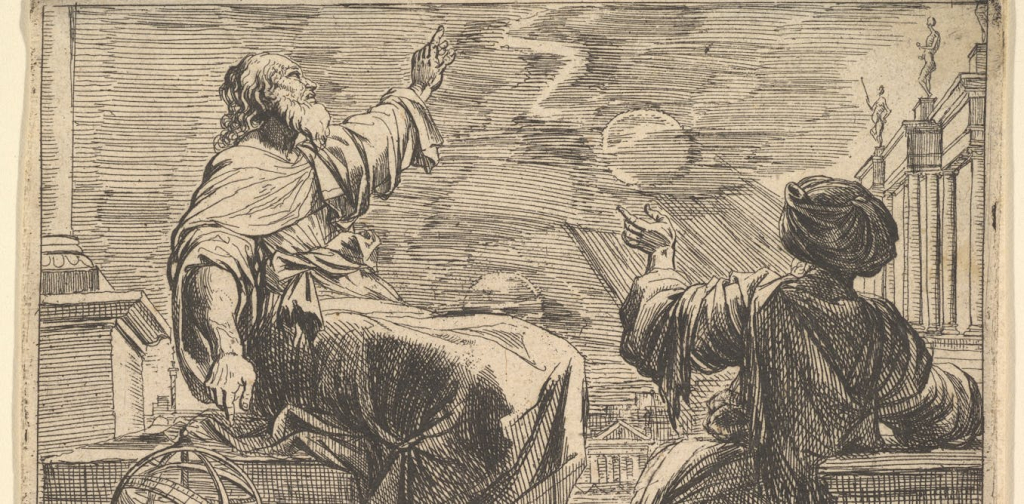

On August 12, Europe – in particular the Iberian peninsula – will look to the sky to witness a historic solar eclipse. We already know when it will begin, how long it will last, and what part of the sun will be hidden behind the moon. Apps on our phones allow us to calculate the exact moment of greatest darkness, and recommend the best places to see it.
But throughout much of human history, eclipses were far more than an astronomical curiosity. Indeed, they were thought to be powerful events, capable of reordering the world itself.




Ancient Rome was no exception to this, as the sun played a major role in its pre-Christian religion. While academics and ruling elites had inherited explanations from Greek astrology, eclipses – a word derived from the Greek meaning “disappearance of the sun” – were still interpreted as signals from the gods. In Rome’s religious society, they were closely followed.
These two worldviews – one scientific and empirical, the other superstitious – coexisted for centuries, offering a window on how the Romans understood the relationship between nature, religion and power. The synthesis of these ideas is still in use today, when we use the Latin-derived word “omen” to describe a sign that both foretells an event and tells us something about it.
It was Babylonian astronomers who discovered that eclipses were cyclical. Their methods for predicting them were inherited by the ancient Greeks, and then by the Romans. The Roman intellectuals Pliny the Elder and Seneca – in their respective works Natural History and Thyestes – theorised abut eclipses. Roman astronomy was thus anything but rudimentary – it built on a classical tradition that began in Homeric literature.
One notable example of Romans using astronomy came during the time of Emperor Claudius. The Roman historian Cassius Dio recounts that, prior to an eclipse on August 1 in the year AD45, the fourth emperor of the Julio-Claudian dynasty had the phenomenon publicly announced to prevent the population from succumbing to panic.
Evidently, the imperial authorities were aware that they could predict the eclipse, and of the deep fear that its ominous nature instilled in the population.
Read more: How eclipses were regarded as omens in the ancient world
Prodigia et metum: wonder and fear
While the Romans understood the astronomy behind eclipses, this did not preclude religious interpretations of them. For a Roman, the universe was ruled by the gods. A natural phenomenon could therefore have a physical cause while also conveying a divine message.
In The Life of Romulus, the historian Plutarch recounts how, in June 708BC, the death of Rome’s first king was accompanied by day turning into night. Perhaps for this reason, eclipses were often classified as prodigia – omens signalling a disruption of the balance between gods and men, which required a response from the state religion.
The works of the historian Livy are full of further examples. In 340BC, an eclipse coincided with a hailstorm, and the Senate decreed rituals to restore peace with the gods.
On July 17 in the year 188BC, another eclipse plunged Rome into darkness for nearly two hours. According to Livy, this caused such alarm that three days of purification were decreed on the sacred Aventine Hill.

Eclipses coinciding with periods of political crisis reinforced their ominous nature. During the years of Roman expansion into Macedonia, an eclipse was interpreted as a harbinger of the Greeks’ defeat at the Battle of Pydna in 168BC.
In 49BC, Cassius Dio mentioned a total solar eclipse amongst a series of omens that foretold misfortune for Rome. The impact was such that some magistrates even delayed taking up their posts, considering the timing to be unfavourable.
The politician and philosopher Cicero interpreted the partial solar eclipse of May 18, 63BC as a bad omen for his consulship that would begin that year
Eclipses even feature in the Bible. One famously followed Jesus’ death during the reign of Tiberius, the ultimate expression of the prodigia that came after the crucifixion.
In Rome, interest in eclipses lay not merely in the fact that they darkened the sky for a few minutes, but in the significance attributed to that darkness. The cosmos and history were part of the same order, and any disturbance in the heavens had to be properly interpreted. They believed that the future and salus (health and wellbeing) of the people and, above all, of the state depended to a large extent on how accurate these interpretations were.
Mentes hominum: ordinary people’s experience
The vast majority of the Roman population had never read Aristotle or Posidonius, nor did they have access to the works of Seneca or Pliny. Their experience of the eclipse was therefore very different. For them, the Sun – the guarantor of light, the calendar and daily routine – would just unexpectedly vanish in broad daylight. It was only natural to interpret that darkness as a fearsome cosmic disturbance.
There are records of superstitious popular beliefs that Rome inherited from other cultures. These included making noise by banging on pots and pans to help the Sun regain its light or to drive away the forces that seemed to threaten it by making it disappear from the sky. In this way, the people believed they were helping to ward off a phenomenon that disrupted the natural order and which, like all things unknown, caused fear and uncertainty.
Faced with the August eclipse, our own reaction will not be one of fear or unease. Nevertheless, when the eclipse on August 12 prompts us to look up at the sky, we can remember that the Romans also looked up at it. In doing so, they would have asked a question that astronomy could never answer: what are the gods trying to tell us by making the Sun disappear so suddenly?

A weekly e-mail in English featuring expertise from scholars and researchers. It provides an introduction to the diversity of research coming out of the continent and considers some of the key issues facing European countries. Get the newsletter!






















Comments are closed.