


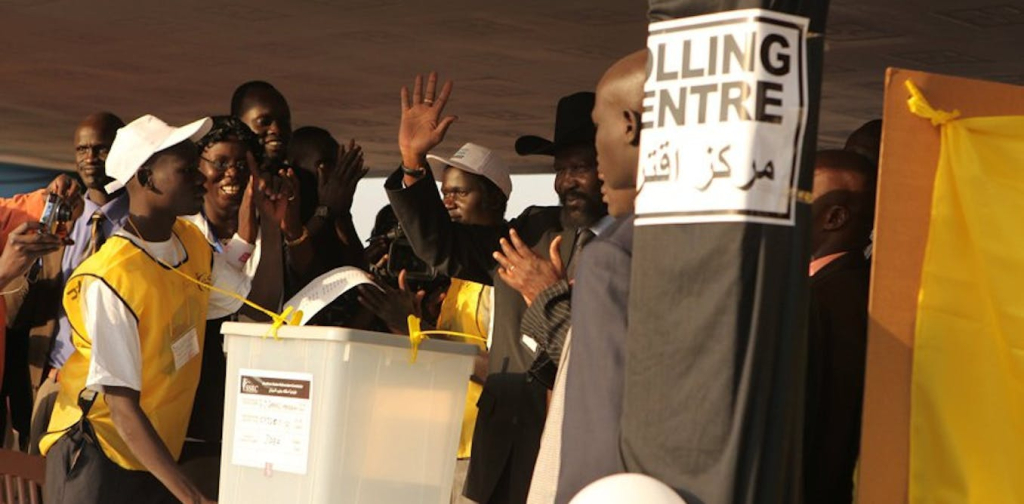

South Sudan is expected to hold an election on 22 December 2026, the first in the country’s history. It’s already been postponed twice, in 2022 and 2024.
A great deal is being said and written about whether or not there should be an election. But, having researched South Sudan’s post-war transition since the revitalised peace agreement was signed in 2018, I would argue that the real question is whether another extension would create the political conditions that previous delays failed to deliver.


South Sudan’s first national elections will almost certainly be imperfect. Few countries emerging from violent conflict hold flawless elections.
But another transition extension is even less likely to resolve the country’s underlying political problems. These include elite power struggles, weak institutions and unresolved security arrangements.
In my view, the transition has reached its limits. What’s needed to move ahead is a succession plan. Naming a running mate for President Salva Kiir could facilitate a political succession that would be less disruptive than an unplanned and sudden succession in the event that the transition gets prolonged again.
Unpreparedness is real
The National Election Commission announced the poll date six months in advance, as required by law. But neither the state of preparations nor the available funding made this look realistic.
Critics have warned that the country isn’t ready. Institutions remain weak. Insecurity persists across parts of the country and civic education is lacking. Cornerstones of the 2018 peace agreement – such as a permanent constitution and a joint army that integrates the armed opposition forces – aren’t in place.
The first vice-president – and potential presidential contender – Riek Machar remains detained and on trial for his role in armed fighting in Nasir, Upper Nile State, in March 2025.
Read more: Kiir and Machar: insights into South Sudan’s strongmen
Preparations are also falling behind. The current election law is flawed – for instance, it mistakenly provides for 105% of the seats in the national assembly – and voter registration hasn’t started.
The election commission has also decided to reuse the constituencies from Sudan’s 2010 elections. This has prompted legal objections that these boundaries don’t reflect reality in an independent South Sudan.
Unfinished business
The signing of the peace agreement in 2018 established a fragile power-sharing arrangement. It brought the country’s warring parties into a transitional government of national unity. General elections were intended to conclude the transition period.
Each extension was justified by the promise that additional time would allow completion of the key transitional tasks. That never happened. There is little reason to believe that another two or three years would produce a different outcome.
Read more: South Sudan at 15: how the political elite have found a way to profit from peace as well as war
The biggest gaps in South Sudan at the moment are these:
-
Constitution-making remains politically contested. South Sudan still operates under a transitional constitution from 2011. It largely reflects arrangements inherited from the pre-independence period. A permanent constitution is expected to define matters like the distribution of political power, the relationship between national and state authorities, the role of customary law, and how the country’s diversity is represented in the political system.
-
Security sector reform has made only limited progress. A central provision of the peace agreement is the integration of government forces, the opposition and other armed groups into a unified military force. The aim is to reduce the risk of renewed conflict.
-
Transitional justice processes haven’t started. These mechanisms are intended to investigate crimes committed during South Sudan’s civil war, and provide accountability and reconciliation. Senior political and military figures responsible for implementing these provisions could themselves become subjects of investigation. If indicted by the courts, they would be barred from holding public office. There has, therefore, been little political appetite to establish the processes.
The transition has turned into the main obstacle for these tasks to be completed. An election would make it possible to get on with the tasks by giving someone the authority.
The existing gaps have left the door open to unhelpful developments. The worst is the reproduction of kleptocratic and authoritarian structures.
The case for an election
One of South Sudan’s biggest challenges could be resolved by an election: the question of political succession in the executive.
The question looms large over South Sudan. Whether elections are held or postponed, it’s likely to be a source of political disruption.
Kiir has dominated South(ern) Sudanese politics for more than 20 years. Who could succeed him if he were no longer able to continue?
The transitional framework offers remarkably little certainty on this. Formally, the ruling party would need to name a successor. Nobody has been earmarked. Were succession to become an immediate political issue, the most likely consequence would be violent infighting within the ruling party.
Elections offer something that another extension cannot. They can force the ruling party – which, according to available political perception data, has a good chance to win both presidential and parliamentary elections even without rigging – to clarify the succession issue.
A presidential election would require the governing party to nominate a presidential candidate and a vice-presidential candidate endorsed by Kiir and party organs. Whoever occupies the vice-president position would be the leading and legitimised candidate to succeed should the presidency unexpectedly become vacant.
This does not eliminate political competition. It provides a far clearer and more legitimate succession pathway than the current transitional arrangements.
Those arguing against a poll being held point to the dangers of electoral violence. Election-related violence is a genuine risk. But postponing elections doesn’t necessarily reduce such risk.
Extending the transition again would instead deepen political uncertainty.
Perhaps the strongest argument for elections, however, comes from South Sudanese citizens themselves.
Nationwide survey research shows that around four in five South Sudanese support holding elections, even though most also recognise that violence remains a serious possibility.
This finding deserves greater attention than it usually receives. If most South Sudanese want elections, on what basis should political elites or international partners argue that they should wait?
What needs to be done
None of this means that elections can simply proceed. The financial, legal and practical preparation challenges are severe and will not be resolved overnight. An inter-party dialogue preparing the political ground for elections is a useful initiative. But this is unlikely to resolve the tensions with the main opposition forces behind Machar.
Recent suggestions by international partners like the European Union to discuss a short technical extension – for instance to March or April 2027 – or to hold executive and legislative elections separately are reasonable. But an indefinite postponement won’t lead the country anywhere.













Comments are closed.