


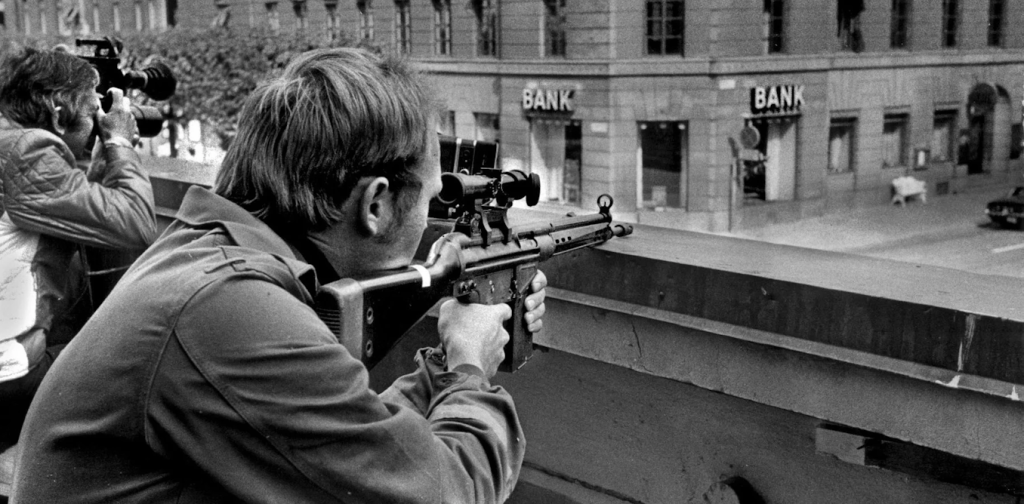

Fifty-three years ago, convicted criminal Jan-Erik Olsson walked into a bank on Norrmalmstorg, a square in central Stockholm, pulled a submachine gun from under his jacket and fired at the ceiling. Concrete and glass rained down. “The party has just begun!” he shouted in a fake American accent, before taking four bank employees hostage.
Olsson demanded 3 million Swedish kronor, access to a getaway car, and the release of Clark Olofsson, a man he’d befriended in prison. The police met these demands, including supplying a full tank of petrol for the getaway car, but Olsson still refused to release the hostages or leave the bank.



As the days wore on, something unexpected happened. Rather than fearing their captors, the hostages – who were held in one of the bank’s vaults – appeared to develop positive feelings towards them. They even pleaded with the police not to harm the hostage takers.

Nils Bejerot, a psychiatrist who advised police during the crisis, coined the term “Norrmalmstorg syndrome” to describe what he saw as the hostages’ unusual reactions. It is notable that Bejerot never interviewed any of the hostages.
Internationally, the term became known as Stockholm syndrome.
However, Stockholm syndrome has never been formally recognised as a psychiatric diagnosis. It doesn’t appear in any of the main diagnostic manuals used internationally by psychiatrists.
Despite this, the term is now widely used to describe situations in which people held hostage, kidnapped or subjected to abuse appear to develop positive feelings towards the person threatening them. They may even seem to side with their captor or resist attempts to rescue them.
Researchers have described several forms of behaviour that can be associated with this response. Captives may have an opportunity to escape but choose not to take it. They may distrust or become hostile toward rescuers and others outside. Small acts of kindness from their captors can take on enormous significance. And they may go out of their way to follow orders to keep their captors happy.
Not irrational
But labelling this behaviour a syndrome can be misleading. These are people responding to an extreme threat. What might look like an irrational attachment from the outside can make sense as a survival strategy. If keeping captors calm, happy or sympathetic reduces the risk of being harmed, then adapting your behaviour in this way may be a perfectly understandable response to danger.
In fact, some of the strategies used by hostages may resemble those deliberately used by police negotiators during hostage situations. Negotiators try to establish a relationship with the hostage taker and build trust, because this can give them greater influence over the person’s behaviour and help secure the hostages’ release.
Research has suggested that captives may adopt similar strategies, trying to establish a relationship with their captor as a way of making themselves safer. This is one reason psychologists are wary of treating this response as evidence of something abnormal.
People who survive trauma don’t always behave in ways outsiders expect. But unexpected behaviour is not necessarily pathological. Instead, it is more useful to ask what purpose the behaviour served for the person experiencing it.
During captivity, for example, trying to please a captor might lead to more food, water, warmth, comfort or medical care. In an abusive relationship, keeping an abuser calm may reduce the immediate risk of violence. The behaviour can therefore serve a protective function, even if it looks strange or contradictory to someone observing from the outside.
Calling this a syndrome can also make a survivor feel that their response is abnormal or irrational. It shifts attention away from the circumstances that produced the behaviour in the first place.
This is why some researchers have argued that the term should be replaced with something that better captures what is happening. One suggestion is “appeasement” – the idea that people may appear emotionally connected to their captors because they are trying to calm them in a life-threatening situation.
Seen this way, the apparent bond between victim and perpetrator is not necessarily contradictory. If appearing loyal, affectionate or compliant makes a dangerous person less likely to cause harm, it may be an entirely rational response to an irrational situation.
More than half a century on, Bejerot’s term has outlived its usefulness. Scrapping the term could change how survivors are understood by police, courts and doctors who may otherwise interpret their behaviour through the lens of a “syndrome” that was never a recognised diagnosis.


















Comments are closed.