


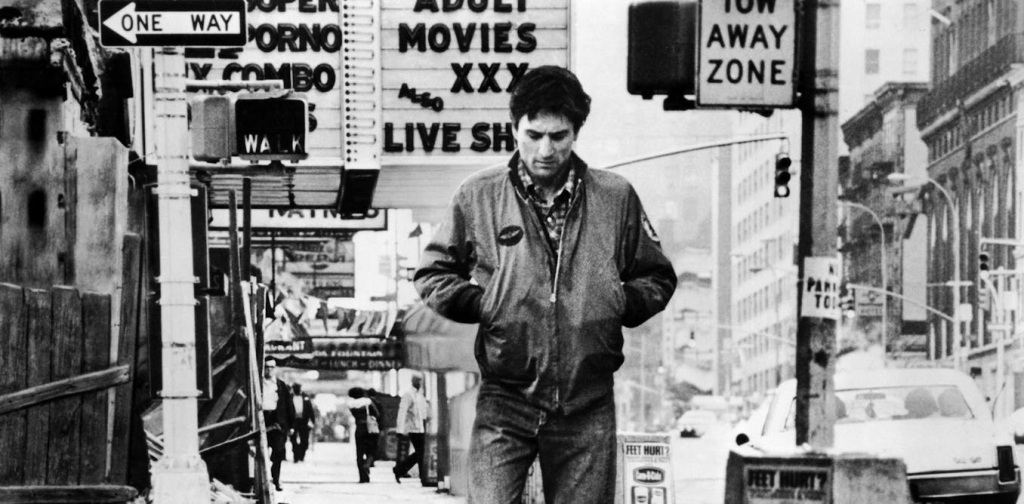

As plumes of steam rise and dissipate from the grates of New York in the opening frames of Taxi Driver, we see the unsettled brown eyes of Travis Bickle, played by Robert De Niro in a career-defining role.
The second of Martin Scorsese’s successful collaborations with De Niro, the pair went on to make another eight feature films. Scorsese was a new breed of director, pushing the boundaries of “New Hollywood” – an era that broke the rules of the studio system to produce something rawer, darker and willing to explore the underbelly of the American dream. This kind of filmmaking was more in tune with the depressed 1970s than the upbeat films of an earlier decade.



For several years now, as part of my America on Film module, I have been teaching Taxi Driver, released in the UK 50 years ago in 1976. The course aims to show how film represents American history. Taxi Driver is an excellent example, and one that students continue to respond to in interesting ways.
This was the year of the presidential election, pitting the replacement for the disgraced Richard Nixon, Republican Gerald Ford, against the Democratic peanut farmer from Georgia, Jimmy Carter.
The Vietnam war was still reverberating and the US was demoralised and disillusioned by the My Lai massacre, the revelation of the Pentagon Papers, the Watergate break-in and cover-up, and the subsequent resignation of Nixon. Paranoia was high. The enemy was no longer just external – this was a period of thawing of relations in the cold war – but within.
There was a flourishing of paranoid conspiracy thrillers like All the President’s Men, Klute, Three Days of the Condor and The Parallax View, which Taxi Driver taps into. Its nocturnal and hallucinatory quality makes us ask whether any of this is actually real or just happening inside Bickle’s head.
Although the US had withdrawn from Vietnam three years earlier, that conflict was still at the front of American minds. Saigon fell in 1975, reuniting the country and signalling the utter failure of imperialist US policy there.
Bickle’s masculinity mixed the American mythology of violence with the look of the Mohawk. By making him a Vietnam veteran, the film put those issues front and centre, as well as the issues vets faced after they came home: loneliness, alienation and PTSD. Taxi Driver belongs to that genre of the returning Vietnam war vet.
It preserves in amber a 1970s New York far removed from the Disneyfied streets of today’s city, revealing a Times Square once filled with peep shows, pimps, prostitutes and hustlers. De-industrialised and dilapidated, the city was close to bankruptcy; crime was rife, drugs and rubbish were everywhere, its economy stagnated.
New York City was a very dangerous place to be, full of racism and misogyny, a biblical Sodom and Gomorrah. The chaos, crime, corruption and moral decay appal Bickle. As he notes in his diary: “All the animals come out at night: whores, skunk pussies, buggers, queens, fairies, dopers, junkies – sick, venal.” When he writes, “someday, a real rain will come and wash all this scum off the streets,” he dreams of a flood-like vengeance and justice.
De Niro becomes an icon
Taxi Driver was not De Niro’s first major screen role, nor was he Scorsese’s first choice – Harvey Keitel was, but he turned it down to play pimp Sport Higgins in the film instead. Still, it capped a trilogy of films that cemented De Niro’s reputation in Hollywood, that included Mean Streets and The Godfather Part II.
A method actor, De Niro prepared intensely for the role, spending weeks driving a cab in New York City before the shoot. Together with the earlier Mean Streets, it helped shape De Niro’s onscreen persona as a tough streetfighter and gangster in films such as Raging Bull, Goodfellas, Cape Fear and Casino. His later roles in Analyze This and Meet the Parents parody this persona.
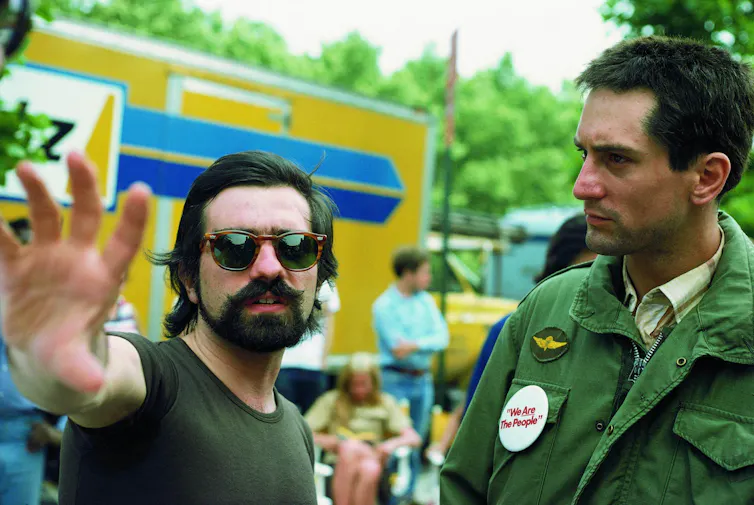
Bickle’s physical transformation prefigures the beefier, hypermasculine antiheroes of the 1980s. Although he begins to work out obsessively, he remains rail-thin, physically distinctive from the stars of the Reagan era such as Arnold Schwarzenegger and Sylvester Stallone.
Keitel, Jodie Foster and Cybil Shepherd also starred. Screenwriter Paul Schrader infused it with his own life experiences and the thoughts of writers Fyodor Dostoyevsky, Jean-Paul Sartre, and Albert Camus. Hitchcock favourite Bernard Herrmann composed the musical score, completing it only hours before he died.
Taxi Driver’s legacy
The movie chimed with the zeitgeist, receiving four Academy Award nominations and winning the Palme d’Or at the 1976 Cannes film festival. Beyond the critics, Bickle became the embodiment of a resentful, angry, self-loathing, socially inept young man with a dangerous saviour complex.
One of them, John Hinckley, became obsessed with the film, began stalking Foster, and attempted to assassinate President Ronald Reagan in 1981 in a bid to get her attention.
Scenes and lines from the film have become iconic. For film scholar Amy Taubin, the improvised line: “You talkin’ to me?” became “arguably the most quoted scene in movie history”. Consider Vincent Cassel mimicking it (in French) in La Haine in 1995: “C’est à moi que tu parles?”
Fight Club (1999) is a modern remake of Taxi Driver, featuring another method actor, Edward Norton, another decidedly unreliable narrator who also has trouble sleeping. Bickle also inspired the titular character of Joker in 2019.
If made today, though, it would be called Uber Driver. But then, most likely, Travis Bickle would be immersed in the online and misogynistic manosphere of mixed martial arts and Maga, admiring figures like Andrew Tate and being an avid keyboard warrior rather than going out into the urban jungle.
He’d be deep into Pornhub rather than the adult cinema Bickle takes Betsy to. He’d have access to an AR-15 semi-automatic rifle. Speaking about Taxi Driver earlier this year, screenwriter Schrader reflected on men like Bickle: “We call them incels now.”





















Comments are closed.