


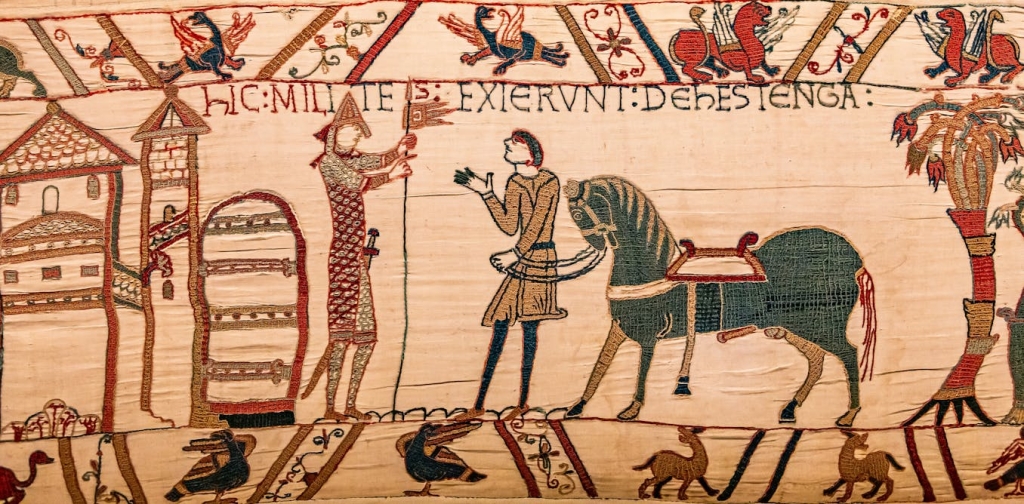

The Bayeux tapestry is many things: a public statement, a massive work of collaborative art, a staple of the teaching of British history. The 70-metre-embroidered cloth depicts the events of the Norman conquest, culminating in the 1066 Battle of Hastings and the death of Harold II.
Since its creation in the 11th century, the Bayeux tapestry has loomed large in English history and shaped the way we think about the events of 1066. However, the tapestry is other things too.



First, it is not actually a tapestry, but an embroidery. The images on the cloth are not woven into it, but worked in crewel threads (worsted wool yarn – crewel is the old Welsh word for wool) on top of a piece of linen.
We should use the correct terminology if we are going to place this piece into its rightful place in the history of women’s creative labour and especially embroidery. Embroidery may be typically considered a solo pursuit of little political importance but this is not the case, as the Bayeux creation clearly shows.
As someone who researches comics, war and violence, I see the Bayeux embroidery as a prime example of the importance of visual narratives for political myth-making and nation-building.
Needlework as historical record
The Bayeux tapestry was, according to historian George Wingfield Digby, “designed to tell a story to a largely non-literate public; it is like a strip cartoon, racy, emphatic, colourful, with a good deal of blood and thunder and some ribaldry”. It is certainly racy – there are 93 visible penises, most of them belonging to horses.
There are many other works from across the world that tell similar stories in this way. For example, Trajan’s column in Rome, completed in 113 CE, is a 30-metre-tall marble column, topped with a statue of St Peter. It features a 190m spiralling frieze that tells the story of the Roman-Dacian Wars (101-102 CE and 105-106 CE). An impressive monument to military prowess, it demands no deep understanding of Latin and the story it tells cuts across the territories of Rome and her trading partners.
We see this in the modern world too: IKEA flat pack instructions, NHS guidance for people taking medication and aeroplane safety leaflets all work in the same way. Pictures – therefore comics – are used to convey universal information.
But how does this connect to women’s creative practice and embroidery? In my previous research, I looked at the way in which needlework and comics come together. Currently I’m researching comics reading methods in narrative needlework.
How can thinking about comics as a reading method open up useful ways to engage with needlework texts? Using needlework as a way to construct one’s own story and create a tangible record of events – especially in times of trauma – has a long and storied history.
Consider the creation of arpilleras in Chile during the military dictatorship under General Pinochet (1973-1990) – burlap pieces created out of scraps of cloth that memorialise the “disappeared”. Or the Hmong story cloths, colourful embroideries made during the Laotian civil war (also known as the “secret war”, 1959-1975), now seen as important cultural and historical artefacts, especially in Hmong diaspora communities.
Though these two examples are not as widely known or recognisable as the Bayeux tapestry, they have a similar purpose. They pictorialise particular episodes in a history of significant events, choosing what we remember, while excluding other parts of the story.
What is particularly interesting is that these modern works, though separated by time and geography, are giving voice to those who do not have access to mainstream channels. These works are created out of defiance and a need to creative a narrative for their story and to remember those who have been lost.
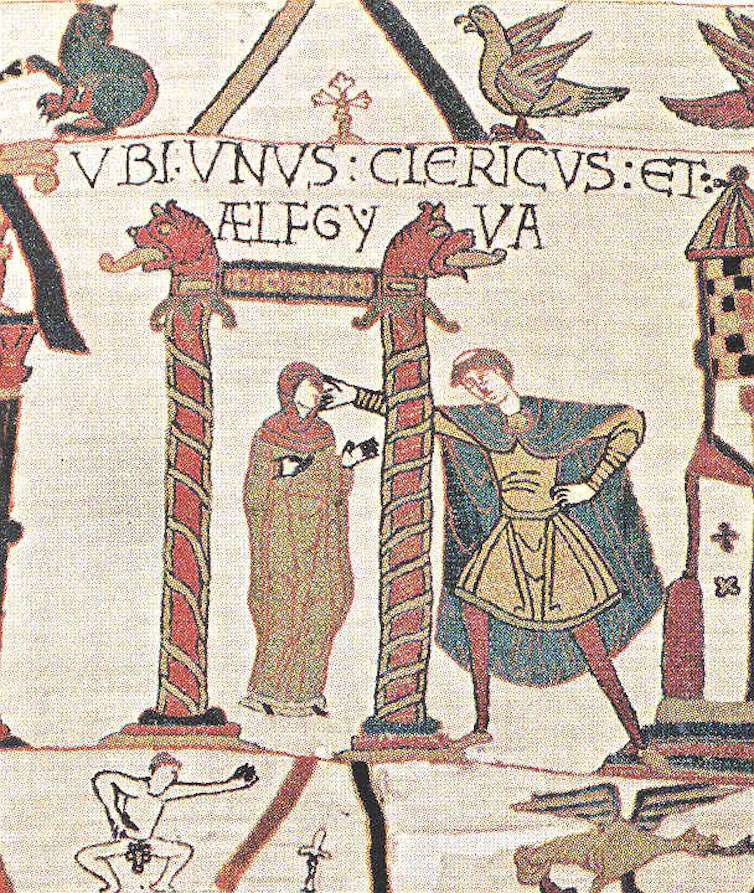
While the Bayeux tapestry was created as a narrative of victory, it was still created by women who would have had very little voice in their own communities and whose labour sits in the background of the work itself. The work of the women who embroidered the greatness of William I could be seen as the creative precursor of that of the women who embroidered their murdered loved ones in Chile and Laos.
The women who stitched the Bayeux tapestry in the late 11th century knew that pictures were a marvellous vehicle for narrative and this remains true today. Though they did not have creative control over the story, we see the touches of their creativity and humour throughout the piece itself.
Centuries later, their crafting sisters in Chile and Laos took up their needles to tell stories that only they could, becoming fully the creators of pictorial memories, making visual the violences that still mark our history.
Comics is not just superheroes and spandex; it can be public art, telling public stories. And if we widen the definition just a little bit, there are many more stories waiting to be discovered.
















Comments are closed.