


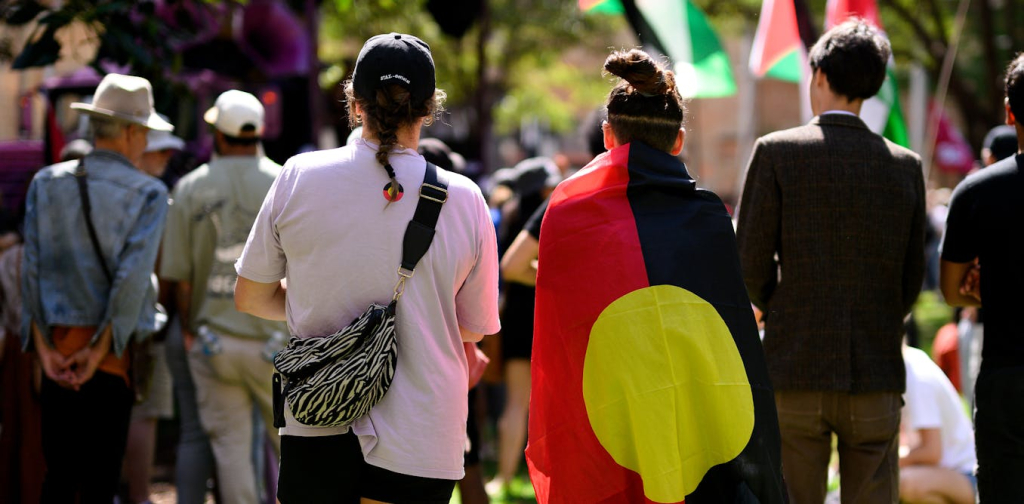

This article contains references to and the names of people who are now deceased.
Australia’s latest homicide data lay bare a grim reality for Indigenous women: lethal domestic violence is not abating.



The Australian Institute of Criminology’s report confirms what communities have long known – Aboriginal and Torres Strait Islander women are killed at rates up to six times higher than non-Indigenous women, overwhelmingly by intimate partners (76%) or family members.
Just eight weeks into 2026, four more Indigenous women have died violently in such circumstances, including the devastating Lake Cargelligo killings of Sophie Quinn along with her unborn child, “baby Troy”, her partner and her aunt, Nerida Quinn.
For grieving families, the questions are raw: are we just another statistic? Will there be justice? And what does justice even mean?
Over-representation is entrenched
The institute’s National Homicide Monitoring Program offers a stark longitudinal picture: 574 Indigenous women killed from 1989 to 2025, with at least two-thirds killed by an intimate partner (based on reports from previous years). There’s no significant downward trend.
Since the institute began tracking the victimisation rate in 2011, Indigenous women have remained far more likely to be killed than non-Indigenous women.
Yet as the 2024 Senate Inquiry into Missing and Murdered First Nations Women and Children found, quantitative data alone do not translate to justice. Systemic racism in policing, inadequate investigations and “woefully inaccurate” records compound the loss families experience.
The Lake Cargelligo case exemplifies this crisis. The alleged shooter, Julian Ingram – Sophie Quinn’s former partner – remains at large after the deaths of Sophie, her unborn child, her aunt and her partner. The community is in both fear and mourning.
Media fixation on the manhunt often eclipses the brunt of the devastation. Sophie and Nerida were daughters, mothers, aunties and kin. John Harris was a brother, son and partner. They were not just abstract victims.
A fragmented system
Beyond the killings, families face a labyrinthine aftermath. There’s no single agency to guide them through criminal processes, trials (if it gets that far), coronial inquests, death reviews, media scrutiny and social media storms.
Fragmented services – such as state-based victim support to time-limited counselling – demand families navigate complicated systems largely on their own when they are most vulnerable.
Coronial processes are often criticised as culturally unsafe and re-traumatising. These can take place after criminal proceedings, sometimes years later, and can prolong trauma.
Indigenous families report feeling the stories of their loved ones being silenced or stigmatised, or only partial narratives being shared. These public versions can clash with the memories they have of their loved ones.
In New Zealand, the Family Violence Death Review Committee has advocated a “super-advocate” model with dedicated cultural support.
Here in Australia, even landmark inquests into Indigenous women’s deaths yield slow government responses, or none at all, leaving families to contest public stories alone.
Public discourse often reduces Indigenous women to pathology or risk, disregarding the kinship webs that defined them as loving and valued members of our communities. They deserve to be honoured as so many other Australian women have been: through dignified memorials, public acknowledgement and stories of their full humanity.
But sadly, as First Nations women, we are not. Without a mandated advocate to shield families and centre Indigenous accounts through the aftermath of a homicide, grief becomes a rollercoaster of conflicting portrayals.

Narrative sovereignty means Indigenous families hold the reins on the stories told about their loved ones. This allows First Nations people to craft, share and protect their people with the respect and ethical care kinship demands.
A dedicated “holding agency”, activated immediately upon a death, would provide a mechanism for this.
While the NZ model does not specifically state this, an Australian model could field media requests, coach families on securing social media accounts against trolls and speculation, and curate all public messaging on the family’s terms and timeline.
This isn’t just public relations. It’s trauma-informed stewardship that safeguards physical safety, honours grief’s nonlinear pace and ensures these women are never reduced to clickbait.
Words need action
There is progress being made, albeit slowly. The newly released National Aboriginal and Torres Strait Islander Plan to End Family, Domestic and Sexual Violence is a crucial step forward.
Called “Our Ways, Strong Ways, Our Voices”, it explicitly honours our missing and murdered women and children, and commits to supporting their families through culturally grounded, community-led responses.
Yet until an action plan emerges to translate this intent into resourced, measurable steps, these remain powerful words on a page, at risk of joining the shelf of unfulfilled commitments alongside the Senate inquiry’s “toothless” recommendations.
For too many Indigenous families, justice has come to mean a perpetrator’s arrest and conviction – if that even happens – followed by a coronial finding filed away. There’s no restoration for the community rupture or protection for those still at risk.
It’s a narrow, carceral lens that measures success by court outcomes, not by whether the Quinn family or the Lake Cargelligo community as a whole can heal or feel safer.
Another round of inquiries, such as the petition calling for a Royal Commission into the killing of Australian women and girls, simply kicks the can down the road.
Indigenous women need action now. We cannot wait while others debate process when we’ve already endured countless reviews without meaningful change.
True justice would honour culturally-led healing. It would allow Indigenous families to tell their own stories and break cycles before another mother and unborn child is lost.
Governments must urgently develop and fund an action plan to support Our Ways, Strong Ways, Our Voices. They should also look at how else to support Indigenous families when they’re affected by death and violence.
The homicide data and Senate findings are not endpoints, but calls to action. We must honour these women by ensuring justice means safety, accountability and dignity for those who remain. Until then, families’ questions will be left unanswered, and the statistics will climb.
13YARN is a free and confidential 24/7 national crisis support line for Aboriginal and Torres Strait Islander people who are feeling overwhelmed or having difficulty coping. Call 13 92 76.













Comments are closed.