


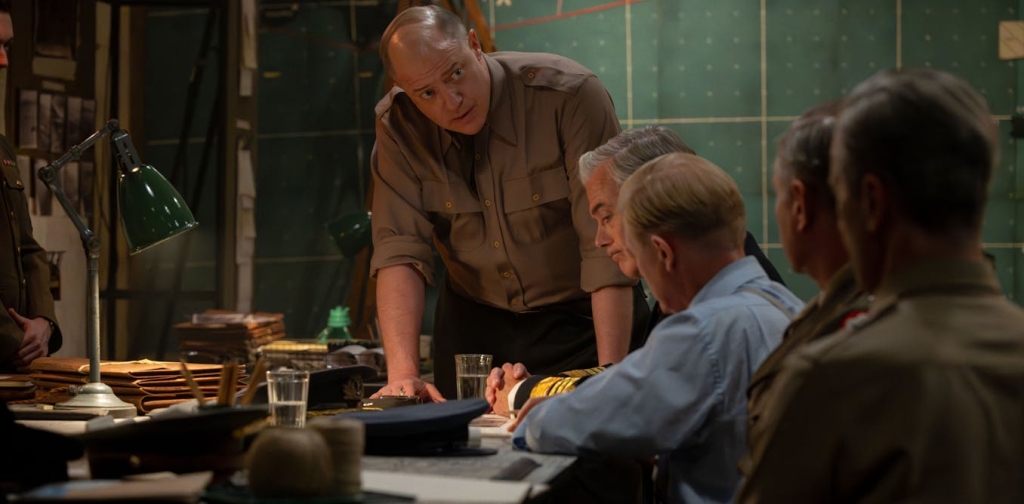

Meteorologist James Stagg gave what many regard as the most important weather forecast in history in June 1944. The fate of more than 150,000 allied troops preparing to invade the Normandy beaches on D-day and the future of the war in Europe depended on Stagg and his forecast teams. Get the forecast wrong and an already perilous invasion might not succeed, prolonging the war. In the briefing room in Southwick House near Portsmouth, waiting for the forecast, sat General Dwight D. Eisenhower.
More than 80 years later, the new film Pressure renews interest in Stagg’s forecast. Seeing a meteorologist as the hero of a new wartime blockbuster is a bit of a thrill for anyone who spends their life studying weather and climate like we do. It also gives us a great opportunity to ask whether today’s modern forecasting systems would have got the D-day forecast right.



To explore this, our new research combined newly digitised historical weather observations, modern weather science and an AI forecasting system to recreate the forecasting challenge faced by Stagg and his teams.
The answer is surprisingly nuanced. Modern AI forecasts would probably have supported the decision to delay the invasion on June 5, but would also have underestimated the severity of conditions of June 6. Even with today’s forecasting technology, D-day would not have been an easy call.
All weather predictions begin from knowledge of the current state of the atmosphere and one theme in the film is the crucial role observations played in the forecasts. Surprisingly, modern scientists have fewer observations available to us than Stagg did at the time. This is because many of those observations have not been transformed from the paper records into digital data, although progress is being made. Making this data accessible to all is vastly enhancing our knowledge of past weather and climate.
Combining the observational data with state-of-the-art weather forecasting models using a technique called data assimilation enables us to produce a comprehensive picture of weather conditions around the D-day landings.
Had weather satellites and modern weather forecasting models been available during the second world war, Stagg and his forecast teams would have questioned how the low-pressure system in the North Sea would develop. They would have also asked whether the cloud cover associated with its weather fronts might scupper any chance of a successful landing.

While it’s impossible to reproduce the tension that Stagg faced, we can try to recreate the weather forecasts he was trying to produce. The film shows two teams using radically different techniques to predict the weather on June 5-6.
The first team (actually an amalgamation of two real-life teams led by Sverre Pettersen and Geoffrey Wolfe) focused on the physical development of weather systems. The other forecast team, led by American meteorologist Irving Krick, found past examples of similar weather conditions and based their predictions that the future would develop in the same way.
Stagg had to combine these often contradictory forecasts to produce simple guidance for Eisenhower.
Meteorological progress
This mirrors the development of meteorology over the 20th century and debates about how best to forecast the weather today. The forecasts on our mobile phone apps come from detailed physical models of the atmosphere run on large supercomputers. They stem from the ideas that Pettersen and his teams were using.
These models have transformed since the 1980s. Our ability to predict large-scale weather patterns has improved consistently by one day per decade ever since.
In 1963, American meteorologist Ed Lorenz discovered that the atmosphere is a chaotic system and explained why weather forecasting is so fiendishly difficult. Making multiple forecasts every day, an ensemble forecast, has allowed us to anticipate the likelihood of a range of different possible futures.
What hadn’t been anticipated, at least not a decade ago, is that these methods might be challenged by ideas similar to those used by Krick and his team. There are now more than a dozen weather forecast models which use AI to make predictions. In essence, these are also analogue forecasts. A neural network is trained to recognise patterns present in more than 40 years of observed weather maps and then make predictions based on how those patterns evolved in the past.
Our new study tested how one of these models, the artificial intelligence forecasting system (AIFS) developed by the European Centre for Medium Range Weather Forecasts might fare when challenged with the D-day forecasts.
We produced a series of forecasts leading up to D-day, recreating the critical forecast briefings shown in the film. While AIFS captured the storm in the North Sea shown in the recreated satellite picture above, we were surprised by the level of uncertainty still present in forecasts for the Normandy beaches.
The storm which affected the early part of the landings, moved more quickly through the North Sea in those forecasts than in reality. Even if Stagg and his teams had been able to see these forecasts, the complexity of the challenge stood out. Would he still have advised Eisenhower to proceed on June 6 given forecasts on June 5 which showed a 30% chance of strong winds for the beaches and significant cloud cover?
While the future for weather forecasting might involve a mix of both physical and AI models, the role of a human expert in interpreting and challenging those forecasts is critical. The technical tools available to the modern forecaster would have been unimaginable to Stagg. Yet someone like Eisenhower still needs the experience and intuition of an expert to interpret forecasts of extreme weather.

















Comments are closed.