


Russia’s full-scale invasion of Ukraine in February 2022 sparked the most significant military conflict in Europe’s post-Second World War history. While European public opinion is overwhelmingly pro-Ukrainian, significant segments of Europe’s population hold ambivalent or even outright pro-Russian positions. As public support is key to providing military and financial assistance to Ukraine, we wanted to understand why some Europeans are sympathetic to the aggressor.
Our study considers that pro-Kremlin positions could come from four main sources:



-
Economic interests
-
Ideology
-
Partisan alignment
-
Disinformation
We analysed data from two academic surveys from late 2023, spanning nearly 30,000 respondents and eighteen European countries.
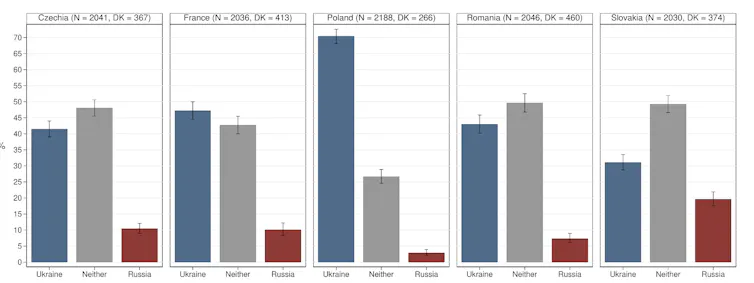
The surveys asked respondents whom they considered responsible for the war and whom they wanted to win. In practice, answers to those two questions are strongly correlated, and vary substantially across countries. For example, support for a Russian victory is virtually absent in Poland, but approaches 20% in Slovakia.
Partisan alignment and disinformation
Our statistical analyses indicate that the strongest predictor of Europeans’ position on the war in Ukraine is the proximity of respondents’ preferred political party to the Kremlin.
The closer a party’s ties, as assessed by academic experts from the CHES project, the more likely its supporters are to favour Russia over Ukraine.
While the data does not allow us to fully determine the underlying mechanism, the results suggest that partisan alignment is the most likely explanation. Those who support Russia do not care too much about the war, but they align with their preferred party’s rhetoric.
The second strongest correlate of Kremlin-aligned narratives is exposure and vulnerability to disinformation.
Pro-Russian views are over-represented among those who consume alternative channels for political news and believe in conspiracy theories. For example, those who mainly consume political news from social media and messaging applications and subscribe to the view that the Covid-19 pandemic was orchestrated by national governments, are 40% less likely to wish for Ukraine’s victory compared to those who consume traditional media and do not believe in conspiracy theories.
The third, though weaker, source of pro-Russian attitudes is ideology: cultural conservatism and authoritarianism.
Respondents who favour strong leaders and question minority rights are more likely to sympathise with the Kremlin. By contrast, economic interests exert little to no effect. Despite fears among analysts that rising energy costs in the aftermath of the invasion could sway public opinion against Ukraine, those who report having suffered during the energy crisis are not more likely to support the Kremlin.
The need to moderate public discourse and combat disinformation
Our results highlight the importance of top-down processes, whereby pro-Russian attitudes primarily reflect signals shared by pro-Kremlin politicians and disinformation spread by alternative sources of political news.
Much of the surprising support for the aggressor does not seem to stem from some ideological affinity or economic interests, but from the information and interpretation that circulates within political systems.
Countering Russia’s influence thus requires assertive moderation of public discourse and robust efforts to combat disinformation. These imperatives contrast with governments’ attitudes in many EU member states.
For example, the current Andrej Babiš’s cabinet in the Czech Republic has renounced any anti-disinformation measures.
In Slovakia, Prime Minister Robert Fico has echoed pro-Russian narratives himself.
These examples highlight a central challenge: efforts to counter disinformation are ultimately constrained by domestic political incentives.
Where political elites amplify or tolerate pro-Kremlin narratives, public attitudes are likely to follow. Strengthening resilience to disinformation ultimately depends on political leadership that is committed to defending the integrity of the information environment.
This article is published on behalf of all the authors of the original study: Filip Kostelka, Martín Alberdi, Max Bradley, Toine Fiselier, Alexandra Jabbour, Nahla Mansour, Eleonora Minaeva, Silvia Porciuleanu, and Diana Rafailova.





















Comments are closed.