




Israel has been building settlements in the occupied West Bank for decades. But Britain’s new ban on the import of settlement goods comes in a response to a major escalation in construction over the past four years, which an International Court of Justice advisory opinion in 2024 concluded is illegal and must stop.
Most striking are recent steps to build a new settlement bloc known as E1 on the outskirts of Jerusalem. First planned as long ago as 1999, but progressing significantly over the past year or so, the E1 bloc would mark a major change to the geography of the West Bank.



Current plans allow for thousands of housing units in the settlement, as well as commercial properties and regional services. The project would establish a new urban area that would connect the large settlement of Maale Adumim with East Jerusalem.
The international community has long seen the construction of E1 as a red line for three main reasons. First, it would isolate East Jerusalem from the rest of the West Bank, including major Palestinian cities like Ramallah and Bethlehem. This matters because East Jerusalem is the proposed capital of a Palestinian state in any future two-state agreement to end the conflict.
Second, because E1 reaches across the West Bank at its narrowest point, it would also disrupt the connections between the north and south of the territory. Fragmenting the West Bank in this way would again undermine efforts to develop a future Palestine state.
And third, the construction of E1 would involve the displacement of Palestinians. This includes people in the community of Khan al-Ahmar, which Israeli authorities ordered should be evacuated in May 2026 ahead of the new settlement construction.
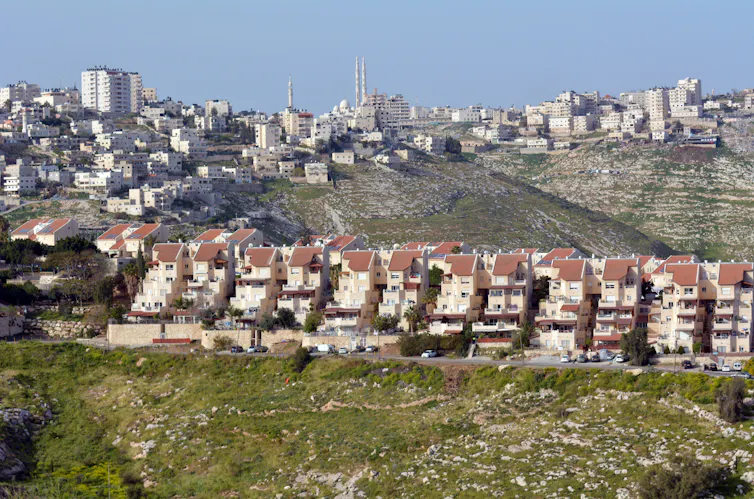
Israeli government ministers have been explicit that E1 would suffocate any future Palestinian state. In September 2025, when announcing new progress on E1, Prime Minister Benjamin Netanyahu said: “We are going to fulfil our promise that there will be no Palestinian state.” His finance minister, Bezalel Smotrich, has also said E1 would “bury the idea of a Palestinian state”.
The E1 project has advanced considerably in recent times, after years of delay. In August 2025, final planning approval was given for more than 3,400 housing units on the site. Then, in August 2026, the first call for construction tenders was issued to build 1,200 residential units in the southern part of E1. The closing date for bidding is on October 19, just before Israeli elections on October 27.
The UK’s import ban, which seems intended to deter companies from taking part in building E1, has been backed by similar measures announced by countries including Canada, France, Ireland and Spain.
Mounting international concern
The ban on settlement goods demonstrates mounting international concern about Israel’s actions. More than 700,000 Israeli settlers now live on land captured in the 1967 six-day war, even though settlements on occupied land are illegal under international law.
Israeli rights group, Peace Now, reports that more than 102 new settlements have been approved since 2022, most deep inside the West Bank. The Israeli military often supports settlers building new outposts, and the Israeli government provides substantial financial backing to establish settlements.
The UN says that more than 6,400 Palestinians have been displaced in the West Bank due to settler attacks and access restrictions since January 2023, of which at least 2,500 were displaced in 2026 alone.
In addition, more than 30,000 Palestinians have been displaced from refugee camps during Israeli military operations in the northern West Bank since late 2024.
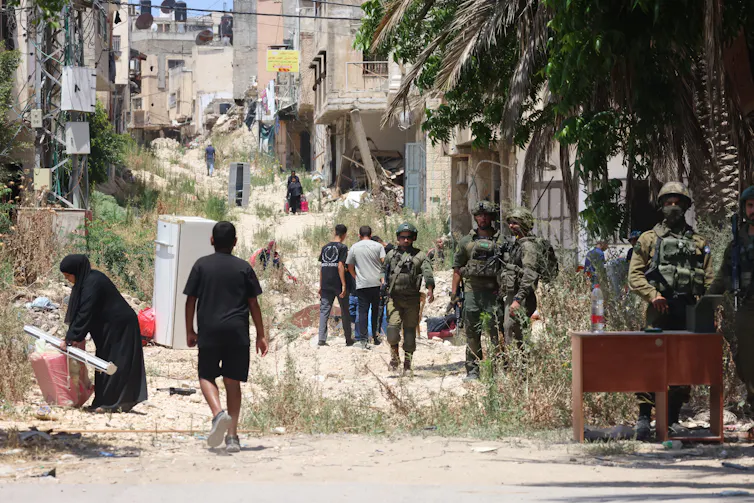
Israel’s expanded control over the West Bank is one element in a broader revisionist policy to push its borders outwards, which marks a step change from a previous strategy of conflict management.
The new moves come in the wake of the October 2023 attacks, when Hamas gunmen killed more than 1,200 Israelis and captured 250 hostages, and Israel’s subsequent war in Gaza, which has killed more than 70,000 Palestinians and devastated the strip.
Since the war began, Israel has seized territory as a buffer zone in southern Lebanon against Hezbollah. It has also advanced into Syria, following the fall of the Bashar al-Assad regime in late 2024. In Gaza, Israel has now taken control of at least 60% of the strip and is considering building three new military settlements there.
Israel’s far-right national security minister, Itamar Ben-Gvir, recently again raised the prospect that Israel may seek to expel the 2 million Palestinians in Gaza. Egypt, which has a border with Gaza, and Jordan, which shares a border with the West Bank, are gravely concerned about the risk of mass deportation of Palestinians across their borders.
The UK government’s action against settlement expansion, accompanied by similar measures introduced by countries elsewhere, signals a new effort to curb these expansionist ambitions.





















Comments are closed.