


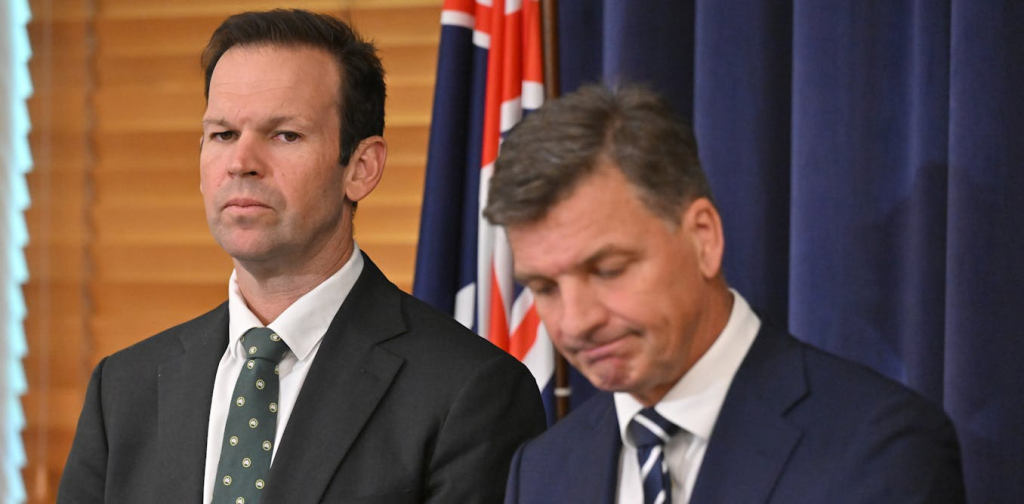

The Coalition’s new leadership is undertaking a consequential shift to the right. This is bad news for climate policy.
Nationals leader Matt Canavan has long opposed climate action. Most notably, he led the charge last year to remove the aspirational target of net zero by 2050 from the Nationals’ platform. The Liberals swiftly followed suit.



The Coalition’s latest objectives seem to be curbing immigration, promoting so-called “Australian values” and celebrating the ongoing extraction of fossil fuels.
The pull of populism
Populism is a type of political speech that divides society into two main groups: the ordinary, often “forgotten people” and the “corrupt” or “untrustworthy elites”. When combined with right-wing nationalism, the concepts of the “people” and “nation” merge in ways that support restrictions on matters such as immigration and international climate action.
The new leaders of the Liberal and National parties are increasingly leaning into this nationalist populist rhetoric.
Since taking the helm of the Liberal ship in February, Angus Taylor has promised the Coalition will “boot out” visa applicants who do not abide by “Australian values”. And he’s taken aim at so-called “migrants of subversive intent” who appear to reject the Australian way of life.
In April, less than a month after becoming leader of the Nationals, Canavan unveiled his “Patriot’s Agenda for our National Economic Revival”. He called for the creation of a “Hyper Australia”, pushing for full-throttle resource extraction and more Australian industry with the help of tariffs. And shortly before the 2025 federal election, Canavan accused Australia’s first parliamentary inquiry into misinformation and disinformation on climate and energy of bullying critics into silence.
It might be tempting to explain the Coalition’s rightward shift as a strategic response to One Nation’s surging popularity. But our recent research suggests the Coalition has developed its own brand of increasingly exclusionary nationalistic populism, with worrying implications for climate action.
What we studied
In our study, we analysed Pauline Hanson’s main parliamentary speeches on climate and energy between 2015 and 2022. We then compared them to speeches made by a sample of six politicians from the Coalition’s climate sceptic faction over the same period. This included three Nationals – one being Canavan – and three Liberals.
Our analysis sifted through these speeches to identify statements and claims that opposed climate policy. We then examined whether the speeches made nationalist and/or populist claims to reinforce their hardline stance on climate. We also noted how various social groups were characterised – and pitted against each other – in these speeches.
Overall, we found significant overlap in how Hanson and the Coalition sceptics used nationalist and populist claims in their speeches. And they did so primarily to oppose decarbonisation, which they all agreed was a sure path to Australia’s economic ruin.
Read more: What does One Nation actually believe in?
All seven politicians dismissed Australia’s obligations under the Paris Agreement. Under Article 4(2) of the agreement, developed countries such as Australia should take the lead in mitigating climate change.
In his speeches, however, Canavan mocked the treaty and argued it was foolish for Australia to move ahead of other countries and to trust China to fulfill its climate commitments.
Instead, these politicians were defiantly nationalistic in their calls to continue exploiting fossil fuels which, unlike renewable energy sources, they view as central to Australia’s past and future economic prosperity.
The speeches also linked their nationalist arguments to “good Australians” who build the nation. This includes the “hardworking” regional Australians – particularly those working in the mining industry – whose work should not be sacrificed for any globalist agenda.
Read more: Climate sceptic or climate denier? It’s not that simple and here’s why
They also criticised “outsiders” and Australians deemed to be betraying the national interest. These included countries such as China and activists such as Greta Thunberg, as well as “dodgy” carbon traders, the Labor party and the Greens.
The speeches also used the simplifying rhetoric of populism to create a division between the “forgotten people” of regional Australia and the “out-of-touch elites” in Canberra and inner-urban areas.
All seven politicians used populist rhetoric to pitch working-class “battlers” against the well-to-do. And they wielded it to reject the expertise of “untrustworthy” climate scientists and policy elites, in favour of the common sense and practical experience of regional Australians.
Finally, we found the six Coalition politicians in our study were already embracing nationalist populist rhetoric in 2015, a year before Hanson re-entered Parliament.
This suggests their rhetorical similarities arise from their existing ideological commitments, rather than Hanson’s political influence. This is further supported by the fact half our sample – including Craig Kelly, George Christiansen and most recently Barnaby Joyce – eventually defected to One Nation.
Read more: Politics with Michelle Grattan: why Farrer is a key test for One Nation vs the Coalition
Where to next?
Last year’s election saw a dramatic reversal in the political fortunes of One Nation and the Coalition. And they will soon be in direct competition in the upcoming Farrar by-election in New South Wales.
We may see these two parties play up their political differences, possibly over whose brand of populist nationalism – both of which are shored up via preferencing – is best. Regardless of how they approach this, it’s unlikely either will make any shifts on climate or immigration policy.
Our findings are consistent with a broader global trend, which has seen the line between conservative centre-right and radical-right parties become increasingly blurred. And this blurring does not bode well for national or international climate efforts, including the implementation of the Paris Agreement.



















Comments are closed.