


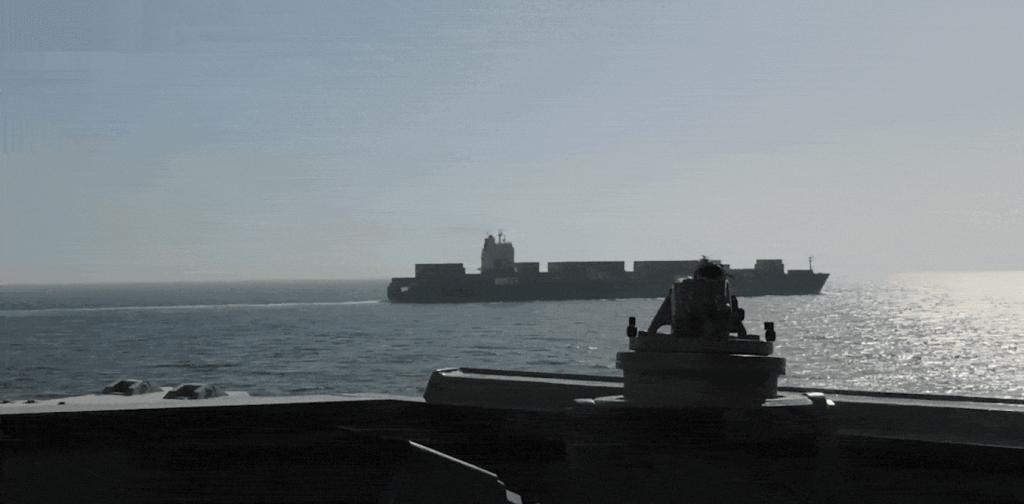

Over the past several days, there have been conflicting reports about the Strait of Hormuz. It’s difficult to know what’s happening from one moment to the next.
Iran said the waterway was open to commercial shipping again, then turned around and said it was closed.


Iran then fired at two Indian-flagged ships going through the strait, forcing them to turn around.
The next day, the US fired on an Iranian cargo vessel, which Tehran called a violation of the two countries’ temporary ceasefire and threatened retaliation.
What’s actually happening in the strait? Are both sides acting lawfully? We asked naval expert Jennifer Parker to explain.
What happened over the weekend?
There have been several key developments over the last 48 hours.
The first was the statement from US President Donald Trump and the Iranian foreign minister on social media that the Strait of Hormuz remained open. It was an interesting announcement because it was consistent with what the foreign minister had said at the beginning of the ceasefire a week and a half ago.
On Saturday, we saw a large number of tankers and cargo vessels move towards the top of the strait to follow what Iran has designated as a new passageway. Some ships that are clearly desperate to get out of the strait were obviously more confident they were safe to transit through at that point.
The Joint Maritime Information Centre in Bahrain said 18 ships were able to transit through, at least ten through the new Iranian-designated transit route, which is north of the normal transit route.
However, Iranian Revolutionary Guard Corps Navy then reportedly attacked a number of civilian merchant vessels. One was an Indian tanker that was on an approved list with the IRGC to travel through the strait.
This suggests the Iranian military may have been disagreeing with the statement of the Iranian foreign minister, saying the strait remains closed.
Is the US blockade legal?
Then, on Sunday, the US fired on an Iranian-flagged cargo ship in the Arabian Sea.
The US is blockading Iranian ports through what’s called a distant blockade. This means US Navy ships are not sitting right off Iran’s ports to stop vessels. Rather, they are positioned further back in the Gulf of Oman and the northern Arabian Sea, with a blockade line effectively drawn between the Iranian-Pakistan border to around the Omani-UAE border.
The US Central Command has reported turning away a number of ships – at least 23 as of April 18.
When a ship approaches the blockade line en route to or from an Iranian port, the US Navy will radio the vessel and say it is not free to go through. Most ships will then turn around.
This is allowed in a lawful blockade under the law of naval warfare. Once a conflict has started, a blockade is a lawful if it complies with certain provisions:
-
the blockade must be declared
-
it must be impartial, meaning it needs to apply to all ships
-
humanitarian goods must be permitted to go through
-
it must be effective, meaning you can’t declare a blockade, start doing it, and then not actually enforce it
-
it can’t close off neutral ports.
Many news reports have said the US is blockading the Strait of Hormuz. But it is actually blockading Iranian ports, not the strait. A blockade of the strait would be illegal because this would affect neutral ports in the Persian Gulf. Ships in an international strait enjoy unimpeded transit passage, which cannot be hampered or suspended by the coastal state.
Is the US permitted to fire on a cargo vessel?
The US says it warned the Touska, the Iranian-flagged vessel, to stop over a six-hour period.
If a vessel doesn’t comply with warnings like this, warning shots can then be fired, depending on your country’s rules of engagement. The country maintaining the blockade may also use “disabling fire” against the ship.
This is what the US claims happened – the US Navy destroyer fired on the Touska’s engine room to make it stop. My assessment is this is consistent with the law of naval warfare because the US Navy is enforcing an effective blockade. It also appears to have adhered to the principles of proportionality and necessity under international law.
The US also seized the ship, which is consistent with the law. In terms of the crew, the US has not announced what it intends to do with them. If the crew is non-Iranian, they would likely be released and repatriated. If the crew is Iranian, or if some of the crew are linked to the IRGC, they could be detained.
By contrast, based on current reporting, the ships fired on by Iran appear to have been neutral merchant vessels transiting an international strait. On the information publicly available, there is no indication they had become lawful military objectives.
This is not a lawful use of force because these vessels are not a lawful military objective.
Neutral merchant vessels are generally considered civilian objects under the law unless, by their nature, location, purpose or use, they make an effective contribution to military action. Therefore, it’s not lawful to attack them.
There are some exceptions to that, including a merchant vessel seeking to breach a lawful blockade.
Where do things go from here?
The US is not saying it’s in control of the strait, it’s saying it’s in control of the vessels going in and out of Iran, which is different.
Iran has claimed it’s in control of the strait since the war began. It has been attacking and threatening civilian, predominantly neutral vessels since then.
What I think we are seeing is a tussle for leverage to supercharge the negotiations between the US and Iran, should they continue this week in Pakistan.



















Comments are closed.