


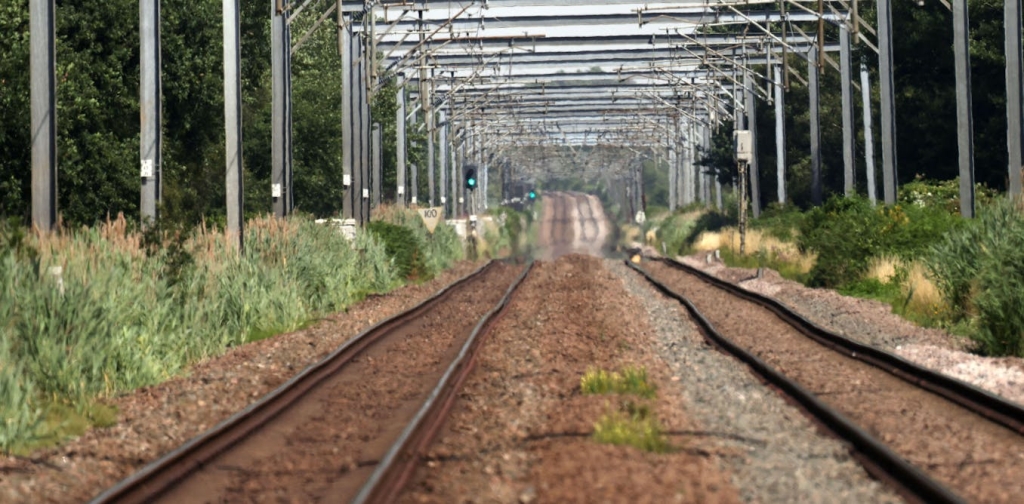

On August 14, the hottest day of an exceptionally hot summer, a train derailed near Lewes in East Sussex, England. Three carriages tipped over and two people were seriously injured. The following day, another train derailed in Essex.
We don’t yet know what caused either derailment, and the UK’s Rail Accident Investigation Branch is still gathering evidence. Network Rail – the public body that owns and manages most of Britain’s railway network – said in response that this summer’s repeated heatwaves have “presented exceptional challenges to the railway”. We do know that heat poses particular problems for railways, and that heat-related failure is an increasing risk in the UK as temperatures rise.



Xueyu Geng is a Professor in Ground Engineering at the University of Warwick, and an expert in railway track design and embankment stability. The Conversation asked her about the key challenges for a rail network in heatwaves, and how trains can stay safe and efficient in ever more extreme heat.
What happens to railways in extreme heat?
Steel expands when heated. Most of the network uses continuously welded rail: long lengths that are effectively restrained by the sleepers, fastenings and ballast, rather than jointed sections that can expand freely. When the rail heats up it wants to get longer but can’t, so it builds up substantial compressive stress instead.
If that stress exceeds the track’s resistance to sideways movement, the track can shift sideways, causing a thermal buckle. That’s why extreme heat is a genuine safety issue, not just a comfort-and-delays problem.
Rail temperature and air temperature are also two different things. Direct sunshine matters a lot: a stretch of track in full sun can run considerably hotter than a shaded section experiencing the same air temperature.
Temperature is only half the story, though. Ballast – the layer of crushed stones beneath the tracks – along with sleepers, fastenings and the condition of the track and ground all affect how much sideways movement it can withstand.
So there’s an important distinction between a “hot rail” and an “unstable track”. A railway can run a high rail temperature safely if the track system as a whole has enough resistance in reserve.
Is this a particular problem for Britain? Do hotter countries manage it better?
I wouldn’t say British infrastructure was simply designed for the “wrong” temperature; British engineers have always had to design for thermal expansion and contraction. The more fundamental issue is that the climate is shifting during the working life of the infrastructure.
Historically, the extreme temperatures built into design and operational planning reflected a climate where very high temperatures were rare. We’re now seeing heatwaves that are more frequent and that push into a temperature range many existing assets simply didn’t experience for most of their service life.
There are already examples of heat causing derailments. For instance, in 2015 a freight train derailed near Langton, Lincolnshire, on the hottest day of the year to that point. An investigation found the track had buckled in the heat.
The risk is now being managed at increasingly high temperatures. On July 19 2022, the UK’s first day over 40°C and still its hottest ever day, operators shut down one of the main lines linking London to northern England and Scotland. The closure was a precaution: rather than risk trains encountering buckled track, operators stopped services during the hottest part of the day.
Extreme heat is especially awkward for a railway specifically, because the infrastructure is so tightly constrained, you can’t let a track drift sideways even slightly, since wheel-rail interaction depends on very tight tolerances. Two adjacent stretches of track exposed to identical weather can have very different resistance to buckling, depending on their stressing history, ballast condition, fastenings, geometry and the ground underneath.

There’s no single “heat-proof” railway technology to copy from hotter countries. What they have is the advantage of treating high heat as a normal design condition rather than an exceptional one, with track designed, maintained and operated accordingly.
Our design assumptions and maintenance strategies need to reflect the climate the railway will actually experience going forward, not the climate it was built for.
How have railways adapted, and what would a truly climate-proof railway involve?
The biggest shift needed is from a “reactive” to a “predictive” approach. At the moment, when extreme heat is forecast, operators step up inspections, monitor rail temperature, and impose speed restrictions where needed. Useful, but it’s responding to immediate risk rather than anticipating it.
The next generation of railway management should bring together weather and solar radiation forecasts, actual rail temperature, track geometry, rail stressing history, ballast and fastening condition, drainage, ground and embankment condition, and train speed and traffic loading. Put those together and you can identify which specific sections of track are vulnerable, rather than treating an entire route as uniformly at risk.
This is where new technologies have a strong role to play. Remote sensors, “digital twins” (computer models of a train system that can be updated with real-world data) and modern data science can all help spot a section approaching a critical condition before it becomes unsafe.
A truly climate-resilient railway isn’t just “stronger rails in the ground”. Prolonged hot, dry weather can change ground moisture and affect earthworks at the same time as thermal stress is building in the rail itself. That’s why resilience has to cover everything from train tracks and drainage to signalling and power systems, all together, not rail steel in isolation.
Should we design new tracks, or retrofit old track, for the heatwaves of the future?
Railway assets have very long lives: a track, bridge or embankment built or substantially renewed today could still be in service in 50 or 100 years. That creates a fundamental mismatch between the current design life and a climate that keeps changing within that lifetime.
The right question isn’t “can this new track cope with today’s hottest day?” It’s “what climate will this asset have to withstand across its whole life?”
This hits railways harder than most other transport modes, for a specific reason: the track has to stay precisely aligned. Roads suffer in heat too – asphalt softens, concrete expansion joints get stressed – but a road vehicle has rubber tyres and steering, giving it some lateral tolerance for minor surface movement. A railway wheel and its raised inner lip – the flange – don’t have that margin. Continuously welded rail has to stay within millimetre-scale geometric tolerance over very long, continuous lengths, with compressive stress building as temperatures rise.
For new infrastructure, climate projections for the middle and later parts of this century should be part of engineering decisions now, because that infrastructure will still be in service then. But I wouldn’t design every component to withstand an extreme 2100 temperature outright: that risks enormous, unnecessary cost for conditions that may not materialise for decades.
The better approach is risk-based adaptation: build appropriate resilience into new infrastructure from the outset, and for the existing network, identify the specific sections where future climate creates unacceptable risk and progressively retrofit those. That might mean improving ballast resistance, drainage, embankment stability, monitoring or thermal management, depending on what the local vulnerability actually is.






















Comments are closed.