



From the Ukraine war and suspected drone sightings at Europe’s busiest airports to the seizure of over 700 unauthorised drones during the 2026 Fifa World Cup, the skies above us and news reporting are abuzz with drones.
Spanning different sizes and functions, drones have become essential military tools and mainstays of contemporary conflicts. This is depicted by the saturation of the Russia-Ukraine frontline “kill zone” with thousands of cheap yet deadly drones – a new combat ecosystem that has seen troops become involved in a terrifying game of hide-and-seek.


The impact of military drone activity spreads far beyond the frontlines. From Ukraine’s repeated long-range drone strikes on Russian oil refineries and logistics centres to Operation Spiderweb – where 117 explosive-laden drones concealed in lorries were smuggled into Russia and remotely released into airbases causing damage to 41 warplanes – news reports continue to chart the creative deployment and devastation of weaponised drones.
Recent cases include the discovery of a drone carrying explosives next to a Ukrainian aircraft loaded with military ammunition at Leipzig airport in Germany. The drone was thwarted only by its failure to explode on impact and was discovered four hours later by an airport bus driver.
The incident underscored the broader underlying threat of weaponised drones, prompting German interior minister Alexander Dobrindt to declare they represent a “new level of danger”.
As the possibility of drone-related incidents grows, the development of wide-ranging countermeasures on and beyond the battlefield continues apace.
Downing drones
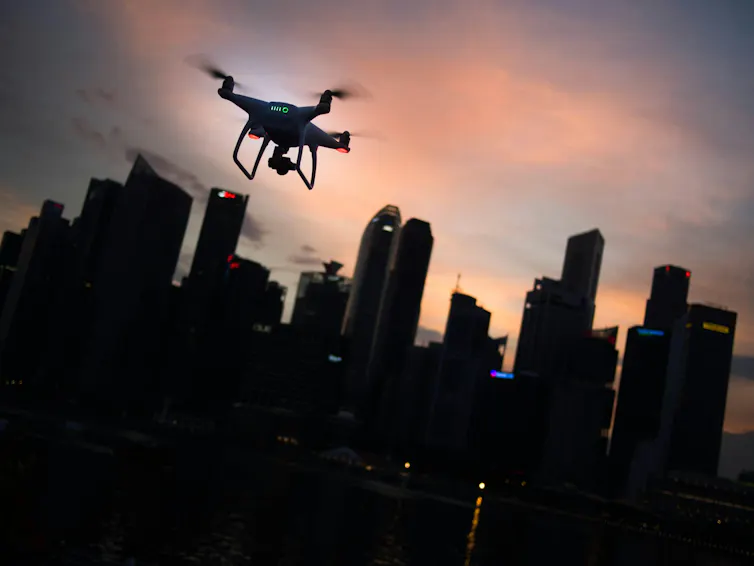
Drones constitute novel threats that cannot simply nor solely be addressed with traditional defence and security systems designed for large, fast-moving crewed aircraft. That the US Department of Defense recently launched an online counter-drone marketplace to simplify acquiring vetted counter-drone technology – and that Nato plans to follow suit – underscores the growth of this issue in recent years.
Counter-drone systems are typically divided into two groups: detection and tracking, and interdiction. Detection and tracking systems typically include radar, radio-frequency, electro-optical, infrared, acoustic and combined sensor approaches. Each of these recognises the sounds and signatures of drones differently.
While radar offers long-range coverage, it can struggle with tracking smaller drones. Birds, for example, can cause false positives. Similarly, while electro-optical sensors complement radar, they can require a clear line of sight, limiting deployment locations.
The introduction of AI-enabled systems is also notable. These systems bridge the gap between tracking and intercepting by autonomously calculating a drone’s flight path, with supporting operators confirming engagement with the single press of a button. Reports suggest they have been deployed in Ukraine – a development that may come to mark a significant intervention.
Interdiction refers to interacting with or destroying drones. It includes non-kinetic approaches that disrupt or disable a drone without physical contact, as well as kinetic approaches which involve the physical interaction with or destruction of a drone.
Non-kinetic interdiction measures such as radio frequency and global navigation satellite system jamming can disrupt communication links. This prompts drones to hover, land or “return to home”. But these measures run the risk of disrupting nearby external systems, limiting their application in urban areas and near airports.
The Ukraine conflict also demonstrates how such countermeasures are part of a wider game of cat-and-mouse, necessitating continuous adaptation and counter-adaptation. Following the mass deployment of jammers attacking drone radio links, both sides adapted by deploying drones controlled by fibre-optic cables.
By eliminating the radio link, this rendered jammers useless. This response became so integral that trails of cables now render the battlefield a tangled web, requiring soldiers to navigate with greater caution.
Kinetic or “hard-kill” options include lasers, nets, projectiles and high-power microwaves. They are typically understood as a last-resort countermeasure. Alongside being costly, the destruction of drones introduces risks of falling debris and collateral damage to people and property. Reports from February 2026 of the US military accidentally downing of a Customs and Border Protection drone with a high-energy laser in Texas illustrate such concerns.
Nonetheless, British forces deployed missile systems to down over 100 Iranian-linked drones that were targeting a coalition base in Iraq earlier in 2026. US marines are also being trained to counter drones with standard-issue weapons including shotguns, while the US Army is looking to source a cannon for counter-drone defence.
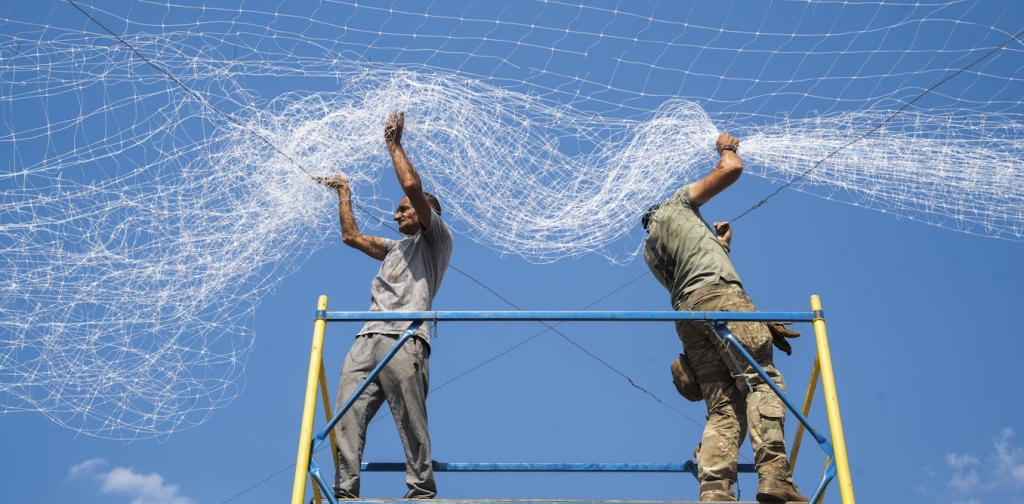
Alongside since retired experiments with birds of prey trained to down drones, other kinetic approaches include the use of anti-drone nets and metal cages. Russian forces have added such measures to land vehicles and oil tankers as defensive layers designed to force a detonation gap. Ukrainian soldiers have also adopted a “low-tech defence against a high-tech” problem by pole mounting fishing nets on roadsides in frontline towns.
Such efforts are not limited to the battlefield. In recognition of a drone’s ability to bypass traditional control points and secure areas, the UK government has invested in physical countermeasures at prisons.
These include external netting and wires, and the reinforcing of 13,000 cell windows with heavy-duty steel grilles at sites considered most vulnerable to drone incursions. But, while accompanied by wider site-specific legislation, the weak and crumbling walls of some Victorian prisons have complicated installs.
There is no magic bullet drone counter-measure available. Rather, layered approaches – tailored to different sites and contexts – are required. As drones and the threats accompanying them develop, so too must efforts to mount an effective response.






















Comments are closed.