


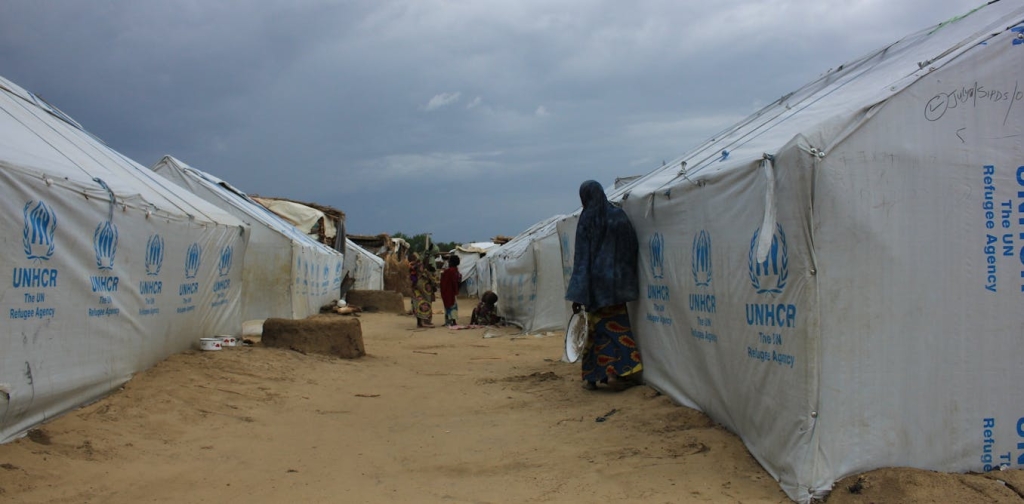

The eruption of the Bundibugyo strain of Ebola in the eastern region of the Democratic Republic of Congo in May 2026 sparked a major crisis.
Transmissions and deaths are skyrocketing, and no vaccine is currently available.

This virus is notably prevalent in settlements and communities for internally displaced persons (IDPs) and communities. This happened too with the Mpox outbreak that started in the Congo in 2025 and spread to the rest of the world.
But who are “internally displaced persons”? And why are they disproportionately affected by disease outbreaks such as Ebola and mpox?
Across Africa, there were estimated to be 31.7 million people living in internal displacement camps as of the end of 2025. More than 29 million of them were displaced due to conflict and violence.
Sudan hosted the largest number of internally displaced people of any country in the world – approximately 9.1 million of its total population of around 52 million. Another 2.8 million remained displaced outside the country as refugees.
Over 20 years ago, I began doctoral research in Colombia with more than 40 displaced communities living in conflict-affected regions. This has since extended to include research on Mexico, central America and Yemen. I then helped set up networks to support researchers and policymakers working on internal displacement in Africa, Latin America and the Middle East. This work led to the recently published Handbook of Internal Displacement.
Based on this work, it’s become clear that the issue of “internal displacement” remains poorly understood despite the very large number of people involved and their significant role in shaping social trends.
This may be about to change. The Handbook includes expert input from over 70 researchers globally. Its 45 thematic chapters offer a comprehensive reference point for work across many different fields. These include sociology, politics, economics, history and law, as well as development, humanitarian, migration and conflict studies.
The Handbook opens up new ways of thinking and engaging with the consequences of internal displacement in Africa and beyond.
It also offers a crucial resource. It highlights the fact that internally displaced people – rather than refugees – make up the bulk of displacement globally. This points to the need for resources to be allocated to the challenges that come in the wake of displacement.
Internally displaced people
Global policy describes internally displaced people as those
who have been forced (…) to flee or to leave their homes (…) and who have not crossed an internationally recognized State border.
The term is a convenient policy label to distinguish them from cross-border refugees. But, within their own countries, IDPs are really just “the displaced”.
Africa records the highest levels of war-related internal displacement of any region globally. In 2025, even with the new wars raging in the Middle East, Africa remained the epicentre with 14.5 million new internal displacements.
In 2024, it saw vastly more displaced people (11.5 million) than every other region combined (8.5 million).
The scale of displacement reflects the high number of countries in Africa that are in conflict, as well as the large, protracted wars that displace huge numbers of people each year. This includes the DRC, which reported 9.7 million war-related internal displacements in 2025.
Yet war is just one driver of displacement.
What’s driving displacement
In Africa, a multitude of climate-related hazards – such as cyclones, flooding and drought – generate cascading risks. In 2025 alone, they pushed an additional 2.9 million internal displacements.
Other displacement drivers in Africa include criminal, extremist and terrorist violence and large-scale development projects.
Each driver further weakens people’s ability to cope, while displacement itself creates additional pressures. In many African nations, war and disasters occur simultaneously and can interact in ways that intensify internal displacement.
The impact
Internal displacement can disrupt lives to a shocking extent.
It has wide-ranging effects on society, affecting the communities that host IDPs, the places they pass through and the home communities to which some eventually return.
Unlike refugees, IDPs stay within their country and remain exposed to the dangers and devastation caused by the conflicts and disasters they fled.
Although they may be citizens, they are often treated with suspicion and end up marginalised and hidden in local populations. Where they lose access to land, housing, work, and social and family support networks, they often experience high levels of poverty.
These accumulated disadvantages often make IDPs, such as those in the DRC, more vulnerable to illness and death than other war-affected populations (including refugees).
African countries have traditionally relied on settlements and camps as a way of responding to displacement.
The “protected villages” policy in Uganda was an early example of encampment, resettling displaced people into villages ostensibly removed from the conflict between the government and the Lord’s Resistance Army in the 1990s. More recently, the majority of the 4 million displaced Ethiopians in 2023 lived in camps or camp-like settlements.
Internal displacement in Africa is increasingly an urban phenomenon, and feeds into wider trends towards urbanisation.
As a result, cities and towns, such as Mogadishu and Baidoa in Somalia, now host many displaced people. This creates a whole new set of development challenges.
The losses caused by displacement can undermine development. National development plans can also be thrown off course when people are no longer where those plans expect (or want) them to be.
In cities, heightened pressure on local services also creates a need for flexible and imaginative urban planning.
What needs to change
Africa is the only region globally where governments have created regional legal treaties for protecting IDPs.
For example, in 2006, countries in central Africa created a pioneering Protocol on the Protection and Assistance to Internally Displaced Persons. The African Union then spearheaded the Convention for the Protection and Assistance of Internally Displaced Persons in Africa in 2009.
But IDPs still attract relatively little political interest or funding from the wider international community. Unlike refugees, they are too often seen by donors as a faraway problem confined to poorer parts of the world.
This is wrong. Disasters create many IDPs each year, even in countries like the US. What is more, the low profile of internal displacement has real-life consequences for IDPs in regions like Africa. One study found that between 2010 and 2019, per capita health aid to people displaced by conflict was less than one-seventh of that provided to refugees.
Aid cuts by major donors like the US, the UK and Germany in the 2020s have exacerbated the problem. This has forced aid agencies into “hyper-prioritisation” – using scarce resources only for the most urgent needs – since 2025.
Across its many chapters, the research in the Handbook of Internal Displacement underlines that internal displacement – and the vulnerabilities it creates and worsens – cannot be ignored. The needs of internally displaced people (and host communities) must be properly factored into social assistance, humanitarian and development interventions.
The Handbook offers detailed guidance on how this can be done, while supporting the efforts of displaced people to protect themselves during crises and overcome displacement-related vulnerabilities.











Comments are closed.