


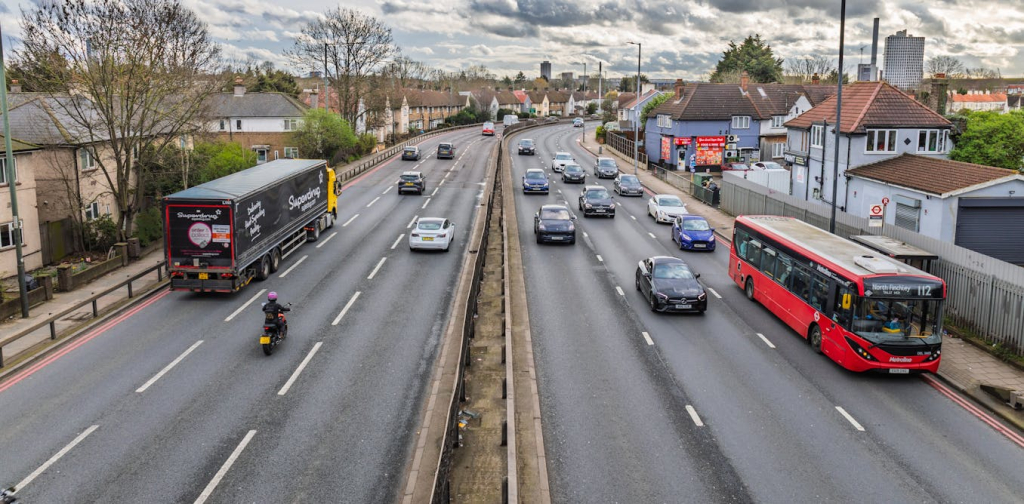

Picture a busy road running through a residential neighbourhood. The noise, the fumes, the danger to cyclists and pedestrians – all familiar concerns. But here is one you might not have considered: that traffic may also be making your street more prone to vandalism, burglary and violence.
That is what our new research, using data from tens of thousands of households across England, Scotland and Wales, suggests. We found that when motor traffic increases in a neighbourhood, residents’ assessments of street crime go up.



At first glance, there is no obvious reason why traffic should influence crime. However, a closer look at crime theory reveals several plausible pathways.
The most direct mechanism is guardianship: the idea that everyday surveillance by residents and passersby helps keep crime in check. Influential American urbanist and activist Jane Jacobs famously called this “eyes on the street”.
While it might seem that traffic provides a ready supply of guardians in the form of drivers, their deterrent effect is negligible. Instead, heavy traffic undermines guardianship in multiple ways: wide roads and parked cars fragment public space and obscure sightlines, outsiders are less likely to stand out, and, if traffic discourages walking, there are fewer genuine guardians to keep an eye on things.
Traffic also erodes the social fabric. Research consistently shows that busy roads undermine community ties: neighbours talk less, look out for each other less and feel less ownership of shared spaces.
Criminologists describe communities’ ability to sustain these kinds of social ties and shared norms as “collective efficacy”. Its absence is one of the strongest predictors of violent crime. Chronic stress from traffic noise and congestion is also a likely driver of aggression and antisocial behaviour.
Finally, “broken windows” theory holds that visible disorder (potholes, noise, litter) signals neglect and invites further incivility. Traffic contributes to all of these.
What we found
To test these ideas, we used data from Understanding Society, a large-scale longitudinal study that followed thousands of UK households across three survey waves between 2011 and 2018.
Crucially, the study records both residents’ assessments of crime in their area and interviewers’ evaluations of whether the street they live on carried heavy traffic. Because these two measures were collected separately, any shared bias in how they are recorded is minimal. Looking at residents’ own perceptions – rather than recorded crime – avoids some of the biases inherent in police data, including under-reporting and changes to recording practices. As well as providing a stable measure over time, this captures what residents actually experience on their streets, including everyday, low-level offences that are rarely reported to police.
We used fixed-effects models, which compare each household to itself over time, effectively stripping away background differences between neighbourhoods (such as wealth and density) that might otherwise affect crime. This means our findings reflect what happens when traffic changes within the same neighbourhood, not simply that busier areas might be more crime-prone.
The results were consistent. When a neighbourhood went from low to high traffic, residents’ assessments of vandalism increased by around 9%, burglary by 6%, and violence by 6.5%.
We also found support for the collective efficacy mechanism. As traffic increased, residents reported that neighbours were less willing to help each other – a direct measure of community bonds fraying. That erosion of mutual trust, in turn, was associated with higher perceived crime.
To check our findings, we accounted for potential differences in how interviewers recorded traffic levels. These checks demonstrated that our headline figures are, if anything, likely to underestimate the effect.
Our findings align with, and complement, recent studies that have directly tested this relationship.
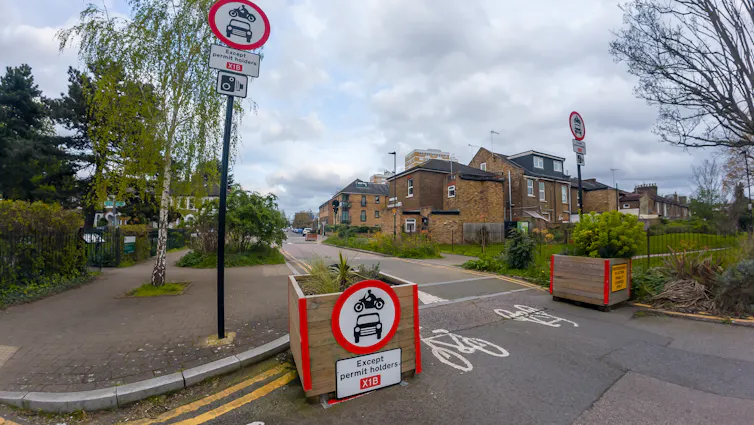
Research on London’s low traffic neighbourhoods – schemes that restrict through-traffic on residential streets – found that their introduction led to roughly a 10% reduction in recorded crime. Those studies used a quasi-experimental design with high validity, ours uses a national observational approach that can be applied more broadly. Together, they build a compelling case.
What this means for policy and crime prevention
Low traffic neighbourhoods and 20mph zones are already justified on road safety, health and environmental grounds. Our findings add crime reduction to that list.
Many crime prevention strategies, such as the UK’s Secured by Design guidance for new residential developments have, historically, promoted designs which discourage pedestrian accessibility. This is intended to make it harder for offenders to enter and escape.
However, if reducing walkability pushes people into cars, and cars make streets less safe, then those well-intentioned design choices may be making things worse by generating crime elsewhere. Effective crime prevention needs to consider the entire urban layout.























Comments are closed.