


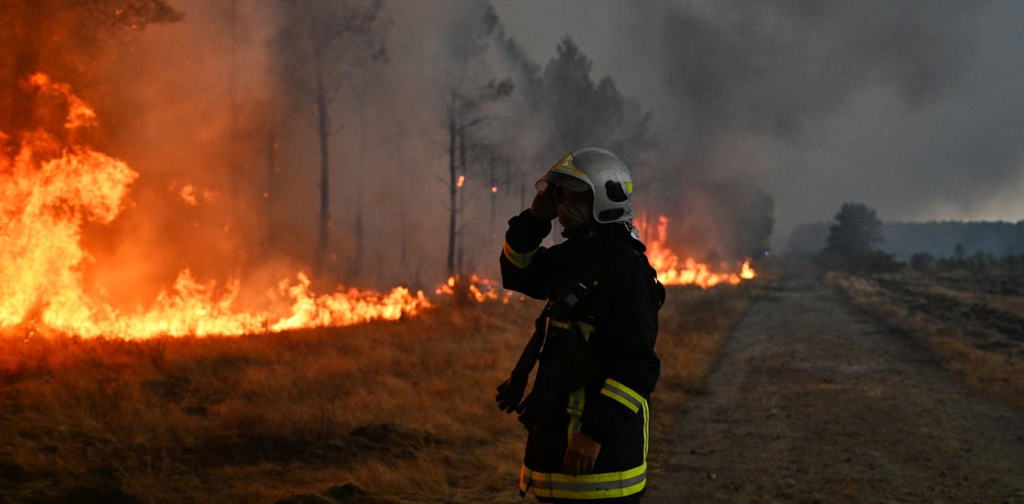

United States President Donald Trump has accused Canada of “wilful negligence” over wildfires, blaming its forest management, threatening tariffs and floating demands for compensation. His argument is absurd.
Smoke does not carry a passport. Wildfires are burning across several countries, causing evacuations and devastating communities. In North America, smoke from fires has spread over many parts of central Canada and the U.S.


Wildfires are currently scorching vast areas in Oregon and the Pacific Northwest. France and Spain have evacuated hundreds of thousands of residents as wildfires close in on Bordeaux, France, and grow around Madrid, Spain. Despite Trump’s claims, Canada cannot log, rake or prescribe-burn its way out of a planetary problem.
Wildfires require ignition, combustible fuel and weather that permits rapid spread. Climate change does not usually strike the match — people and lightning do that, with lightning responsible for most of the area burned in Canada. But warming weather increasingly determines whether a spark dies or becomes a catastrophe. Hotter air, earlier snowmelt and longer summers mean a drier landscape and more severe fire seasons.
In 2004, colleagues and I demonstrated that human-caused climate change had already left a detectable fingerprint on the area burned by Canadian forest fires. A 2024 study found that human influence has made fire seasons like Canada’s record 2023 season more than five times as likely across nearly every Canadian ecozone.
Of course, forest management practices matter. Fire suppression, accumulated fuels, vulnerable development and inadequate community protection raise risk in some regions. But many of Canada’s largest fires burn in remote boreal landscapes, and much of the boreal forest is not manageable.
Mitigation, not just adaptation
Trump’s demand that Canada pay for wildfire smoke is especially galling. The U.S. has emitted more cumulative fossil carbon dioxide than any other country. Trump withdrew the U.S. from the Paris climate agreement while promoting fossil-fuel expansion — worsening the conditions that drive wildfire risk — and now blames a neighbour for the smoke.
His supporters should understand that today’s smoke is a warning of what continued warming will bring.
Nonetheless, Canada cannot hide behind the absurdity of Trump’s statements. The country remains one of the world’s highest per-capita emitters of greenhouse gases. Better emergency response, FireSmart communities, resilient infrastructure, prescribed and cultural burning and science-based forest management can reduce losses.
Read more: Dealing with wildfires requires a whole-of-society approach
However, these measures only buy time; they do not address the root of the problem.
There is sometimes a tendency — especially among some non-Indigenous commentators — to invoke Indigenous cultural burning as a general solution. However, this suggestion does not amount to an effective policy.
Cultural burning is sophisticated, locally valuable and was often suppressed by colonial governments. But no knowledge system — Indigenous or western — provides a complete operating manual for the speed and scale of climate warming we are facing.
Cultural and prescribed burning can reduce fuels and fire severity in appropriate landscapes. They cannot re-freeze permafrost, cool the atmosphere or restore lost snowpack. They are adaptation tools, not substitutes for mitigation.
El Niño

The strengthening El Niño adds risk, but it’s not the root cause. El Niño is a natural, temporary rearrangement of heat between the tropical Pacific and the atmosphere, unfolding atop a long-term human-caused warming trend.
The U.S. National Oceanic and Atmospheric Administration gives El Niño an 81 per cent chance of becoming very strong from October through December and a 97 per cent chance of persisting into early spring 2027.
El Niño will tilt the odds toward drought in some regions, heavy rainfall or flooding in others and additional heat and marine heatwaves. In Canada, a mild winter or thinner snowpack could mean earlier spring drying and greater fire risk next year. It also typically raises fire danger in Australia, and I expect extreme wildfire conditions there during the country’s approaching summer.
Read more: How an El Niño becomes a super El Niño
Net-zero solutions
Stopping the escalation requires geological net zero: cutting fossil carbon emissions as far as possible and permanently returning an equivalent amount of any residual fossil carbon to geological storage. There is no technological loophole permitting unlimited continued emissions.
Hard-to-abate residual emissions will require durable carbon dioxide removal, while reversing any temperature overshoot would require sustained net-negative emissions. We need investment in negative-emissions technologies alongside decarbonization — never instead of it.

One approach my colleagues and I have studied pairs direct air carbon capture and storage with ocean thermal energy conversion. This energy conversion uses the temperature difference between warm surface and cold deep-ocean water to generate low-carbon electricity.
Floating systems could power carbon capture and storage facilities that remove carbon dioxide from the air and store it in geological formations beneath the seabed. The approach is not commercially mature and requires rigorous environmental assessment, but it warrants serious research.
The atmosphere responds to cumulative carbon, not ideology or borders. Adaptation can lessen damage. But only rapid decarbonization to geological net zero can stop us from continually loading the fire dice. Sustained net-negative emissions would then be required to begin unloading them.












Comments are closed.