



Since the release of ChatGPT in 2022, artificial intelligence (AI) has dominated the cultural landscape. Uptake across various sectors, including law enforcement, quickly followed, usually with minimal foresight and little to no guardrails, like effective policies or laws, to govern AI use.
The largely unregulated use of AI in law enforcement is deeply concerning; it jeopardizes police legitimacy and could compromise the integrity of the justice system because it means the public cannot trust that evidence used by police is not compromised by AI.



Procedural justice, or the perception of fairness, is key to police legitimacy. It’s maintained both through unbiased law enforcement practices and the sharing of accurate information with the public and courts.
It’s well documented that AI programming is rife with bias and distortions of information. Evidence even suggests that AI bias can be “worse than reality.”
While debates about bias and problems with AI are ongoing, it’s clear that the selective use of AI by police is inherently biased and must therefore immediately cease.
AI creep into policing
Police use of technology to manipulate evidence is developing into a standardized practice in law enforcement, due primarily to how easy it is for anyone to use AI.
In June, for example, a front-line senior detective in the United Kingdom improperly used AI to “create evidential material in a number of cases.” Police in the United States and Canada, meanwhile, have officially published AI-generated images of drug bust seizures.
The continued integration of AI into facial recognition and surveillance technologies has also raised concerns over the dangers of misidentification. AI is known to be more likely wrong than correct in identifying images of women and people with darker skin tones.
Earlier this year, police in North Dakota used AI facial recognition to misidentify a Tennessee grandmother for crimes that she didn’t commit; as a result, she was held in custody for more than five months.
In Maryland late last year, an officer drew a gun on an unsuspecting teenager because an AI-driven high school surveillance system had misidentified a bag of chips as a possible firearm.
These cases, among others, illustrate the dangers of AI use in law enforcement. Despite the known risks, police agencies have inexplicably forged ahead with this fundamentally flawed technology.
AI police controversies
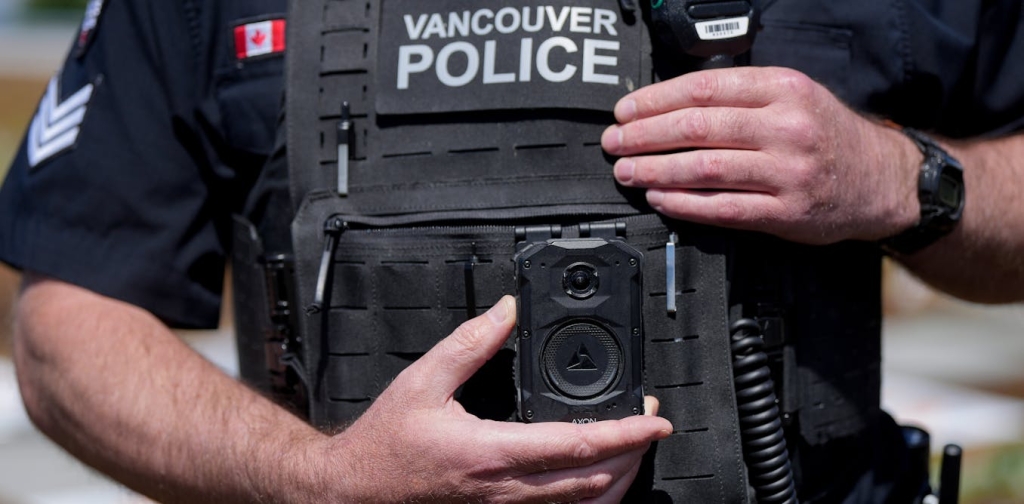
As part of its body camera program, Canada’s RCMP recently completed a pilot project using AI to draft police reports. The technology uses a customized variant of ChatGPT and raises serious concerns about the veracity of police reports that are often key sources of evidence referred to at trials, which could be months or years removed from the incident.
Earlier this year in Utah, an AI-generated police report using the same technology stated that an officer had turned into a frog during an encounter because the audio on the officer’s body camera had captured Disney’s movie The Princess and the Frog playing in the background.
It was only in this extraordinary context that a police administrator admitted he “learned the importance of correcting these AI-generated reports.” But what about all the unremarkable details of police reports that might be fabricated by AI and otherwise overlooked?
The question of how accurately officers check AI-generated reports is one of many unresolved concerns, in particular the ever-present threat of a wrongful conviction or cases being dismissed because the AI police reports are found in court to be false.
Disrupting the inevitable
There are also numerous inherent privacy risks that stem from the use of AI technologies.
The public cannot opt out of interactions with police when their images, voices and personal information may be captured on body cameras and fed into AI, and they have not consented to their information being used to train these models.
It’s still not known whether the data gathered by police will be used to train and further develop future iterations of AI for use in law enforcement. There is no uniform model for AI adoption and implementation across Canadian police services, so the public has very little insight into how these technologies and their information will be used.
Some police services have even refused comment on their AI policies when pressed by media organizations.
Police services boards have effectively rubber-stamped adoption of AI platforms even while police governance models for these technologies are in their infancy.
The converging relationships between public police forces and for-profit software companies show the emergence of an economic relationship that is fundamentally reshaping how police interact with the public. Existing oversight models for police use of AI are incapable of responding to the enormous legal, ethical and social risks stemming from these ventures.

Safeguarding the system
So what can be done to disrupt what appears to be inevitable?
The evidence is already compelling enough that the use of AI technologies by Canadian police must be prohibited. It’s wrong to conflate the use of AI in the public and private sector with its use in the justice system, because no other institution has state-sanctioned authority to remove the freedoms of people accused of crimes.
Law enforcement must therefore be held to the highest possible standard.
The known risks of AI use in law enforcement are numerous. Miscarriages of justice already occur because of human errors, police misconduct and systemic biases, among other factors that are difficult or impossible to effectively control. AI shouldn’t be one of them.















Comments are closed.