



Whether it’s trimming off a piece of mushy parsnip or cutting away a slightly mouldy bit of apple, many of us have used produce long after their peak of freshness.
While fruits and veggies are important for our health, they’re also highly susceptible to bacteria, fungi and other pathogenic microbes. Overripe fruit and veg can harbour E coli, Salmonella and Listeria bacteria, all of which can cause food poisoning. Understanding how to properly store fresh produce can maximise their freshness and keep them safe to eat for longer.



The use-by dates printed on packaging are usually a useful indicator of how long fresh produce can safely be stored and eaten. But the environment fresh produce is stored in can affect the shelf-life of produce – so use-by dates may not always be accurate.
Fruit and veg are living – so things like humidity, temperature, atmospheric gas, light, how long it’s been in storage and any potential microbial contamination can all affect how long produce can be stored.
The ideal storage conditions will also be different for each fruit and vegetable.
Fruit
Apples have a shelf-life of around one week at room temperature, and three to four weeks in the fridge. These should ideally be stored in the fridge’s veg drawer and washed before eating.
Apples which are a little bruised are safe to eat but don’t consume if they’re mouldy.
Bananas can last around two to seven days, depending on how ripe the bunch was when bought.
Store bananas at room temperature until ripe, then refrigerate to extend shelf life. Brown or mushy bananas are safe to eat so long as they aren’t mouldy.
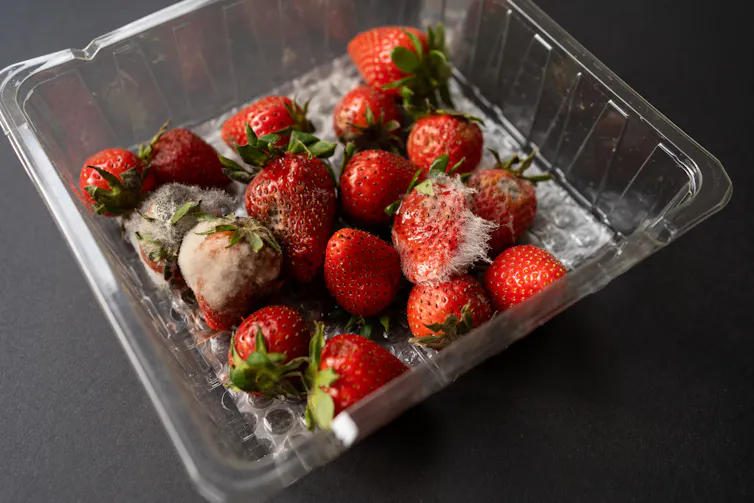
Berries have a shelf life of around 3-7 days if refrigerated. Store them in their original packaging. Only wash before eating, as washing may spread fungal spores.
Again, don’t eat if mouldy. Even if only one berry in the punnet has mould and the rest look fine, they may still contain mould. This is because the toxins produced by moulds and other fungi – called mycotoxins – are invisible and directly penetrate food and can spread to adjacent foods.
Mycotoxins, such as the Aspergillus aflatoxin, can cause serious damage to the liver and have been linked to liver cancer.
Citrus fruits are usually good for around one week at room temperature, and up to one month in the fridge. Keep the fruits whole and store in the fridge in a mesh bag that allows airflow. Cut citrus can be kept in an airtight container for up to five days.
Grapes can last several days at room temperature, and up to two weeks when refrigerated. Store them in their original ventilated package to enable airflow, and wash only before eating. As with berries, if any of the grapes have gone mouldy it’s best to bin the bunch to avoid mycotoxin contamination.
Tomatoes should be allowed to ripen first at room temperature, then stored for up to two weeks in the fridge. Slightly soft or mushy tomatoes can be eaten so long as there’s no mould present.
Vegetables
Carrots and parsnips can be stored for up to two weeks in a cool pantry, and for more than a month in the fridge. Just make sure they’re stored in perforated bags to allow airflow.
Sprouted carrots or parsnips can still be eaten, but if they’re mushy or mouldy that means bacteria or fungi are already growing so throw them away.
Cucumbers can be stored in a plastic bag or container for up to a week in the fridge. Cut cucumbers should be placed in a clean plastic bag or container and eaten within 1-2 days, as microbes will start growing quickly.
Lettuce is usually okay to refrigerate for three to seven days if left whole. For mixed lettuce leaves, it’s best to follow the use-by date on the package. Whole lettuce should be stored in breathable packaging in the fridge’s salad drawer. Wash only before use. Any lettuce that has become mushy or turned brown shouldn’t be eaten.
Mushrooms have a shelf life of only one day at room temperature, and three to seven in the fridge. Denser mushroom species – such as shiitake or button – tend to keep longest. Store mushrooms in breathable bags in the middle of the fridge.
Onions can sometimes last more than six weeks when stored in a cool, dry, well-ventilated area. Do not wrap in plastic, as a lack of air flow reduces shelf life. You also shouldn’t store them with potatoes or other veg that release moisture, as this will cause fungus to grow. Sprouting onions can still be eaten if no mould is present.
Potatoes can also last more than six weeks when stored in a cool, dark, dry place.
Do not eat green or sprouting potatoes, as these often contain natural toxins which can cause severe gastrointestinal symptoms such as vomiting, abdominal pain and diarrhoea. Even if you cut off the sprouted or green bits, the toxins may still have spread throughout the entire spud. Importantly, these toxins are not destroyed by cooking.
Exposure to light greatly increases the formation of these toxins.
Maximising shelf life
Storing certain produce together can also affect shelf life.
Certain fruit and veg produce gases during when ripening – most notably ethylene. This gas acts as a ripening hormone, accelerating the process and reducing the shelf life of other produce nearby.
Read more: Why you should always wash fruit and veg before eating them – and the best technique to use
Bananas are high ethylene producers, while apples are even stronger ethylene releasers. Both can prematurely accelerate ripening of other fruit and veg, which can lead to over-ripeness, spoilage and mould growth. It’s therefore a good idea to avoid storing these fruits near other produce.
To minimise wastage, also consider buying only as much produce as you’ll eat within a few days.





















Comments are closed.