


When players arrive in the US this year for their World Cup pre-tournament media shoot, they will each step into a scanning chamber to capture their precise body-part dimensions and create 3D, AI avatars. Why? Because even when you’re the biggest sport in the world, you can’t afford to stand still.
This year’s Fifa World Cup will feature more teams (48), more matches (104) and more cameras than ever. Describing the scale of the tournament, Fifa boss Gianni Infantino told fans to expect the equivalent of “104 Super Bowls”.



Infantino wants to “break” America, where soccer has never reached the same levels of mainstream popularity as it has in the rest of the world. The last time the World Cup was held there was 1994. Singer Diana Ross missed a penalty in the opening ceremony and Italian player Roberto Baggio missed one in the final. England missed out altogether. Memorable, but it didn’t capture American hearts.
This summer 5 million paying customers will buy eye-wateringly expensive tickets to watch games play out in stadia across three different host countries – Canada, the US and Mexico. And it’s predicted up to 6 billion will engage with the competition around the world; on screens, phones, tablets, in bars, bookmakers and fan zones.
Sport exists in the same ultra-competitive attention economy as other forms of entertainment. If Fifa want to get inside the minds and mobile phones of audiences, then they’ll need to think visually in a broadcast sense, but also vertically, in terms of creating content which will cut through online.
At the recent Winter Olympics held in Milano-Cortina, Italy, the drone cameras caught eyes and stole the show. Drones worked well buzzing after skiers down a fixed-track mountain course or chasing skaters around an ice rink but they won’t work in football stadiums where the unpredictability of the action means a drone could get hit by the ball.
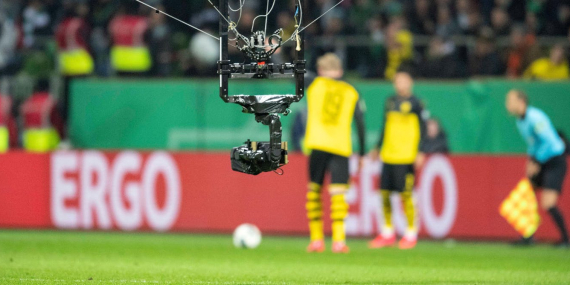
However, this World Cup will have cable-suspended, gyro-stabilised spider cameras swooping above the action. Expect to see them used more on the live action than in previous World Cups, perhaps even during penalty shootouts.
At every game there will be 45-50 cameras focused on the action including pole cams, cable cams, 360 cams and one new camera taking you closer to the action than ever before. “Referee view” will allow audiences to see what the referee sees. Cameras mounted on the referee, trialled at the Fifa Club World Cup last year, will show us what the ref can – and can’t – see. These points of view are not new to sports broadcasting (they are common in rugby) but the issue in the past has been the stability of the vision. For this competition, broadcasters will use AI stabilisation software to improve the smoothness of the shots.
The AI World Cup
AI-enabled 3D avatars will also assist VAR decisions by ensuring precision around player ID and tracking. This will drive semi-automated offside technology, so you’ll get greater quality images and faster, fairer decisions.
At the 2022 World Cup in Doha, Qatar, there was access all areas for a Netflix documentary called Captains, broadcast after the tournament. Ever since the Formula 1 Drive to Survive fly-on-the-wall format took us inside F1’s previously sacred inner sanctums, fans want to see everything on and off the pitch. But this year if you want to go behind the scenes, you’ll have to go online.
In a landmark partnership, Fifa have hooked up with TikTok and YouTube – two of the planet’s most popular content destinations. They’ll become Fifa’s first ever “preferred platforms”, a go-to place for fans and creators.
Trialled at the Women’s World Cup in 2023, the agreement will give TikTok ability to live-stream parts of matches, access to behind-the-scenes content and specially curated clips. Meanwhile YouTube’s deal permits broadcast partners to post highlights on the platform, live-stream some games in their entirety and give YouTube “first party” presence with archive matches from previous tournaments playing across the platform.
American sports coverage is all about entertainment and this World Cup even the statistics will be given a glow up. Get ready for something called “data-tainment”, providing fans with what Fifa describes as “unparalleled insight and enjoyment”. Expect a seamless integration of advanced analytics with real-time graphics, all based on official optical tracking data.
What’s the end goal? It seems Fifa want those at the stadium to enjoy the benefits of watching from their sofa (replays, stats, analysis) and those viewing from home to feel the more visceral, immersive aspects of being there at the stadium (cinematic lenses, wearable cameras, enhanced audio). At the stadium spectators will be able to see key decisions play out on the big screen, with real-time stats delivered to their phones. Stadium connectivity, an issue in the past, will be amped up to ensure everyone stays connected.
It’s a delicate balance. Despite the innovations announced, Fifa knows the enduring appeal of watching football is its simplicity. Traditional audiences do not want gimmicks disrupting their beautiful game. Fifa has a tightrope to walk because the American audience it so dearly craves like their sport packaged in a certain way. The rest of the world – well, they seem happy with football the way it is.
World Cups of the future will be a more immersive experience. Audiences at home wearing VR headsets as real-time player tracking graphics appear live in their lounge. But the reality remains that live football match coverage hasn’t changed that much in decades. What you get to watch won’t change much, but where you watch it will, traditional broadcasters no longer the only show in town. And it’ll be what happens in the stoppages and the moments around the game which is set for revolution. A revolution that will be televised – and streamed, downloaded and clipped to watch on catch up later.






Comments are closed.