



Kebenaran hakiki—apa yang dalam tradisi spiritual sering disebut sebagai Al-Haqq—sering kali hadir dalam wujud yang teramat murni, absolut, dan tak kasatmata bagi keseharian manusia. Ia ibarat pancaran cahaya putih yang menyilaukan; ada di sekeliling kita, meliputi segala eksistensi, namun terlampau abstrak untuk langsung digenggam oleh akal budi dan laku hidup manusia yang serbaterbatas.


Di sinilah kita memerlukan sebuah metodologi untuk membaca kehidupan. Dalam lanskap pemikiran Emha Ainun Nadjib (Cak Nun) dan gerak kebudayaan Maiyah, khazanah pemikiran serta nilai-nilai Islam hadir memenuhi ruang tersebut. Namun, ia tidak hadir sebagai sekat dogmatis yang kaku atau benteng eksklusif yang memisahkan manusia. Islam, dalam epistemologi Maiyah, diposisikan secara cerdas dan indah sebagai sebuah prisma.
Hukum Refraksi Kebenaran
Dalam ilmu fisika, sebuah prisma kaca tidak pernah menciptakan cahaya. Tugas prisma hanyalah menangkap seberkas cahaya putih murni yang semula tak kasatmata, lalu membiaskannya (refraction) menjadi spektrum warna-warni yang memukau: merah, jingga, kuning, hijau, biru, nila, dan ungu. Melalui proses pembiasan inilah, cahaya yang tadinya satu dan abstrak menjadi beraneka ragam, konkret, dan akhirnya bisa ditangkap serta diapresiasi oleh mata manusia.
Jika kita bawa metafora ini ke dalam ruang dialektika Maiyah, cahaya putih murni itu adalah Kebenaran Semesta—nilai-nilai fitrah kemanusiaan yang universal seperti keadilan, cinta kasih, kesetaraan, martabat, dan keindahan eksistensial. Nilai-nilai ini diakui dan dirindukan oleh setiap manusia, melampaui sekat suku, bangsa, maupun agama.
Ketika cahaya murni ini melewati prisma pemikiran dan metodologi Islam, ia mengalami refraksi yang luar biasa. Ia mewujud menjadi warna-warna prinsip yang siap diaplikasikan dalam kehidupan sehari-hari. Cahaya universal itu membias menjadi konsep rahmatan lil ’alamin (rahmat bagi semesta alam), melahirkan warna kesadaran bernama syukur, memancar menjadi laku muamalah yang berkeadilan, serta membiaskan metode tadabbur untuk membaca tanda-tanda zaman.
Merayakan Warna, Bukan Mendewakan Kaca
Di sinilah letak kejeniusan dan kejernihan cara pandang Cak Nun. Sepanjang perjalanan Maiyah, beliau tidak pernah mengajak orang untuk sibuk mengagumi atau “mendewakan” struktur kaca dari prisma itu sendiri secara formalistik. Maiyah tidak terjebak pada fanatisme wadah, melainkan fokus pada kemanfaatan isi.
Islam dalam ruang ini tidak dipahami sebagai institusi yang memenjarakan kebenaran, melainkan sebagai instrumen refraksi yang membuat Kebenaran Agung menjadi fungsional bagi manusia.
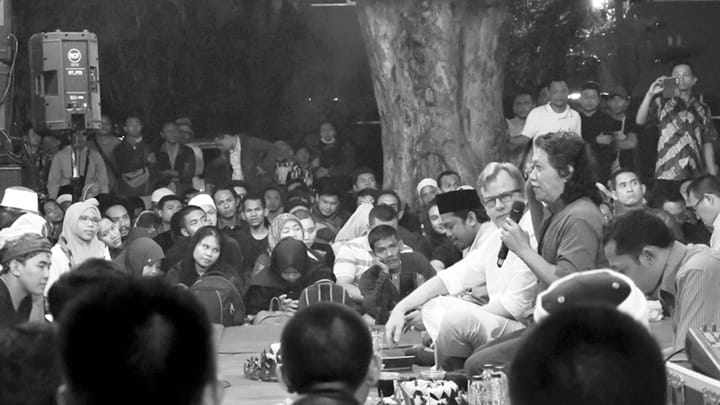
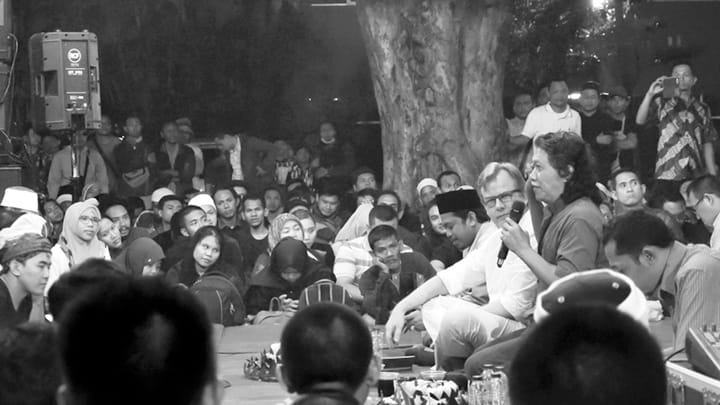
Pendekatan ini secara otomatis membebaskan Maiyah dari ketergantungan dogmatis yang sempit. Maiyah tidak menjadi eksklusif Islam secara institusional, namun ia menggunakan ketajaman lensa Islam untuk membedah kompleksitas eksistensi. Efeknya sangat membebaskan: siapa saja—tanpa memandang apa pun latar belakang iman, ideologi, atau status sosial mereka—bisa datang, duduk melingkar, dan sama-sama memanfaatkan kehangatan serta keindahan spektrum warna yang dihasilkan oleh pembiasan tersebut.
Seorang non-Muslim, misalnya, tidak perlu dipaksa menjadi bagian dari “kaca prisma” tersebut untuk bisa menikmati indahnya warna keadilan sosial atau ketulusan cinta kasih yang memancar darinya. Mereka berhak, dan sangat bisa, mereguk kesegaran warna-warna universal tersebut karena sumber asalnya adalah Cahaya Putih yang sama—Cahaya Yang Maha Esa.
Membaca Realitas
Dengan menggunakan metodologi prisma ini, Maiyah memberikan kita alat yang sangat lentur namun kokoh untuk membaca realitas eksistensi. Saat dunia modern hari ini kerap memaksa kita melihat segala sesuatu secara hitam-putih—terjebak dalam polarisasi politik, gesekan antar-iman, atau benturan kelas sosial—lensa pembiasan ini justru menyingkap bahwa hidup ini penuh dengan spektrum warna yang kaya.
Melalui pembiasan khazanah Islam yang kontekstual, Cak Nun mengajak kita untuk tidak menilai kehidupan secara sepenggal atau seserpih. Kita diajak melihat bagaimana warna spiritualitas bertali-temali dengan warna kebudayaan, bagaimana warna keadilan ekonomi berkelindan dengan tanggung jawab ekologis. Semua warna itu penting, dan semuanya saling menggenapi untuk membentuk satu bulatan pemahaman yang utuh (komprehensi pandang).
Pada akhirnya, ruang khidmat yang dibangun di Maiyah membuktikan bahwa agama, ketika diletakkan sebagai prisma pembias cahaya universal, tidak akan pernah menjauhkan manusia dari kemanusiaannya. Ia justru mendekatkan. Ia tidak menciptakan jarak, melainkan melarutkan pembatas, mengajak kita semua untuk tidak sekadar mengagumi instrumen keagamaan, melainkan menjadi saksi sekaligus pelaku dari indahnya pelangi kebenaran di muka bumi.
The Prism of Truth: Reading the Spectrum of Values within the Maiyah Circle
Ultimate truth—what spiritual traditions often term Al-Haqq—frequently manifests in a form that is too pure, absolute, and invisible to the naked eye of human daily life. It is like a blinding beam of pure white light: it encompasses all existence and surrounds us completely, yet remains too abstract to be immediately grasped by the limited reach of human intellect and everyday behavior.
This is precisely where we require a methodology to read and interpret life. Within the philosophical landscape of Emha Ainun Nadjib (Cak Nun) and the cultural movement of Maiyah, the rich treasury of Islamic thought and values steps into this space. Yet, it does not arrive as a rigid dogmatic barrier or an exclusive fortress that segregates humanity. Rather, in the epistemology of Maiyah, Islam is intelligently and beautifully positioned as a prism.
The Law of Spiritual Refraction
In physics, a glass prism never creates light. Its sole function is to capture a beam of invisible pure white light and refract it into a mesmerizing spectrum of colors: red, orange, yellow, green, blue, indigo, and violet. Through this process of refraction, what was once uniform and abstract becomes varied, concrete, and ultimately visible to the human eye.
If we apply this metaphor to the dialectics of Maiyah, the pure white light represents Universal Truth—the primordial human values (fitrah) such as justice, love, equality, dignity, and existential beauty. These are values yearned for by every human soul, transcending the boundaries of tribe, nation, or creed.
When this pure light passes through the prism of Islamic thought and methodology, it undergoes a profound refraction. It manifests as a spectrum of actionable principles for daily life. The universal light refracts into the concept of rahmatan lil ’alamin (a blessing for all creation), radiates the vibrant color of syukur (mindful gratitude), pours into just social interactions (muamalah), and projects the method of tadabbur (deep reflection) to read the signs of the times.
Celebrating the Colors, Not Worshiping the Glass
This reveals the brilliance and clarity of Cak Nun’s perspective. Throughout the journey of Maiyah, he has never invited people to merely admire or “worship” the physical glass structure of the prism itself in a formalistic manner. Maiyah never traps itself in the fanaticism of the vessel; its focus is entirely on the utility of the essence.
Within this space, Islam is understood not as an institution that imprisons truth, but as an instrument of refraction that makes the Supreme Truth functional for humanity.
This approach automatically liberates Maiyah from narrow dogmatic dependency. Maiyah does not become institutionally exclusive to Islam, yet it utilizes the sharp focus of the Islamic lens to dissect the complexities of existence. The liberating effect is profound: anyone—regardless of their faith background, ideology, or social status—can come, sit in the circle, and mutually benefit from the warmth and beauty of the refracted spectrum.
A non-Muslim, for instance, does not need to be forced to become part of the “glass prism” itself to appreciate the beauty of social justice or the sincerity of love radiating from it. They have every right, and the full capacity, to absorb the freshness of these universal colors because the primary source is the exact same White Light—the Light of the One Supreme Source.
Reading the Geometry of Reality
By deploying this prism methodology, Maiyah equips us with a tool that is highly flexible yet remarkably resilient for reading the complexities of existence. At a time when the modern world consistently pressures us to view everything in binary black-and-white—trapped in political polarization, interfaith friction, or class struggles—this lens of refraction reveals that life is instead a rich, multi-hued spectrum.
Through the contextual refraction of Islamic wisdom, Cak Nun invites us not to judge life in fragments, patches, or splinters (sepenggal, sepetak, atau seserpih). We are guided to observe how the color of spirituality is intertwined with the color of culture, and how the color of economic justice is inextricably linked to ecological responsibility. Every color matters, and each complements the other to form a complete, holistic understanding (komprehensi pandang).
Ultimately, the sacred, reflective space built within Maiyah proves that when religion is positioned as a prism that refracts universal light, it never distances human beings from their humanity. It does the exact opposite: it draws us closer. It does not create borders; it dissolves them, inviting us all to stop merely romanticizing the instruments of faith and to become active witnesses and practitioners of truth’s beautiful rainbow on earth.
















Comments are closed.