


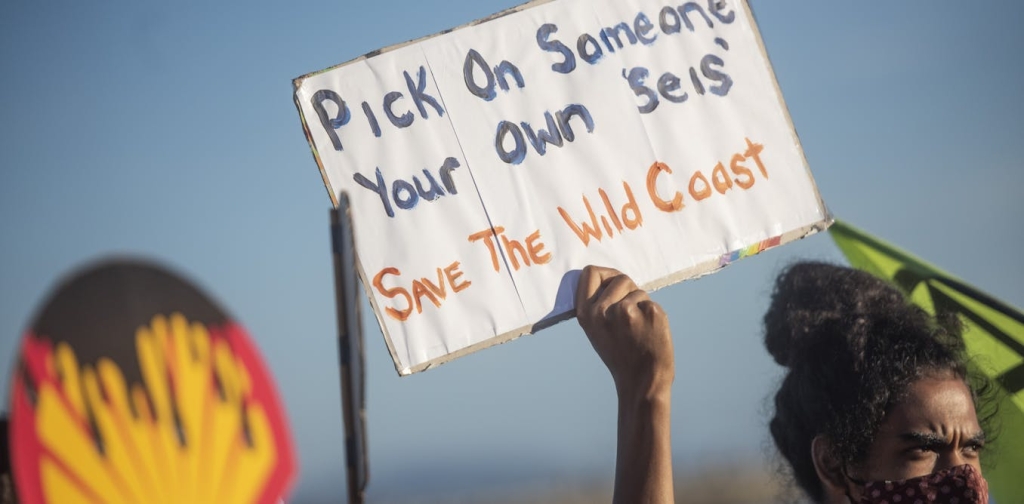

South Africa’s Constitutional Court – the country’s highest court – handed down a landmark judgment for climate change and environmental justice in mid-August 2026.
The companies had planned to use seismic surveys in the waters off the country’s Wild Coast. These surveys use powerful sound waves to map underground rock formations.



The Wild Coast is an ecologically rich stretch of South Africa’s Eastern Cape coastline. The communities who’ve lived there for thousands of years have close cultural and livelihood ties to the ocean. The intense underwater noise generated by seismic surveys raised concerns about potential harm to marine species and ecosystems.

The Constitutional Court said that the exploration right had to be set aside because of serious flaws in the decision by government to grant it. These flaws included inadequate consultation with communities, and failure to consider important environmental and climate concerns.
This judgment means that Shell and Impact Africa can no longer rely on this exploration right to search for oil and gas along the West Coast.
It marks the end of a high profile dispute that started in 2021. Six communities, NGOs and environmental justice organisations approached a lower court, arguing that they’d not been consulted about Shell’s plans. Since then the case has been heard by two courts. It finally went before the Constitutional Court, the final arbiter under South African law.
Read more: Planned seismic survey by Shell has kicked up a storm in South Africa. Here’s an explainer
It is the first ever climate case to reach South Africa’s Constitutional Court as the dispute was not only about possible harm to marine life: one of the key legal questions was whether the climate impacts of new oil and gas exploration had been properly considered.
I am a specialist in environmental and climate change law who researches how international and domestic law can be used to advance climate justice across Africa. I argue that the judgment is a real milestone in climate justice. Climate justice is the idea that climate change is not experienced equally and that those who benefit from environmentally harmful activities are not necessarily those who bear their costs.
The ruling reflects the court’s own observation: climate change has moved from the margins to the “centre of legal accountability”.
Five key dimensions of climate justice emerge from the court’s approach.
The first is procedural justice: who gets a say? The second relates to recognition justice. This asks whose identities, histories and relationships with nature count. The third is distributive justice – who receives the benefits of development and who bears its costs. The fourth is inter-generational justice. This asks what today’s decisions mean for future generations. And the fifth is that the judgment creates space for thinking about justice beyond humans.
The judgment sets an important precedent (a legal ruling that can guide how similar cases are decided) for future climate cases and decision-making across South Africa. It also connects South African constitutional law to a growing global body of climate law focused on legal accountability, human rights and justice.
The court has put climate change at the heart of environmental decisions
Section 24 of South Africa’s constitution gives everyone the right to an environment that is not harmful to their health or well-being. The constitution says the environment must be protected for present and future generations.
The judgment emphasised that the government cannot treat environmental protection as something that comes after economic development.
Read more: Why South African community’s win against mining company matters
In other words, if the government is deciding whether to approve a mine, oil project, road or other development, it must consider both the benefits of the project and the harm it could cause to people and the environment. Those decisions must be fair to people living today as well as future generations.
This is important in South Africa, which has experienced hundreds of years of colonialism and apartheid. Any damage done to the climate and environment is a harm that is layered on top of deep, existing social and economic inequalities.
The court’s reasoning
The judgment shows that climate change cannot be separated neatly from questions of race, class, history, culture, participation, development, future generations and ecological protection.
Procedural justice: The court makes it clear that consultation is not an administrative box to tick. Public participation in decisions affirms dignity by giving affected people “a seat at the table”. It recognises affected communities as participants rather than obstacles to development.
Recognition justice: This asks whose identities, histories and relationships with nature count and should be considered in government decisions. The communities’ concerns involved livelihoods, cultural and spiritual practices and connections with ancestors and the ocean environment. The court placed these within a longer history of dispossession and marginalisation of coastal communities.
Third, distributive justice: This asks who receives the benefits of development and who bears its costs. The court questioned assumptions that all oil and gas projects create jobs. It asked who receives those jobs and what social, ecological and cultural costs affected communities must bear. It stated:
Investment without benefit to those who are most vulnerable and most affected is not in the public interest.
Fourth, inter-generational justice: This asks what today’s decisions mean for future generations. Section 24 itself protects the environment for present and future generations. The Constitutional Court connects sustainable development and international climate obligations to the foreseeable effects of emissions on future generations.
Finally, the judgment creates space for thinking about justice beyond humans. Concerns about marine and bird life and the court’s emphasis on ecological systems invite a broader understanding of justice that includes ecosystems and other species.
Global climate law and South Africa
One of the judgment’s most significant contributions is its treatment of international climate law.
The court states:
Climate change, by its nature, transcends borders. Its causes are diffuse, its consequences shared but uneven and its governance inherently international.
In simple terms, decisions made in South Africa can contribute to climate impacts elsewhere, just as South Africa is affected by emissions from other countries. This is why the government’s climate responsibilities are also shaped by international law.
The court also looked at recent climate advisory opinions from the International Court of Justice, the International Tribunal for the Law of the Sea and the Inter-American Court of Human Rights.
Together, these opinions make it clear that governments have legal duties to prevent serious environmental harm caused by climate change.
Referring specifically to the International Court of Justice 2025 climate advisory opinion, the court stated that the South African government must also prevent significant environmental harm, exercise due diligence and consider the foreseeable effects of emissions on present and future generations.
What happens next?
The Constitutional Court has sent a clear message to the South African government: environmentally significant decisions cannot ignore climate change. Environmental risks, constitutional rights and the interests of affected communities must form part of lawful decision-making.
The judgment does not say that fossil fuel exploration or other development projects can never be approved. But it means that fossil fuel companies must properly consult communities that could be negatively affected by drilling or exploration. It also means that these companies must follow environmental laws before they invest in exploration.
Shell and Impact had already invested around R1.1 billion (US$62 million) on the project. However, the court said the fact that the companies had already spent a lot of money did not mean they could override people’s constitutional rights, or expect those rights to take second place to commercial interests.
For future climate litigation, the judgment provides communities and other rights holders with stronger constitutional grounds for demanding that climate change, participation, culture, dignity and inequality are taken seriously. It also connects Section 24 directly with the rapidly developing international law on states’ climate obligations.


















Comments are closed.