


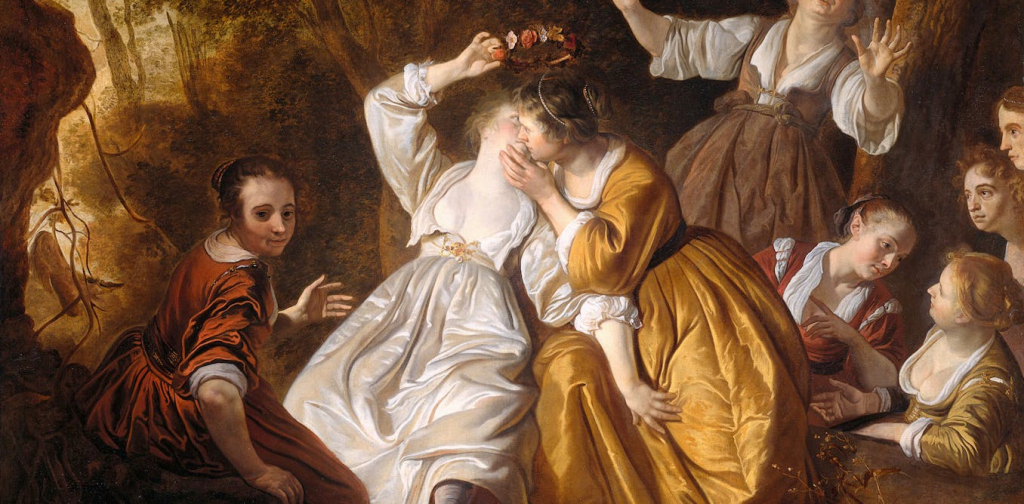

Marie Maitland, a 16th-century Scottish gentlewoman, has for centuries been recognised as the likely scribe of the Maitland Quarto. This important manuscript, now held in the Pepys Library of Magdalene College, Cambridge, is an anthology of Scottish poetry by members of the noble Maitland family and their associates.

Maitland’s name appears twice on the first leaf and is also found in a partial anagram in the opening sonnet (“maid ane immortall”). By way of emphasis the anagram is repeated beneath the poem.
In recent years, researchers have acknowledged the probability that Maitland not only copied and curated the manuscript, but that she also composed some of the poems.
This includes, most notably, Poem 49, a lyrical exploration of one woman’s desire for and commitment to another. This is an erotic as well as an emotional poem. At the end of the second stanza, the speaker submits to her lover:
Ye weild me holie at your will /
and raviss my affectioun.
In her new book With My Own Hand: The Secret Life of Marie Maitland, Scotland’s Sixteenth Century Sappho, historian and translator Ashley Douglas places an analysis of Poem 49 at the heart of her thoughtful and often speculative reconstruction of this early modern woman’s queer life.
Douglas contends that Maitland included within the manuscript two further sapphic poems: Poem 72, which she argues was written by Maitland’s unidentified married woman lover and Poem 89, composed by Maitland herself. Douglas suggests that the three poems, read together, tell the story of their relationship and its unhappy ending. Another verse, which may have been written either for Maitland by another woman or about herself, compares her to Sappho, the famous lesbian lyrical poet of ancient Greece.
Reclaiming lesbian history
Digging deep into the archives to find long overlooked records, Douglas discovered that Maitland was born in the late 1540s. She remained unmarried until after the death of her father, the courtier Sir Richard Maitland, which occurred when she was in her late thirties.
Up to this point, Maitland enjoyed considerable financial independence. Douglas convincingly argues that her father did all he could to ensure that this would be maintained after his death. This was likely a reward for her serving as his scribe after he lost his sight. Unfortunately, the plan didn’t work. When her brother John (the future Lord Chancellor of Scotland) became head of the household, for reasons of political and financial expediency, Maitland was quickly married off to a much younger man. She died just ten years later, possibly in childbirth.
According to Douglas, Maitland should be recognised as a “new Anne Lister”. Lauded as the “first modern lesbian”, Lister – a member of the Yorkshire landed gentry – enjoyed an unusually autonomous life in the first half of the 19th century.
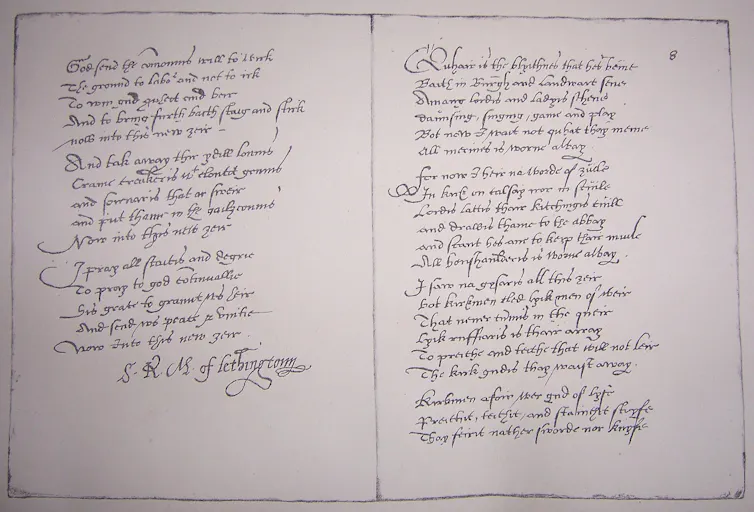
From her extensive diaries, which were partly written in her “crypt hand” code, we know Lister had multiple relationships with women. Indeed, she wrote explicitly about her sexual experiences, finding the terminology to describe them in the epigrams of the ancient Roman poet Martial and other sources. Maitland, on the other hand, wrote about love and desire, but not about sex itself.
In this respect, I would suggest, Maitland’s verses anticipate more closely the late 17th-century poetry of Katherine Philips and her circle, which depicts intensely amorous friendships between women in platonic terms.
Douglas, however, rejects describing the desire for women expressed in Maitland’s poetry in terms of friendship on the grounds that such labelling renders historical lesbianism invisible.
It is certainly the case that the burden of proof seems much higher when it comes to sexual relations between women. Without the sort of detailed firsthand accounts found uniquely in Lister’s diaries, or the vanishingly rare evidence from court cases or other official records, the default assumption is often that women in the past did not have sex with each other.
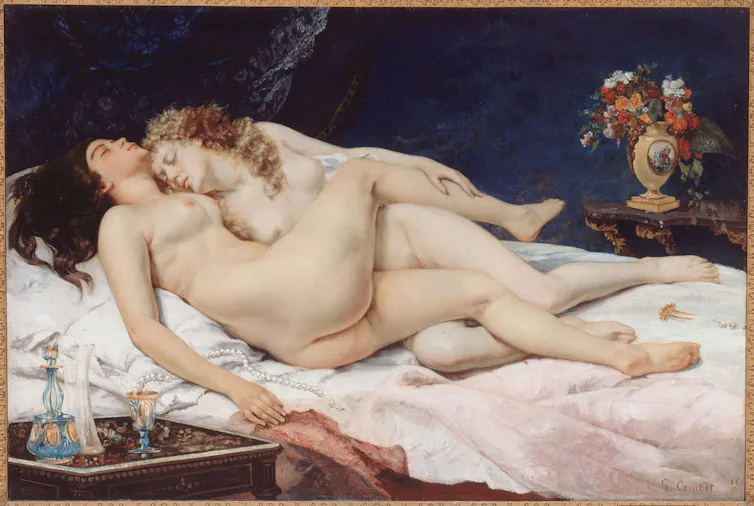
This assumption is made even when the women are known to have shared a home (the British Museum, for example, is equivocal about the nature of the relationship between the Ladies of Llangollen, who famously eloped and lived together and even shared a bed). But what is perhaps most remarkable about Lister’s diaries is that they reveal that so many women in her social circle, whether they were single, married or widowed, had relationships – and sex – with her.
If we didn’t have Lister’s diaries, we simply wouldn’t know about this aspect of their personal lives. With this context in mind, the possibility that, two centuries earlier, the young Maitland had a sexual relationship with another woman, seems perfectly plausible.
Between 2019 and 2022, the television series Gentleman Jack portrayed Lister (played by Suranne Jones) as a highly intelligent, charismatic, sexually liberated and gender non-conforming lesbian in search of commitment in late Georgian England.
Douglas represents Maitland as Lister’s sapphic forebear – an educated, intellectual and self-determining woman who found (and, sadly, lost) her love, and much of her liberty, in the repressively patriarchal and conflict-riven environment of Reformation Scotland. In this respect at least, Maitland could be considered the new Gentleman Jack.
This article features references to books that have been included for editorial reasons, and may contain links to bookshop.org. If you click on one of the links and go on to buy something, The Conversation UK may earn a commission.















Comments are closed.