


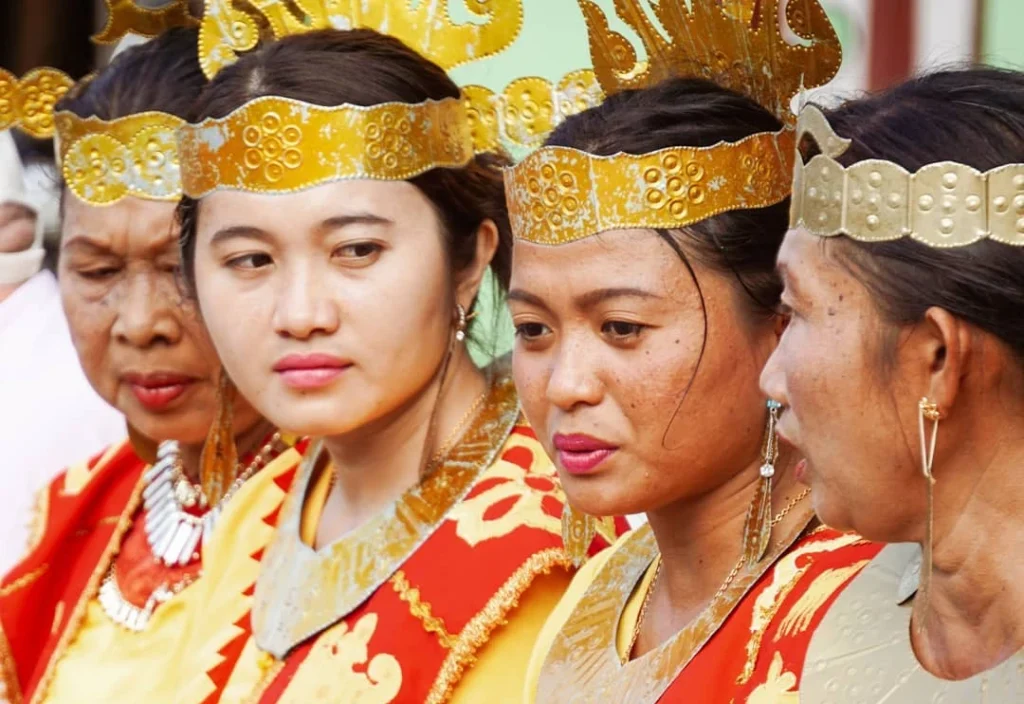

It always begins with the soft sound of footsteps, wood being shifted, water being drawn. When the sky was still dark, and the rooster had not yet fully crowed, Ina Samaeri was awake. She is a woman who lives in Balodano, West Nias Regency, North Sumatra Province, Indonesia.
Her body moved as if it knew what to do, even before the day had really begun. Mohalöwö (work) comes earlier than light. It is not something that is asked about, nor is it chosen. Work is a sinangea mufalua (obligation) that is simply inherited, especially for women.


Ina Samaeri prepares a simple breakfast, boiling gowi (sweet potato) and gae (banana), making sure there are provisions that can be taken to the laza (rice field) or kabu (field) later. Everything was done quickly, quietly, as if time should not be wasted on hesitation.
I remember her body always moving. It never truly stopped. Even when she was inötö manabina (heavily pregnant) or had just given birth, work still awaited. There was no room for delay.
There was no language to describe tiredness. There was only halöwö sabua (hard work) that was endured like breath, unconsciously, unquestioned. As the sun began to rise, Ina Samaeri was already walking towards the fields. Sometimes she returned home when it was almost dark, because her provisions were eaten in the ose (small hut) in the middle of the fields.
Her body carried a burden beyond just the fruits of her labor. She carried the hopes of her family, the needs of her home, and something never directly mentioned, which is the responsibility to leave no one wanting. In our village, women like Ina Samaeri were breadwinners. But those breadwinners were never named, never praised, and rarely heard.
The world where Ina Samaeri lives
In Balodano, women’s work was never considered special. It existed as something taken for granted, almost invisible. From childhood, I learned that there was a division of labor that was never written down, but was dutifully carried out. Ono alawe (girls) grew up at a certain distance from decision-making spaces. They learned to observe, help, and wait.
Women were not encouraged to go far. Schooling was sufficient to the extent deemed necessary. Anything beyond that was considered excessive. There was a belief that lingered among us that higher education was more appropriate for onomatua (boys), because they were the ones who would later carry the family name. Women, on the other hand, were prepared to remain close to home, to the kitchen, to the fields.
When guests arrive, the ono alawe are directed to the back. Not because they are unimportant, but because that is the appropriate place. Preparing food, serving drinks, and ensuring everything runs smoothly is silent. Silence is taught as a form of si fao falöfaröi (obedience). Too much talk can bring fa’aila (shame), not only to oneself but also to the family. Adult women live in a similar pattern.
Read More: Why Gender Sensitivity Matters for Disaster Risk Reduction in Indonesia
They are rarely involved in decision-making, both within the family and in the wider social sphere. Their voices are not truly sought, as they are deemed unnecessary. What is guarded is fosumange mboto (self-respect), but that self-respect often means the ability to bear burdens without complaint.
I grew up seeing all of this as normal. There is no such thing as injustice. There is no such thing as inequality. There are simply customs, passed down from one generation to the next, accepted without question. And within these customs, women’s bodies continue to function.
When work is no longer neutral but hurtful
There were days when I saw Ina Samaeri walking slower than usual. Her hands still carried weight, but her steps were halting. Her body was inötö manabina (heavily pregnant), but her work never adjusted to it. Mohalöwö (work) continued to wait, as if a woman’s body had no right to ask for a break.
Early in the morning, she set off for the fields, walking for almost an hour. No transportation, no other options. Halöwö sabua (hard labor) became part of her daily routine, hoeing the fields, clearing the ashes, and carrying firewood.
As the sun rose, sweat mixed with her labored breathing. There was no one to ask if she was up to it that day. There was only the necessity to keep moving.
I remember that after she gave birth, time seemed to give no room for recovery. A body that had just gone through a long illness had to wake up again before dawn. The baby was left at home or carried while domestic chores awaited. It was as if a woman’s body was always considered ready, always considered capable, even when it was clearly fragile.
Read More: No More Silence, Let’s Talk About Unwanted Pregnancy
Meals were taken in an ose (small hut) in the middle of the fields. The provisions were simple: gowi, gae, and a little rice. Never enough to replace the drained energy. But Ina Samaeri never complained.
Silence was part of the si fao falöfaröi (obedience) taught long ago. Complaining would only increase fa’aila (shame), as if fatigue were a personal failure, not the result of an overwhelming burden.
At the time, I didn’t have the words to describe what I saw. I only knew that the women’s bodies in my village worked relentlessly, even when they should have been resting.
They bore not only the work but also the hope of ensuring that their children would not starve, that the house would keep running, that the family’s needs would be met, especially for the sake of others’ dreams.
In Balodano, women’s bodies are rarely seen as fragile. They are more often seen as available.
When what was considered normal starts to feel strange
I don’t remember one major moment that suddenly changed the way I saw the world. The realization came slowly, like a tiny crack that appeared silently. It grew from things I had previously taken for granted. From the constant work of women’s bodies. From the silence that was passed down as virtue.
As a child, I watched Ina Samaeri and other women in my village go through similar days. They rarely sat down without a reason. If their bodies stopped, there was always an explanation: illness, too tired, or no work. Rest never stood alone as a right. It always had to be justified.
I began to realize that ono alawe and onomatua did not grow up with the same expectations. Boys were talked about for their futures. They were mentioned in adult conversations about school, about traveling far away, about dreams. Girls, on the other hand, were more often spoken about in the context of helping, caring, and fitting in. They were taught from an early age not to expect too much.
That realization made me see work differently. Mohalöwö was no longer just a daily activity, but a language used to regulate who had the right to dream and who should support it. Women’s work kept things going, but their existence was rarely acknowledged as anything more than a duty.
Read More: Arrests at the End of the Day: Arrested While Hanging Out, Allegations of Sexual Harassment
I realized that what was happening in my village was more than just physical exhaustion. There was something deeper at work, where gender dictated who was worthy of being heard and who should remain silent. Women were taught to maintain their fosumange mboto (self-respect) by holding back, by not demanding, by accepting.
At that point, I began to ask questions, though I didn’t yet dare to speak them aloud. About why women’s bodies were always considered available. About why their work was never enough to give them a voice. About why dreams were often built on the exhaustion of others. The crack was small. But from that moment on, I could never see things the same way.
When village stories speak to the world
What I saw in Balodano wasn’t an isolated story. It was part of a broader pattern, one that exists in many places, with different names and faces.
In many communities, women’s bodies are often the spaces where obligations are imposed without question, without much choice. This experience taught me that gender inequality rarely manifests as overt violence. It often infiltrates through habit, through what is considered normal.
Women’s work is framed as devotion, not as equal contribution. Silence is disguised as obedience, not as a limited space for voice.
In many places, dreams are not shared equally. Some dreams are nurtured, discussed, and given resources. Others are pushed aside, deemed too big, or unnecessary. When women’s education, time, and energy are directed toward supporting the dreams of others, what is being robbed is not only individual opportunities but also the collective right to determine the direction of one’s life.
Read More: 2025 Year-End Edition: Women’s Resistance in the Season of Arrests and the Year of #DemocracyApocalypse
This reflection led me to understand that rights are not always taken by force. They are often relinquished gradually, until they are no longer recognized as something that should be had. The right to rest. The right to recover after childbirth. The right to be heard in decisions concerning one’s body and future.
The story of women in Balodano is a story of dignity maintained amidst exhaustion. It’s about bodies that sustain life, yet are rarely recognized as subjects with the right to choose. This is where the voice of gender finds its meaning, not as a loud demand, but as a reminder that justice begins with the recognition of bodies and experiences that have been marginalized.
Understanding this, I see that the struggle for gender justice doesn’t always begin on the big stage. It often stems from small memories, from villages far from the center, from bodies working in silence.
A voice born from memory
When I think back to Balodano, what comes to mind isn’t a major event, but rather bodies that continue to work. Women who wake up before dawn and return home when the day is almost over. They never call themselves strong, but their lives demand that strength every day.
Ina Samaeri may never have called what she experienced injustice. She simply lived day by day, ensuring that no one lacked. But within her work and silence, there’s a resilience rarely given space to be recognized.
Those breadwinners stand anonymously, supporting much, but are rarely addressed. Writing this isn’t my attempt to speak for them. It’s my way of preserving their memory, so that the work that has long been taken for granted doesn’t completely disappear.
So that the women’s bodies I’ve seen don’t remain merely in the background, but as part of a history worth remembering. Perhaps voices don’t always come as screams. Sometimes, they come as memories that are finally given a place.
(Editor: Nurul Nur Azizah)
(Source Illustration of Nias Women in North Sumatra from @goniastour)
















Comments are closed.