




It’s one of the clearest things about me. I’m black and white … I think I cried for a month when we lost the FA Cup Final in 1974. I was only ten and it was near my birthday as well. I was absolutely gutted. [Jo, Newcastle fan since the 1970s]
Sexism in football, according to a recent BBC report is “a problem that isn’t going away”. When working on my book The Feminization of Sports Fandom, I discovered that the increasing opportunities for women to become football fans over the last three decades has not automatically led to equality.



Now a University of Durham exhibition based on my work will play a role in challenging negative attitudes and help reimagine a more positive future for women football fans.
My research draws on more than 200 interviews with women sports fans in the UK. These accounts demonstrate that sexism and misogyny have been, and continue to be, rife in football. This work has contributed to several UK parliament select committees, with findings providing evidence for the urgent need for safer, more welcoming and inclusive environments for women fans.
It shows how various strategies are used by men to undermine the status of women as “real” or “authentic” fans, and that women are routinely required to “prove” themselves as such. This is supported by statistics from football’s anti-discrimination organisation Kick It Out, which received reports of more than double the number of sexist incidents at football matches this season (2025/26) compared with the same point last season.
Colleagues and I also undertook the first research on UK male football fans’ attitudes towards women, surveying 1,950 men. It revealed that openly misogynistic attitudes still dominate football fandom in the UK. Three-quarters of men held either overt or covert misogynistic attitudes towards women in football.
To address this, we wanted to stage an exhibition that would call out common misperceptions of female fans. Away From Home: The Untold Stories of Women Football Fans is in equal measure about celebration and challenges. Co-designed with David Wright from Durham University’s Museum’s Galleries and Exhibitions Team, it recognises women’s memories and experiences as football fans – past and present – preserving these stories for the future.
Raising the profile of female fans
The lack of visibility of female football fans in popular and academic accounts, combined with assumptions that women did not attend football matches in the past, has contributed to the widely held views that women fans are less “authentic”. Or they are perceived as newcomers to football with less knowledge and thus treated with less respect.
Our exhibition, currently on show at the Beacon of Light in Sunderland, shares personal accounts of women fans of Newcastle United and Sunderland AFC from the 1950s to the present day, and reveals such assumptions and prejudices to be completely false.
This pop-up show is also about opening up challenging conversations regarding the work that is still needed to create safer spaces for all girls and women. Giving a platform to the experiences of female fans – both positive and negative – can help lead to changes in attitudes and a new appreciation for these women.
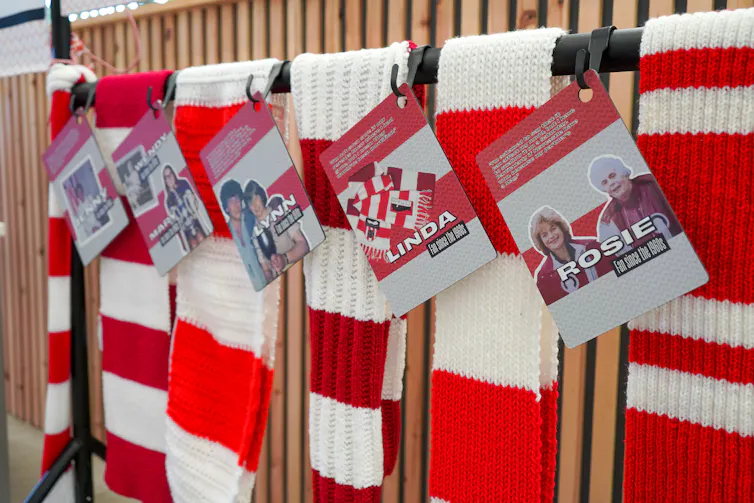
Despite football playing such an important part of culture, exhibitions on football are rare. Exhibitions with a fan focus even more so, and those focusing on female fans almost non-existent until now. Designed in the style of matchday stalls, the exhibition is popping up at sports centres and supporter fanzones such as Sunderland’s Beacon of Light.
Each fan featured is represented by a homemade football scarf, produced by supporters in a reference to an age before mass-produced official merchandise. Visitors can wear these scarves as they browse the stories, creating connection and emphasising the universal elements of football fan experiences. This familiar space and accessibility is critical if we are to unlock some of the challenging issues of sexism and misogyny that lie at the heart of this research.
Many of the stories emphasise the lifelong connections between fans and clubs that will be relatable to all fans, irrespective of club or gender. Margaret, a regular at Sunderland since the 1950s, sums this up:
Your football team gets into your heart and that’s where it stays. You cannot change that. My heart is with Sunderland Football Club, has been since my dad took me, and that’s the only place I would ever go.
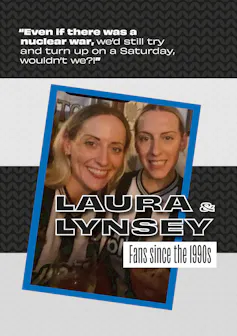
Many featured fans describe gender inequalities in their experiences. This includes the expectation of giving up attending matches after marriage or starting a family, despite male partners continuing to attend.
There are also examples of sexism and extreme hostility towards women’s presence in the football stadium across all generations – as Beryl, a fan since the 1950s, describes: “The men just assume that you’re an idiot. Because they’re a man and football’s their game.” Lynsey, a fan since the 1990s, agrees: “We hear comments like: ‘What would you know about football? You’re a woman.’”
Creating better spaces for women
Highlighting these experiences can help us to reconsider negative attitudes to women fans today and imagine what the future could look like for them.
For a long time, women fans have felt they needed to accept what Newcastle fan Tracey describes as “football’s terrible sexist culture”, but there is a sense that this is changing.
As the exhibition tours, our work in collaboration with police and other major groups and organisations is developing solutions based on evidence that will help create safer, more welcoming and inclusive spaces for women fans. This includes improvements in national mechanisms for reporting and responding to violence and abuse.
Football can be an important force for positive social change. This exhibition and the research that underpins it forms part of these wider collective efforts to increase public awareness and understanding of the challenges women fans face. But crucially, it also celebrates these women’s lifelong memories, and the powerful sense of identity being a football fan can provide.























Comments are closed.