


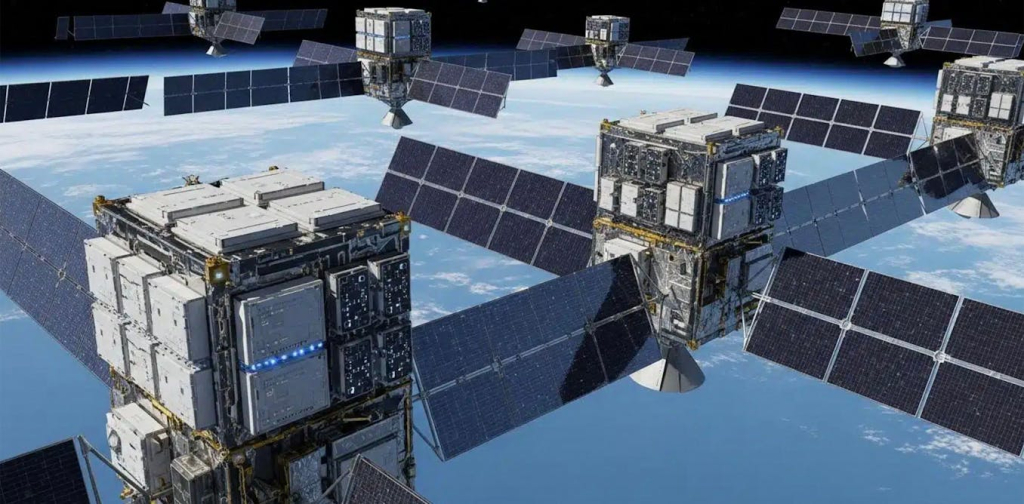

AI companies increasingly want to move their operations into space. Elon Musk’s SpaceX has applied to launch over a million AI data centre satellites and ultimately build them on the moon.
Jeff Bezos, Google, OpenAI and others have similar plans. The idea is to harness 24/7 solar energy and, in Bezos’s vision at least, to move all polluting industries off-world, re-zoning Earth for humans and nature.



It’s an intriguing plan. But once you factor in the whole life cycle, from water and rocket fuel used to launch these satellites into space, to keeping them cool and eventually disposing of old satellites, the environmental case becomes less clear.
Outer space, out of mind
Off-worlding polluting industries is not a new idea. In the 1970s, when the last Iranian oil crisis caused rocketing fuel prices, Nasa kicked off a plan to build huge solar plants in space. The idea flopped when the oil began to flow again.
Nasa also explored the prospect of storing nuclear materials on the moon and blasting hazardous waste at the sun. These plans may have been feasible from an engineering perspective but were politically impossible due to the risk of radioactive particles eventually falling back to earth.

Since data centres need so much energy, much of it for AI, such astronomical ideas are back on the table. Regular Earth-based data centres were responsible for around 5% of all electricity used in the US last year, for instance, mostly using fossil fuels. Their share of US power demand will likely triple by 2028.
The fragile frontier
That’s why the cold vacuum of space, with its endless supply of solar energy, is being pitched as a more sustainable alternative to big, noisy, hot data centres in our back yards.
Meanwhile, a recent petition from environmental law charity Earthjustice, is calling for a comprehensive review. They argue these proposals fail to acknowledge any environmental impact. “This is not just poor planning and a missed opportunity”, the petition states, “it violates federal law”.
Indeed, SpaceX’s planning applications come with assurances of no meaningful environmental impact. “It’s always sunny in space,” according to Musk, who says orbital data centres are “obviously the only way to scale”.
Yet data centres in space would be even more prone to overheating than those on earth. That’s because, like a Thermos flask, space keeps things hot. There’s no water or air to carry excess heat away. Instead, keeping powerful AI chips cool in orbit requires massive ammonia-filled radiators that let heat escape as infrared radiation. This isn’t very efficient and those radiators are much larger than the computers they cool. Lifting these huge structures to orbit would require a lot of rocket fuel.

Most plans for orbital data centres depend on the future success of SpaceX’s heavy-lift Starship. But every Starship launch burns over 1,000 tonnes of liquid methane, releasing around 80,000 tonnes of CO₂ (about the same as what 20,000 cars emit in a year). The warming associated with soot emissions in the upper atmosphere is 500 times more intense than the same emissions at ground level. We know soot from rockets reduces stratospheric ozone – the stuff shielding us from harmful UV rays. In the lower atmosphere, most soot falls back to Earth in weeks. In the stratosphere, soot stays there for up to four years, prolonging its damaging effects.
While it is always sunny in space, solar panels degrade much quicker there. Microchips are also easily damaged, falling prey to a phenomenon known as “bit flipping” – when high-energy particles rewrite memory hardware randomly changing data from 1 to 0. Retrieving busted hardware from space is not financially viable. SpaceX satellites have a five-year shelf life before being incinerated as they fall back to Earth. The environmental impacts of things burning up in the atmosphere are not well known.
Musk’s AI satellites would be connected by lasers. Should any one of the million or so satellites become untethered and collide with another, it would create further debris, creating more risk of collisions, more debris, and so on. Scientists call this the Kesler Syndrome and worry that orbital debris fields could hinder human activities in space for a very long time.
Orbital data centres would have a huge water footprint too. To catch toxic dust and protect their concrete launch pad from heat damage, a typical spaceport uses a deluge system releasing around 2 million litres of water with every launch. SpaceX has repeatedly broken environmental laws with its deluge system, allowing contaminated run-off from Starship launches to enter protected waters off the coast of Texas.
Some suggest these sci-fi schemes are designed to prop up SpaceX’s teetering stock price, rather than humanity’s computing needs. Others see orbital data centres as just one of many ambitious visions to tackle the environmental costs of AI. Either way, my research suggests this quest to off-world the industry’s headaches will have profound implications that are not well understood.




















Comments are closed.