



Bincangperempuan.com- Global efforts to eliminate female genital mutilation/cutting (FGM/C) continue to face a harsh reality: the number of women and girls subjected to the practice is increasing, not declining. Although the international community has committed to ending FGM/C by 2030 under Sustainable Development Goal (SDG) 5.3, conditions on the ground show an alarming trend.
According to the latest data from UNICEF and the World Health Organization (WHO), the number of women and girls who have undergone female genital mutilation/cutting (FGM/C) has continued to rise over the past two decades. In 2000, an estimated 130 million women and girls were living with the consequences of FGM/C. By 2010, this figure had increased to around 200 million. In 2016, approximately 200 million cases were recorded across 30 countries in Africa and the Middle East. The number rose further to an estimated 230 million in 2022, and in 2024–2025 it is projected to reach between 230 and 250 million, although comprehensive global data have not yet been fully finalised.


This increase reflects both the expansion of the practice into new regions and the growing trend of medicalisation. Malaysia, Indonesia, Sudan, and several Asian countries show signs of the “normalisation” of FGM/C within both Muslim and non-Muslim communities, even though the majority of cases remain concentrated in West and East Africa.
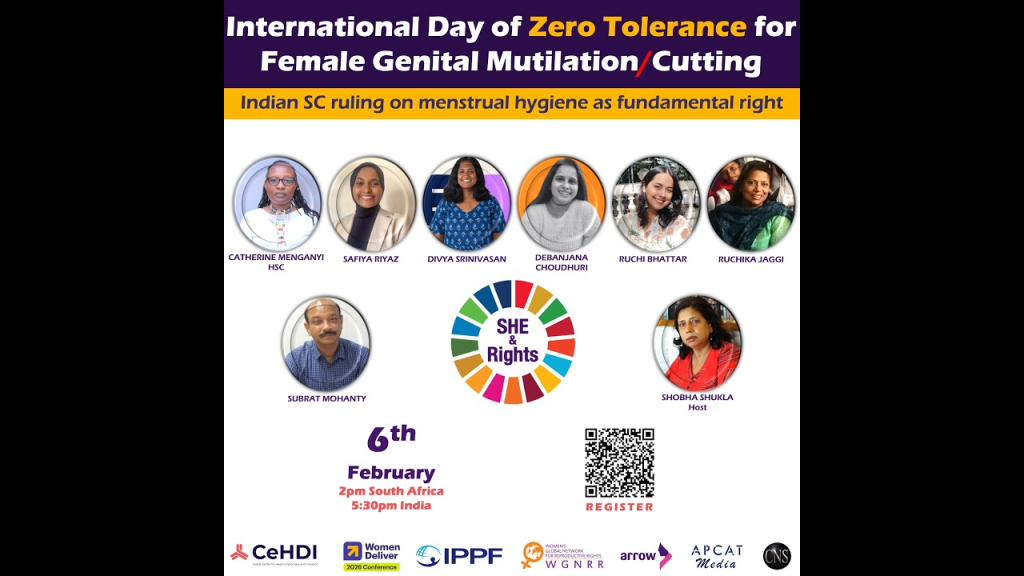
In a public discussion titled Sexual Health with Equity and Rights (SHE & Rights), health activists and women’s rights defenders stressed that FGM/C is not merely a tradition but a form of gender-based violence with severe consequences for reproductive health.
FGM/C involves the partial or total removal of the external female genitalia without medical indication. Its impacts include chronic infections, extreme pain during menstruation, complications in childbirth, sexual dysfunction, and lifelong psychological trauma.
Shobha Shukla, Executive Director of CNS and host of SHE & Rights, emphasised that FGM/C must be understood as a matter of body politics. “FGM/C is not a neutral cultural practice. It is systemic violence that positions girls’ bodies as objects of social control,” she said.
Medicalisation: Violence Legitimated by the System
A phenomenon that further worsens the situation is the medicalisation of FGM/C—namely, the involvement of health professionals as perpetrators, making the practice appear “safe” or “professional.” This occurs in several countries, particularly in communities with access to modern medical services.
Safiya Riyaz from the Asia Network to End FGM/C described this trend as a betrayal of medical ethics. “There is no safe form of FGM/C. When health workers perform it, violence is legitimised as a medical practice,” she said.
Medicalisation reinforces the idea that girls’ bodies can be controlled in the name of moral standards. In many communities, FGM/C remains linked to narratives of purity, sexual restraint, and readiness for marriage, despite medical evidence showing that the practice does not promote health or wellbeing.
Root Causes: Patriarchy, Sexuality, and the State
Activists argue that the root of FGM/C lies in patriarchal power relations that position women’s bodies as objects of social surveillance. The practice is passed down through generations under the pretext of preserving family honour, but in reality it often functions as a tool for controlling female sexuality from childhood.
Many countries have declared FGM/C illegal, yet enforcement remains weak or is used as an excuse to ignore human rights violations. “Cultural sensitivity” is frequently invoked to justify inaction and allow violence to persist.
Catherine Menganyi, an FGM/C survivor from Kenya, said the trauma caused by the practice never truly disappears. “It is not only a physical wound. It is psychological trauma that follows us for life. States often talk about laws, but they forget to listen to survivors,” she said.
She stressed the importance of community-based approaches that position women as agents of change rather than mere objects of awareness campaigns.
States Urged to Use International Human Rights Mechanisms
Activists are calling on governments to use international human rights mechanisms—such as the Universal Periodic Review (UPR)—to accelerate the elimination of FGM/C. The practice is widely recognised as a violation of children’s rights, the right to health, and the right to be free from violence, as enshrined in international human rights instruments.
FGM/C also reveals how reproductive health is often reduced to a clinical issue, when in fact it is deeply social and political. Girls’ bodies become battlegrounds between tradition, religion, state authority, and patriarchal power.
Until states fully recognise that girls’ bodies are individual rights-holders that cannot be violated in the name of tradition, the practice is expected to persist and even expand.
Baca juga: Global Backlash Threatens Women’s Sexual and Reproductive Health Rights
Menstrual Poverty, a Silent Killer
Menstruation is a biological process, but menstrual poverty is a political product. When women and girls lack access to sanitary pads, clean water, decent toilets, and health information, menstruation shifts from a natural process into a source of disease and social exclusion.
In the SHE & Rights public discussion, women’s health activists described menstrual poverty as a “silent killer” of reproductive health. It does not always appear in mortality statistics, but it is visible in sick bodies, interrupted education, and eroded dignity.
According to various global reports, hundreds of millions of women worldwide lack access to safe menstrual products. They are forced to use old cloths, paper, sand, leaves, or other unhygienic materials. These conditions increase the risk of reproductive tract infections, skin irritation, and long-term complications caused by chronic inflammation.
Debanjana Choudhuri, a gender justice activist, described menstrual poverty as a failure of states to guarantee basic rights. “Menstruation is treated as a private matter, even though its consequences are a public health issue. When the state fails to provide facilities, women’s bodies are forced to absorb structural burdens,” she said.
Menstruation and School Dropouts
The impact of menstrual poverty is most visible in education. Many girls are forced to miss school or drop out entirely because they lack sanitary products or because schools do not provide adequate toilets.
In many developing countries, schools lack clean water, disposal bins for pads, or safe spaces to change. Menstruation thus becomes a humiliating, painful, and risky experience.
As a result, millions of girls experience regular absenteeism each month. In the long term, this reinforces cycles of poverty and deepens gender inequality in education.
Ruchi Bhattar, a journalist and lawyer, noted that menstruation has long been treated as a social taboo. “When the state fails to provide facilities, women’s bodies are forced to carry both shame and pain at once. This is not just about pads, but about who is considered important in public policy,” she said.
In this context, menstruation is not only a health issue but also a right-to-education issue. When girls are forced to stay home because of their bodies, the education system reproduces gender-based inequality.
Women’s Bodies and Bias in Health Policy
Health policies in many countries still centre pregnancy and childbirth as the primary concerns of women’s health. Yet reproductive health spans the entire life cycle, including menstruation. Menstrual poverty shows how women’s basic needs are often trivialised. Sanitary pads are treated as ordinary consumer goods rather than essential health items.
In many poor households, buying pads is not a priority. Boys’ needs are prioritised for schooling or food, while girls are expected to “adapt” to their bodies. “Menstruation is biological, but menstrual injustice is the result of gender-insensitive policy,” Debanjana said.
This condition reveals how women’s bodies are made to bear the weight of structural poverty. Menstruation is not only about blood, it is about the distribution of resources within families, communities, and states.
Stigma and Symbolic Violence
Beyond material deprivation, menstrual poverty is intensified by stigma. Menstruation is often associated with dirtiness, impurity, and shame. In many cultures, menstruating women are restricted from daily activities: they may be barred from kitchens, religious spaces, or even isolated from public life.
This stigma discourages women from seeking medical help when they experience menstrual disorders. Severe pain, heavy bleeding, or infection is often considered “normal” because menstruation itself is associated with suffering.
Yet menstrual disorders can indicate serious reproductive health problems such as anaemia, endometriosis, or infection. “When pain is normalised, the state can remain indifferent. This is a form of symbolic violence against women’s bodies,” Bhattar said.
Baca juga: Krisis Pendanaan Global, Mengancam Layanan Kesehatan Reproduksi Termasuk di Indonesia
Menstrual Poverty and Vulnerable Groups
Menstrual poverty is not experienced evenly. Poor women, women in conflict zones, refugees, persons with disabilities, and transgender and non-binary people face layered risks.
Transgender and non-binary people who menstruate are often erased from public policy because health systems recognise only the category of “women.” As a result, they lack safe access to menstrual products and sanitation facilities.
Activists stress that menstrual policy must recognise the diversity of bodily experiences and not be limited to narrow definitions of womanhood. At a minimum, fulfilling menstrual rights requires guaranteed access to free or affordable sanitary products, adequate toilets and clean water, and stigma-free reproductive health education, as well as formal recognition that menstruation is experienced across different gender identities. Without these measures, menstrual poverty will continue to reproduce inequality.
Menstruation as a Political Issue
Menstruation has long been framed as a private matter for women. This framing allows states to evade responsibility. Yet budgetary decisions, sanitation policies, and education systems determine whether women can menstruate safely or not.
“Menstruation is political because it determines who can go to school, who can work, and who can live in good health,” Debanjana said.
Eliminating menstrual poverty means recognising that women’s bodies are not a private burden but a public responsibility. Access to pads and toilets is as important as access to vaccines and medicines. If states are serious about reproductive health agendas, menstruation can no longer be treated as a marginal issue. It must become an indicator of social justice.
Without state intervention, menstrual poverty will remain a silent killer rarely recorded as a cause of death, but deeply present in sick bodies, disrupted education, and stolen futures.
















Comments are closed.